
EcoLur
The project for arranging tourist routes in the so-called Mageli Cavern is underfulfilled, while public hearings can be considered only as preliminary discussions. This opinion was expressed by most participants for the project discussion on Mageli Caverni improvement submitted to environmental impact assessment of Inkar Company. The public hearings were held in Areni Village by “Inkar Company” and Nature protection Ministry on 18 February.
The company intends to hold tourist tours and for these purposes they plan to conduct construction works, to widen the entrance, to concrete floors and to build a staircase.
Mageli Cavern is located in Noravank Gorge and is a number of interconnected karstic caves. The cave has several entrances, and some of them are obstructed with stones, while the others are not available. While the only available exit is under the supervision of Noravank Custodian: this is how the locals call environmentalist Vardges Karakhanyan who helps to preserve the amazing nature in Noravank for several years.
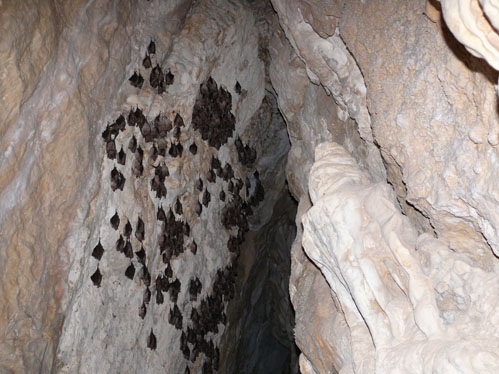
Caves are a good destination for tourists. Simultaneously each cave is a complex and extremely specific ecosystem, as 8 bat species live in Mageli Cave, while 6 of them are registered in the Red Book.
“The cave mustn’t be opened for tourists unless the current population of bats is recovered there,” said Chairman of the Armenian Society for Birds Protection and Head of Vertebrate Animals Department of the Center for Zoology and Hydroecology of the National Academy of Sciences of Armenia, “we hardly saved them for complete elimination. All the time some people broke in the cave, burnt polyethylene bottles and left the same bottles there. We cleaned it and closed the entrance with bars. Now only the number of the cheiroptera is under monitoring so as not to frighten off the colony.” Under Ghasabyan, pot-holers visited the cave they counted only several dozens of cheiroptera which was left from 10,000-member colony. Now we can count about 700-800 birds.” (See photos)
Professor Eduard Yavrumyan, a specialist in the cheiroptera, outlined the importance of these animals not in the regard of biodiversity, but in regard of their fight against vermin. “Bats exceeded birds in insect elimination. Each animal unit can eliminate up to 500 insects during one night. Now you can count what you get and what you can get deprived of,” he said, “chemistry is not the best way to fight against vermin.”
Smbat Davtyan assured civil works will do no harm to the bats: “We will work cautiously without nay noise,” he said. “Without noise? How will you manage to work without noise, if you are going to demolish walls and to widen the entrance? As soon as civil works start, bats will get disappeared,” Ghasabyan objected.
Environmentalists are also concerned, as the Agency for Preservation of Historical and Cultural Monuments, which bears legal responsibility for Mageli Cave, doesn’t possess any real mechanisms for its preservation. Custodian Vardges Karakhanyan expressed his flat disagreement with this project: “You’ll come, make money and leave, while we will lose everything we have. There are other caves which are more attractive and have no bats, as they have already got disappeared. Take tourists there, construct whatever you want, moreover they don’t have any status of a monument.”
When EcoLur asked what the selection of this cave was conditioned by, Smbat Davtyan said, “with more favourable conditions.”
Under Areni Village Head Zhirayr Eghyan, the company’s plan is attractive, as they are promised jobs and tourism promotion the village can benefit from, as they produce famous “Areni” wine. Nevertheless, possible harms for agriculture should be assessed.
Nature Protection Ministry “Environmental Impact Assessment” SNCO Expert Nazik Mkrtchyan thinks the project must show operation analysis and income computation.
Besides, Mageli Cave is located in the administrative territory of Ghishik Community, while their representatives were not invited to public hearings.
Thus, a decision was reached to consider these public hearings as initial discussions and to hold them once again taking into consideration observations and suggestions.
February 21, 2011