
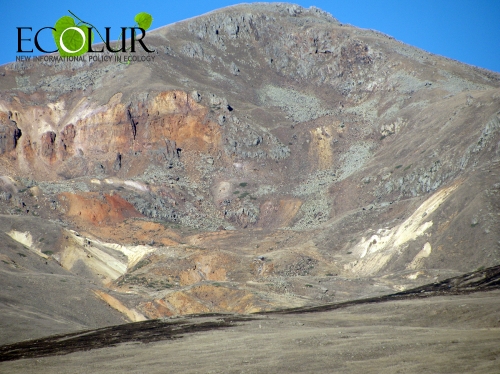
Inga Zarafyan, President of EcoLur Informational NGO, has outlined the main risks associated with the operation of the Amulsar gold mine. In her assessment, the Amulsar project poses serious risks to water resources and involves acid drainage and waste-related hazards.
Cyanide Technology Near Water Basin
The project envisages a cyanide leaching pad for gold extraction. Environmentalists are concerned that the facility is located near the catchment basins of the Arpa and Vorotan rivers, whose waters are also connected to the Lake Sevan water system. Independent expert assessments have indicated that the cyanide leaching pad would partially cover the catchment basin of a tributary flowing into the Arpa River, while pollutants could also spread through groundwater.
Acid Drainage and Waste Dumps
Experts have assessed the project as posing a high risk of acid drainage and pollutant leakage. Approximately 150 million tonnes of waste rock will accumulate. In addition to gold, all associated chemical elements present in the rocks will be subject to active chemical processes.
Radioactive Elements
Although the mining company categorically denies the presence of radioactivity, scientific sources indicate that approximately 75 tonnes of uranium and 25 tonnes of thorium are present in the deposit area.
Inga Zarafyan noted that, against this backdrop, the gold content is extremely low—just 0.78 grams per tonne of ore.
“Can you imagine? To extract such a small amount, you have to contaminate the entire area,” she emphasised.
Zarafyan is currently conducting research to establish how the development of a deposit with such limited gold reserves was advanced despite enormous environmental and social risks and the Bern Convention’s call to halt construction at Amulsar and revise the Environmental Impact Assessment (EIA).
The President of EcoLur Informational NGO also outlined the steps the Bern Convention Standing Committee has called on the Armenian authorities to take regarding the Amulsar gold mine project, how the Ministry of Environment responded, and the project’s main environmental risks.
Calls by the Bern Convention
The Amulsar issue was brought to the attention of the Bern Convention Secretariat in 2020, when it received Complaint No. 2020/04, entitled “The Amulsar Gold Mine Project and Its Impacts on Emerald Network Sites”.
In 2023, when signs emerged that the mine might resume operations, the Convention Bureau referred the issue to the Standing Committee. The latter called on the Armenian Government to:
- Halt construction of the Amulsar gold mine, taking into account the potential adverse impacts on habitats and species protected under the Convention.
- Revise the existing EIA, taking into account new biodiversity data, assessments by local scientists and civil society, as well as potential transboundary impacts.
- Accelerate the process of establishing Jermuk National Park, which would include Mount Amulsar.
- Ensure more active civil society participation in processes concerning Amulsar and the Emerald Network, rather than conducting discussions behind closed doors.
In September 2024, the Convention Bureau again approached the Armenian authorities, asking them to include the complainant in consultations on the review of the Emerald Network and to revive discussions on Jermuk National Park. According to information published in March 2025, the Convention Standing Committee reiterated its earlier calls to halt construction, revise the EIA and accelerate the designation of the national park.
The Bern Convention Secretariat called on the Armenian authorities to establish Jermuk National Park before COP17 in Yerevan, demonstrating a clear and strong commitment to biodiversity conservation.
The authorities were also called on to conduct a new Environmental Impact Assessment for the Amulsar project before extraction activities begin.
In consultations on the review of the Emerald Network, civil society participation must be meaningful, and the proposals and observations submitted must be duly considered and reflected in the decisions taken.
According to Inga Zarafyan, the Ministry of Environment has not made a positive decision in response to any of these calls.
October 16, 2026 at 14:10