
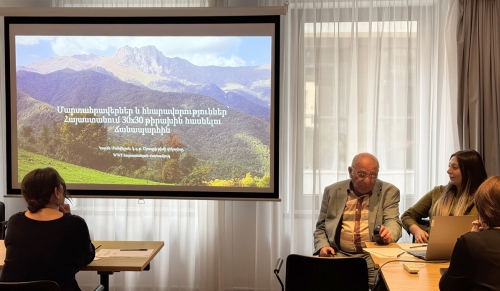
On May 8, experts gathered in Yerevan to discuss the Republic of Armenia’s Biodiversity Conservation Targets and Action Plan for 2026-2030, with a focus on specially protected natural areas, agrobiodiversity, and agroecology. The discussion also addressed the integration of gender equality into the management of protected areas and agrobiodiversity.
The discussion was organized by “Armenian Women for Health and Healthy Environment” NGO within the framework of “Empowering Women in Communities Adjacent to Protected Areas in Armenia”, project, which is funded by the international organization Women Engage for a Common Future (WECF).
It should be noted that the document “Republic of Armenia Biodiversity Conservation Targets and Action Plan for 2026–2030” was approved by Order No. 100-L of the RA Minister of Environment. Order No. 100-L
No separate biodiversity strategy was adopted; instead, the framework was approved through a ministerial order.
According to the Minister’s order, Armenia has defined five strategic goals and 30 targets derived from the four goals and 23 targets of the Kunming-Montreal Global Biodiversity Framework.
Countries party to the Convention on Biological Diversity have committed to ensuring the effective conservation of at least 30 percent of the planet’s terrestrial and inland freshwater ecosystems by 2030. Each country is also expected to ensure the protection of 30 percent of its own territory.
Armenia has set a target of ensuring the effective conservation of 20 percent of the country’s terrestrial and freshwater ecosystems by 2030, although it has the potential to reach the global 30 percent target.
Karen Manvelyan, Program Director of WWF Armenia, presented the challenges and opportunities facing Armenia in achieving the 30x30 target. He noted that expanding Armenia’s network of specially protected natural areas (SPANs) will play a key role in this process.
At present, Armenia’s SPAN coverage totals 386,355 hectares, accounting for 13.1 percent of the country’s territory. Since 2012, the total SPAN area has expanded by 88,600 hectares, or 3 percent. Armenia currently has three state reserves, four national parks, 27 state sanctuaries, and 233 natural monuments.
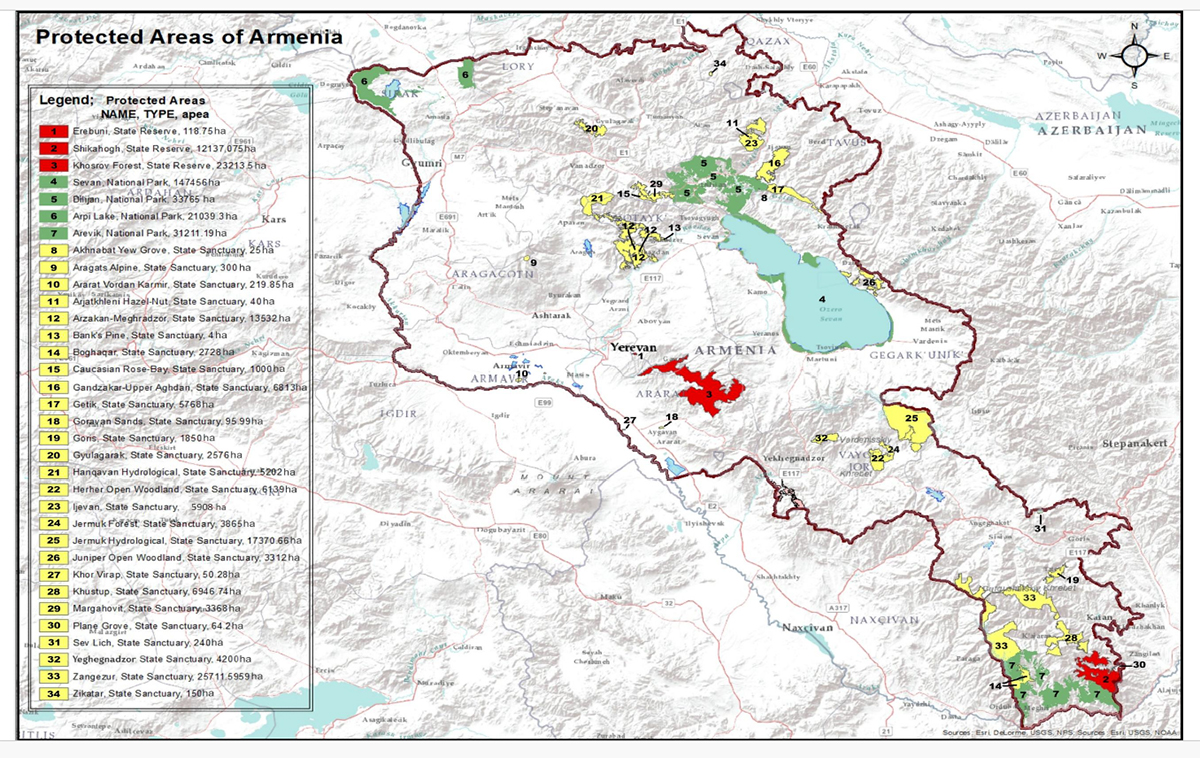
According to Karen Manvelyan, the establishment of “Tatev” and “Jermuk” national parks will expand the total SPAN area by another 9,800 hectares. By 2030, SPAN coverage is expected to reach 396,155 hectares, or 13.3 percent of Armenia’s territory. At that point, Armenia is expected to have three state reserves, six national parks, 23 state sanctuaries, and 233 natural monuments.
It is also expected that by 2030, the coverage of Other Effective Area-Based Conservation Measures (OECMs) will reach 151,035 hectares, accounting for 5.1 percent of the country’s territory. Overall, the combined expected coverage of SPANs and OECMs by 2030 will total 547,190 hectares, or 18.4 percent of Armenia’s territory.
Karen Manvelyan noted that if SPANs or OECM areas are established within Key Biodiversity Areas, Emerald Network sites, and state forest lands, the total protected coverage could reach 30 percent of Armenia’s territory, incorporating an additional 270,000 hectares of SPANs and OECM areas.
May 12, 2026 at 17:48