
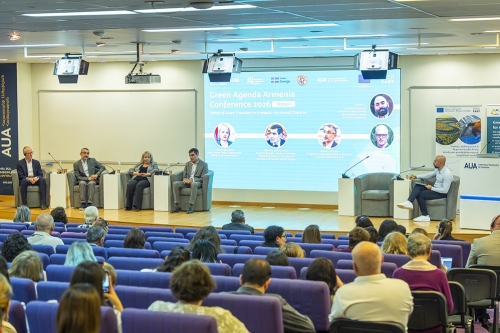
The Green Agenda Armenia Conference 2026 brought together nearly 300 participants and more than 40 speakers at the American University of Armenia on May 11 for a day-long discussion on the country’s environmental priorities, implementation challenges, and pathways toward a greener and more resilient future.
Held at a time when Armenia is preparing to host COP17, the conference served as a broad platform for assessing progress across key sectors of Armenia’s green transition agenda, identifying existing gaps, and strengthening dialogue between state institutions, international partners, experts, academia, civil society, and the private sector.
The conference was organized within the framework of the Sweden-funded Green Agenda Armenia project, implemented by Stockholm Environment Institute and the AUA Acopian Center for the Environment, in collaboration with the European Union’s EU4GreenRecoveryEast. This year’s edition marked one of the first large-scale joint initiatives bringing together two major green transition projects operating in Armenia.
Alen Gasparian Amirkhanian, Director of the AUA Acopian Center for the Environment and Lead of Green Agenda Armenia, expressed hope that the conference would evolve into a long-term annual platform for evaluating Armenia’s environmental progress and strengthening cooperation across sectors.
Amirkhanian also emphasized the significance of this year’s collaboration with EU4Green Recovery East, describing it as an important and unique step toward improving coordination between projects working on similar priorities in Armenia. “The more we coordinate and cooperate, the better the results will be for Armenia and Armenia’s integration into the EU and global economy,” he said.
Vahagn Tonoyan, Programme Representative in Armenia for EU4Green Recovery East, highlighted the importance of cooperation between environmental initiatives operating in Armenia. “The conference provided an important platform to discuss green transition efforts in Armenia, bringing together policymakers, academia, civil society, international partners, and independent experts. Collaboration between similar projects to discuss and assess progress offers valuable insights,” he said.
Tonoyan also noted that the discussions provided valuable input for refining EU4Green Recovery East’s priorities and activities in Armenia.
Sofia Strive, the Project Manager of Green Agenda Armenia, Moldova, and Ukraine at the Stockholm Environment Institute, highlighted the importance of informed policymaking at a time when Armenia is navigating transitions. She noted that projects such as Green Agenda Armenia play an important role in providing the background knowledge and analytical support needed for long-term decision-making. “Every step of the way matters in terms of which direction you go,” she stated, adding that the project contributes to building a stronger understanding of the long-term implications of green transition pathways in Armenia.
Klas Waldenström, Head of Development Cooperation and Deputy Head of Mission at the Embassy of Sweden in Armenia, stressed that green transition remains a central priority both for Sweden’s international cooperation efforts and for Armenia’s long-term development agenda. “We see a green transition not only as a necessity for the environment and climate, but also as a competitive advantage,” he stated, adding that implementation will be the defining challenge moving forward.
Waldenström also highlighted the broader significance of cooperation between governments, academia, and international institutions in advancing environmental reforms and supporting Armenia’s preparations ahead of COP17.
Frank Hess, Head of Cooperation Section of the EU Delegation to Armenia, reflected on the broader challenges currently facing green transition policy discussions globally, noting the importance of maintaining required priorities within public and political discourse.
“What we need, both in Europe and in Armenia, is intelligent regulation that promotes the environment while creating the right incentives for businesses to become more environmentally responsible actors,” he said. Hess also stressed that environmental protection and economic development should not be treated as opposing priorities, emphasizing the importance of maintaining balance between ecological sustainability and economic realities during the green transition process.
Annual Check-in on Armenia’s Green Transition
Ivana Mijatovic, the Green Agenda Armenia project EU Policy Advisor, started the annual check-in by reviewing the key conclusions of the National Comprehensive Green Transition Readiness Assessment for Armenia (2025). The panelists then presented what new developments have taken place since then, citing active developments in climate action, sustainability finance, food systems, transportation, and biodiversity.
Mijatovic also led a panel discussion on Armenia’s implementation of commitments under the EU-Armenia Comprehensive and Enhanced Partnership Agreement (CEPA). The discussion explored the opportunities and practical challenges connected to EU approximation processes, institutional reform, and sustainable policy implementation with respect to the wider implications for economic development and social cohesion.
Mijatovic emphasized that the Armenia-EU Strategic Agenda (adopted in December 2025) and CEPA provide “a clear blueprint for improved governance, systemic policy planning and economic development,” while also supporting Armenia’s response to biodiversity loss, pollution, climate change, and energy transition challenges. She also stressed the importance of strengthening Armenia’s institutional and administrative capacities to ensure the effective implementation and enforcement of environmental reforms in practice.
About the Green Agenda Armenia Project
The project “Green Agenda for Armenia, Moldova, and Ukraine” aims to support the 3 countries in making substantial advances in meeting the European Green Deal’s (EGD) ambitious objectives of economic growth, climate neutrality, pollution prevention, and biodiversity protection. The project, launched in Yerevan in 2023, is a collaborative initiative implemented by the Stockholm Environment Institute (SEI) in partnership with the Government of Armenia, supported by Sweden, with the AUA Acopian Center for the Environment serving as the implementing partner in Armenia since June 2025.
May 21, 2026 at 12:39