
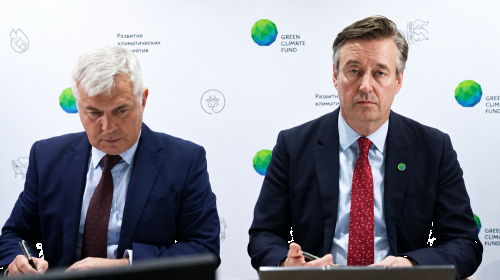
The Green Climate Fund (GCF) plans to expand its climate programmes in Armenia and place greater emphasis on initiatives that simultaneously contribute to both climate change adaptation and biodiversity conservation, as Thomas Eriksson, Director, Department of the Eastern Europe, Central Asia, and the Middle East Region, stated during an online media briefing on July 7.
GCF Investments Have More Than Doubled
According to Thomas Eriksson, since the GCF introduced its "Region-First" approach in September 2024, the total volume of climate investments initiated by the Fund in Central Asia and the Caucasus, including co-financing, has increased from US$2.1 billion to US$5.4 billion.
Armenia Is One of GCF's Key Partners
Responding to a question from EcoLur, Thomas Eriksson noted that the GCF has already invested approximately US$205 million in Armenia, financing 10 different projects. These include sustainable forest management, green development of rural communities, early warning systems, green finance, electric mobility (e-mobility), improving the energy efficiency of public buildings, and strengthening ecosystem resilience.
"I recently visited Armenia to review the ongoing projects and discuss future initiatives with our partners. We already have a strong project portfolio, but we would like to do even more in Armenia," he said.
According to him, the GCF is currently working with the Government of Armenia and partner organizations to develop new programmes.
The Energy Efficiency Programme: A Success Story
One of the GCF's largest initiatives in Armenia has been implemented in partnership with the United Nations Development Programme (UNDP). Under the programme, more than 470 public buildings have been renovated and upgraded for energy efficiency, resulting in energy consumption being reduced by as much as 60% in some cases. More than 550,000 people benefit from the programme, which also prevents approximately 32,000 tonnes of greenhouse gas emissions annually.
According to Thomas Eriksson, this programme could serve as a model for expanding green investments across the region.
According to him, the main objective of the GCF's regional strategy is to strengthen its presence in partner countries, work more actively on the ground, and deepen cooperation with both governments and national partners.
"At the GCF, we have a Readiness Programme, which is a capacity-building support programme available to countries. We want to work more closely with countries and help them transform their ideas and ambitions into real investment projects."
Civil Society Participation Is Important
Responding to EcoLur's question regarding the involvement of civil society organizations, Thomas Eriksson noted that they play an important role throughout all stages of programme development and implementation.
According to him, organizations from around the world can join the GCF Global Civil Society Network, enabling them to participate in discussions on the Fund's policies and programmes, as well as in meetings of the GCF Board.
COP17 May Create New Opportunities
Responding to Ecolur's question as to whether the GCF sees new opportunities for cooperation between climate finance and biodiversity conservation, particularly in the context of COP17, which will be held in Armenia, Thomas Eriksson said that he plans to participate personally in the conference in Yerevan this October.
According to him, the principal point of intersection between climate policy and biodiversity policy is natural ecosystems.
"Ecosystems are fundamental both for climate change mitigation and for adaptation," he noted.
Thomas Eriksson recalled that Armenia is already implementing programmes on forest resilience and sustainable forest management, which simultaneously contribute to biodiversity conservation and the reduction of climate risks.
He also announced that the GCF is preparing new programmes based on the principle of ecosystem-based adaptation (EbA). These initiatives aim to harness the potential of natural ecosystems to strengthen the climate resilience of communities.
According to Thomas Eriksson, the GCF plans to present its experience with such programmes during COP17.
July 08, 2026 at 12:16