
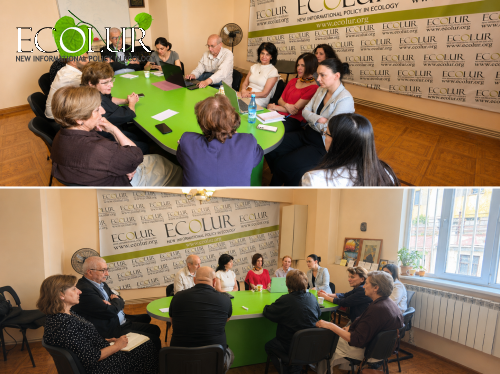
On May 26, 2026, EcoLur Press Club hosted a meeting between representatives of Armenian civil society and Dr. Claudia Ituarte-Lima, Senior Researcher at the Raoul Wallenberg Institute of Human Rights and Humanitarian Law.
During the meeting, the expert presented the role of civil society in the Conferences of the Parties (COPs) to the United Nations Convention on Biological Diversity (CBD), as well as various participation mechanisms and side-event formats. Discussions focused on civil society engagement, avenues for influencing decision-making processes, and opportunities for making civil society voices heard in international forums.
Claudia Ituarte-Lima emphasized that effective participation in COP processes largely depends on having clearly defined objectives from the outset. According to her, before organizing any event or initiative, it is essential to understand the intended outcome.
“It is very important to understand what your objective is. That will determine the most appropriate way to participate in COP processes. Do you want to influence negotiations? Do you want Armenia’s priorities to be more visible and taken into account?” she noted.
The expert outlined the various participation spaces available at COP conferences, including the Blue Zone and Green Zone, as well as events organized outside these official venues. While official events are primarily held within these designated zones, she explained that civil society can also exert influence through initiatives organized in other formats.
As an example, Claudia Ituarte-Lima referred to a civil society initiative carried out during a COP conference in Brazil, where civil society organizations organized a large-scale side event on a university campus, bringing together hundreds of participants, including government representatives from different countries.
“That event attracted hundreds of participants. Representatives of various groups-women, Indigenous peoples, and civil society organizations-spoke there, and the organizers invited the COP Presidency to attend. It was called a ‘People’s Summit.’ They prepared a concrete document and submitted it to the Presidency. You may also consider such an approach: work in advance with civil society organizations that have participated in previous COPs and will be coming here. Together, you can organize a similar event, invite participants, and present a joint document,” she said.
Inga Zarafyan, President of EcoLur Informational NGO, noted that it is important for civil society representatives to understand how to ensure that the outcomes of their initiatives and discussions reach the Convention Secretariat. According to her, the issue is not merely about networking or issuing declarations, but also about identifying mechanisms through which the results of civil society work can be officially recognized and incorporated into the process.
Responding to this point, Claudia Ituarte-Lima noted that such initiatives can indeed reach the Secretariat level, although the limited number of participation slots within the Blue Zone must be taken into consideration. For this reason, she stressed the importance of using additional formats, particularly side events organized outside the official COP venues.
The discussion also highlighted the role of international networks in amplifying the influence of civil society. Particular attention was given to the CBD Women’s Caucus, an international network focused on women’s rights and participation, and the Global Youth Biodiversity Network (GYBN), a global youth network working on biodiversity issues.
According to Claudia Ituarte-Lima, civil society organizations can join relevant networks depending on their thematic focus and use those platforms to more effectively raise concerns and advocate for their priorities.
“If the issue concerns women, you can work through women’s networks; if it concerns youth, through youth networks,” she said.
Claudia Ituarte-Lima also emphasized that civil society organizations do not have voting rights in the adoption of final COP decisions, as COPs are intergovernmental negotiating forums. Nevertheless, civil society plays a crucial role in shaping proposals, generating public pressure, and raising key issues on the agenda.
She noted that final COP documents are often largely agreed upon in advance. However, side events provide valuable opportunities to influence discussions and present the perspectives of different countries and communities.
The meeting also addressed the Kunming-Montreal Global Biodiversity Framework. In particular, the expert highlighted Target 22, which focuses on ensuring the full, equitable, inclusive, effective, and gender-responsive participation of Indigenous Peoples and local communities in decision-making processes, as well as access to justice and biodiversity-related information. She also referred to Target 23, which focuses on advancing gender equality.
The expert stressed that by referencing these targets, civil society organizations can strengthen their positions and advocacy efforts in engaging with governments.
The discussion further underscored the importance of implementing and monitoring both national and international policy frameworks.
“Action plans are usually very ambitious. A policy document may be developed, but it is equally important to monitor its implementation afterward. In this regard, referring to policy documents can add considerable weight to your arguments,” she concluded.
June 03, 2026 at 16:58