
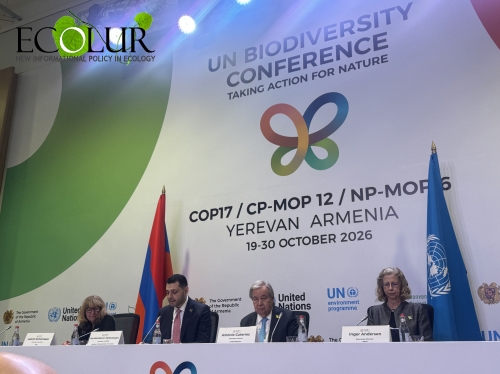
A joint press conference was held in the Blue Zone of COP17, as part of the United Nations Biodiversity Conference, featuring United Nations Secretary-General António Guterres; Armenia’s Minister of Environment and COP17 President Hambardzum Matevosyan; UN Deputy Secretary-General and Executive Director of the United Nations Environment Programme (UNEP) Inger Andersen; and Astrid Schomaker, Executive Secretary of the Convention on Biological Diversity.
In the presence of senior UN officials and Armenia’s Minister of Environment, UN Secretary-General António Guterres officially presented the first State of Biodiversity Action report, assessing progress towards the global biodiversity commitments made in 2022.
Monika Yeritsyan, a journalist from EcoLur Informational NGO, also addressed a question to the UN Secretary-General during the press conference.
“Governments are being urged to increase investment in biodiversity conservation, while economic and financial systems continue to incentivise activities that lead to biodiversity loss. Is the main challenge to biodiversity conservation a lack of financial resources, or are we simply unable to change the economic mechanisms that harm nature? And what changes should governments and financial institutions make to their approaches so that we can genuinely achieve our biodiversity conservation goals?”
In response to EcoLur’s question, UN Secretary-General António Guterres said:
“I think this is a key question. It is a question of influence. The influence of the extractive industries remains far too great. Those who destroy forests have far too much influence in many regions of the world. Those who overfish still have far too much influence. They wield excessive influence in many countries because they retain economic power and exert considerable influence over political power.
“We need to change these power relations. And we have an ally: the fact that the situation is changing.
“Look at fossil fuels. Today, fossil fuels are more expensive than renewable energy. Consider security and safety: following the events in the Persian Gulf and the Black Sea, it has become clear that renewable energy is much more secure than fossil fuels.
“Changes are taking place around the world, and we must now change this balance of influence, power and authority so that governments make much stronger commitments and demonstrate greater commitment to fighting biodiversity loss. At the same time, we must be able to multiply the resources currently allocated to support biodiversity conservation.
“Let me give you an example. If we allocate one dollar to a project, and instead put that dollar into the capital of a multilateral development bank, its value can be multiplied five, seven or eight times, because the development bank can enter the market and raise funds from it. You have seen the creation of Special Drawing Rights (SDRs). There are ways in which multilateral development banks can multiply available resources without creating additional costs for any budget.
“Therefore, we need to ensure that when multilateral development banks receive larger capital contributions at a lower cost, they can mobilise much greater amounts of private finance to support biodiversity, rather than relying solely on providing loans themselves. In other words, there are ways to multiply the resources available.
“So, first and foremost, the balance of influence and power needs to change. And I am optimistic that this is happening. We need to multiply the resources available, and there are ways to do so. Bureaucratic systems complicate change, and sometimes governments do too. But one thing is clear: sooner or later, we will prevail.”
October 16, 2026 at 00:26