
EcoLur
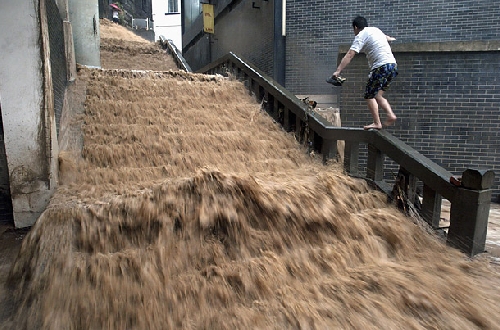
Every day world press publishes news about global catastrophes. According to the latest figures, 550 people died in Brazil because of the flood. No one dares to predict how many corps will be found under the clay layer, while more than 15,000 people became homeless. The number of victims in Australia is 25, while 90 are gone missing. Water has risen by another 4 meters in the state of Queensland and damage has been estimated in the amount of \$ 18 million. Europe also turned out to be flooded, and even such a systematized country as Germany cannot cope with disasters. It’s rather difficult to overcome, if monthly precipitation standard pours out in one day. What are measures to be taken and how to eliminate these consequences?
These questions still don’t refer to us. Downpours spared us, and though mud flows and landslips are characteristic to Armenia, they also spared us and didn’t turn into a catastrophe with irreversible consequences. Even heat was kind to us and lasted only one month with no death cases. Fires were man-made, but here we have another problem: no one stops malefactors, only fix facts – forest fire in this region, so many hectares were burnt down, that’s it. Or they fix the fact the pesticide burial ground is moving as it is located in a landslip zone, that’s it. Then who needs money and how much, while the burial site is moving. Or they fix the whitefish industrial reserves have disappeared in Lake Sevan. Then who and how much money needs for recovering fish reserves, but there is still no fish. The most important thing is that nobody expects for anything to change.
What shall we do, if nature rages and we will have a long-lasting drought? And let it be no floods, but rural landslip processes will become more active, water springs will start getting dry, soil will start slipping down from the mountains where all the forests will have been cut down. And these are not nightmares of global warming, but predictions by Second National Communication on Climate Change. Whether we are ready for such consequences or we think that nature will treat us kindly for some reasons? Wait for an answer…wait for an answer … wait for an answer …
January 17, 2011