

In October 2025, a regional consultation was held in the town of Meghri in Syunik Region on community needs related to the implementation of climate change mitigation and adaptation policies. The consultation brought together MPs, representatives of the Meghri local self-government body, the UN Development Programme, the Ministry of Environment, civil society organizations, experts, and youth.
The goal of the consultation was to raise awareness about Armenia’s national climate commitments—particularly the implementation of Armenia’s 2021–2030 Nationally Determined Contributions (NDC)—as well as to collect information from local authorities, civil society and youth on climate challenges, needs, and opportunities at the community level, and to engage in dialogue with members of the National Assembly.
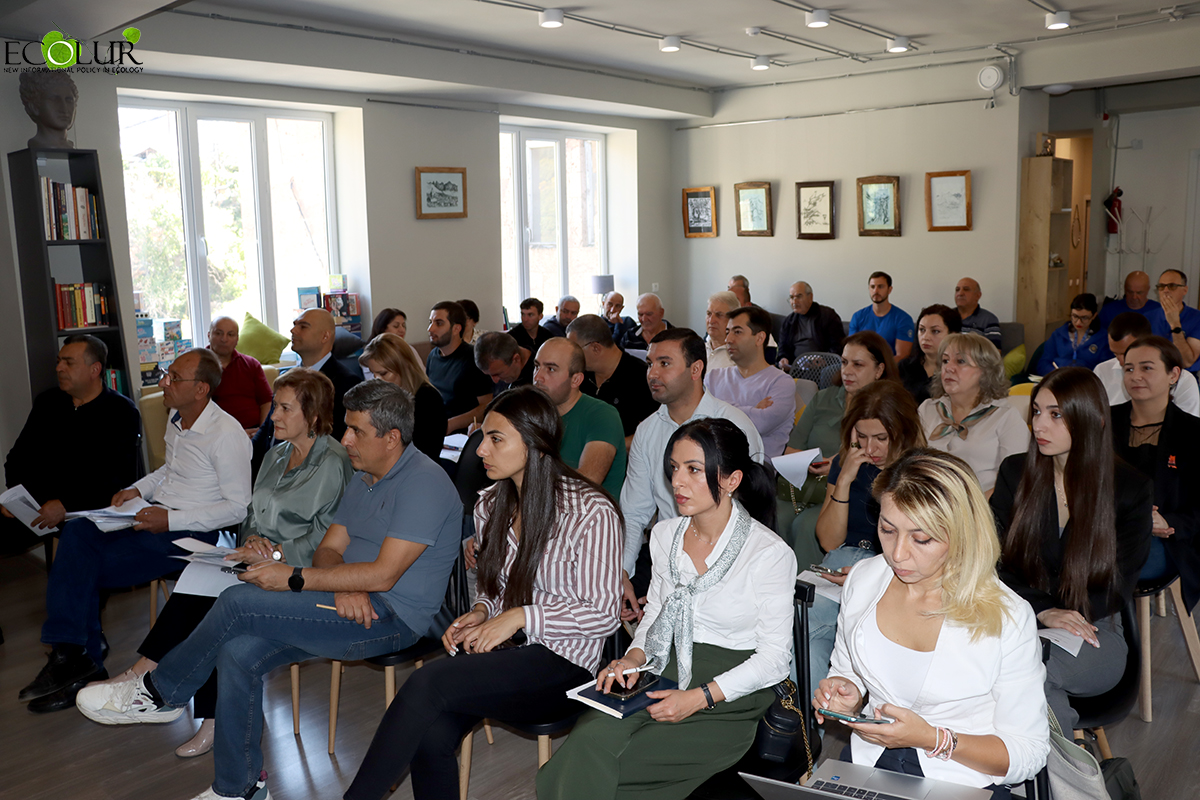
The consultation was held within the framework of the UNDP “Strengthening Responsiveness, Effectiveness, Transparency and Inclusiveness of the National Assembly of the Republic of Armenia” (FORSETI) project. This project is implemented with the financial support of the Government of Sweden and the Government of Canada, in cooperation with the National Assembly of Armenia.
Meghri Community faces numerous climate-related issues, among which water scarcity requires urgent solutions. Although the community has the Araks and Meghri rivers, its settlements—Alvank, Shvanidzor and Nrnadzor-face severe water shortages. The main reasons are insufficient infrastructure and the impacts of climate change.
Meghri Mayor Khachatur Andreasyan noted: “Every year it is getting hotter. We need a reservoir, an irrigation system, and pumping stations. A drinking-water treatment plant is currently being built for Meghri community and Meghri town, which will be commissioned soon. Another plant is being constructed for Agarak town as part of a state programme.
We expect to receive this year the royalty payments from the year before last—332 million AMD. This is a major support for the community and is mainly directed toward improving parks and playgrounds.”

The water system in Alvanq settlement is in emergency condition. Water from the mountain almost never reaches Alvanq. There has been no rainfall for about four months. “As of today, water is available only near the Araks Valley, where deep wells must be drilled, pumps installed, and water lifted to higher areas,” said Ashot Danielyan, Administrative Head of Alvanq. “We need a solar power plant to reduce electricity costs.”
Agricultural land occupies 42.6% of Meghri community’s territory, but no more than 18% is cultivated. The most favorable areas for agriculture are the left bank of the Araks River, the Meghri River valley, and the lower valleys of the tributaries flowing into the Karchavan and Araks rivers. This was presented by Andranik Manukyan, responsible for Civil Protection, Emergency Situations and Mobilization at the Meghri Municipality.

He outlined the main climate challenges the community has faced in recent years: drought, heat waves and intense heat, forest fires, frosts, floods and heavy rains, hailstorms, soil degradation and desertification.
To cope with these challenges, the community has developed a number of measures, including:
• Introduction of drip and modern irrigation systems
• Construction of local reservoirs and water storage facilities for collecting rainfall and runoff
• Use of drought-resistant and heat-tolerant crop varieties
• Implementation of soil protection measures to prevent degradation
• Renovation of the Kapan–Meghri irrigation system
• Cleaning and reinforcing mudflow channels
• Installation of anti-hail nets and stations
• Establishment of early warning systems (SMS alerts, loudspeakers, local monitoring)
• Climate-risk awareness programmes
• Updating the community development plan to include a climate component
• Installation of a community-owned solar power plant of up to 1,000 kW
• Installation of solar panels on the roofs of 11 community-owned buildings to improve energy efficiency and reduce costs
Climate resilience programmes are already being implemented in Syunik Region. Nvard Harutyunyan, Advisor to Syunik Regional Governor, spoke about state- and internationally-supported projects.
“About 70% of the region’s settlements face drinking and irrigation water shortages. We are currently discussing two major projects with the Government, and proposals have been submitted. Meghri is included in both packages. In parallel, we have both subvention and internationally financed programmes aimed at improving community infrastructure,” she said.
Nvard Harutyunyan emphasized that communities must be actively involved in climate initiatives and present their project proposals across various platforms. “As the Government’s representative in the region, we are in constant communication with the Government and submit our proposals through different channels. However, meetings like this are far more effective because issues are discussed on the spot and more comprehensively. This format is important not only for climate change but for any issue concerning communities,” she noted.
November 25, 2025 at 17:17