
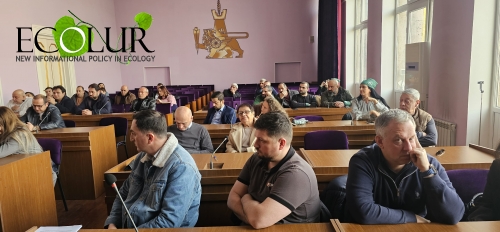
On November 18, the first public hearing on RAYDENA LLC's proposed epoxy prepreg production facility at 33/27 Manandyan Street, on the premises of the former HayElectro plant, was held at the Shengavit District Administration office in Yerevan. Residents, environmentalists, representatives of the Yerevan Council of Elders, and the district head himself opposed the establishment of a chemical-based production facility in a densely populated residential neighborhood.
According to the company, the facility is expected to produce approximately 400,000 square meters of epoxy prepregs annually, using carbon fiber and glass fiber reinforcement materials. Vram Tevosyan, a representative of the project developer, Consecoard LLC, and former Chairman of the State Committee for Nature Protection (1990–1991), stated that production would take place on a closed production line inside an enclosed building, with no industrial wastewater generated. Annual emissions were estimated at 1.248 kg of epichlorohydrin and 6 kg of suspended particulate matter. No filtration systems are planned to capture these emissions, as the project developer considers the quantities too small and difficult to capture.
The project developer stated that the sanitary protection zone would extend 50 meters from the emission source, classifying the activity as "manufacture of products from plastics and synthetic resins (mechanical processing)." However, based on cadastral data, a representative of Yerevan Municipality pointed out that even under the 50-meter requirement, the distance between the company's property boundary and the residential area is only 38 meters. The required distance is not maintained on either side of the street.
It was also noted that calculating the sanitary protection zone from the emission source would require an approved sanitary protection zone plan endorsed by the Ministries of Environment and Health, which has not yet been prepared at this stage.
Geographer Levon Galstyan responded that the activity described in the company's application does not correspond to the category of "manufacture of products from plastics and synthetic resins (mechanical processing)" cited in the legal act regulating sanitary protection zones. In his opinion, the required sanitary protection zone should be 1,000 meters.
Discrepancies in Documentation or Conflicting Interpretations? From “Zero Waste” to 11 Tons of Hazardous Waste
Residents expressed concern that the proposed production facility would be located near residential buildings, Shengavit Medical Center and its maternity hospital, a kindergarten, and a sports school with outdoor training facilities where hundreds of children exercise daily.
Discrepancies in the project documentation were also highlighted. While the preliminary notification indicated "zero waste," it was announced during the hearing that the facility would generate more than 11 tons of hazardous waste. Most of this waste would fall under hazard classes II and III and would be transferred to licensed waste management companies.
After hearing the objections, Romik Mkhitaryan, Head of the Shengavit Administrative District, stated that, as a Shengavit resident himself, he shared the concerns of the community.
"I support locating such production facilities outside residential areas. I stand with you," Romik Mkhitaryan said.
Risks, Hazardous Waste, and the Absence of a Health Impact Assessment
Viktorya Burnazyan, Vice President of EcoLur Informational NGO, and EcoLur expert Roza Julhakyan also attended the public hearing, raising a number of technical, procedural, and legal concerns.
Roza Julhakyan emphasized the hazards associated with epoxy resins, particularly hardening agents (polyamines, including aromatic compounds), noting that these substances can pose greater risks than the base resins, regardless of the quantities used.
She also questioned the emission calculations, arguing that they should be recalculated in accordance with Armenian regulatory standards and that heating materials to temperatures of 80–150°C does not eliminate the possibility of hazardous emissions and vapors.
The expert identified the approximately 11 tons of waste generated annually as a major environmental concern. Proper management of this waste would require waste passports, appropriate storage in sealed containers, and specially trained personnel.
She also questioned the justification for the sanitary protection zone, emphasizing that a 50-meter buffer established for mechanical processing activities does not adequately reflect the risks associated with chemical processes.
"There are numerous uninhabited areas in Shengavit with utility and industrial infrastructure and warehouse zones. And if the company says, 'This location is convenient for us,' we are here to ask questions and get answers," Roza Julhakyan stated.
In her remarks, Viktorya Burnazyan emphasized that the notification clearly indicates that the proposed activity falls under Category A of the Environmental Impact Assessment (EIA) system, which covers activities posing significant environmental risks. She stressed that it is precisely at this stage that the community has a decisive say in the decision-making process.
"We are being told here that the production is safe, that the waste will be transported away, and that there will be no emissions. However, we will only be able to examine all the risks during the EIA expert review stage, when the community will no longer have a decisive say. It is at this stage that residents must make their decision," Viktorya Burnazyan said.
She drew attention to gaps in Armenia's legislation on environmental impact assessment and expert review, noting that neither cumulative impact assessments nor assessments of impacts on human health are conducted during the expert review process.
"There are other locations far from residential areas. Launch your project there. We also support economic development, provided that its impacts on the environment and human health are minimized. Change the location, and then let the community concerned decide whether to give its consent," Viktorya Burnazyan concluded.
Concerns Over SLAPP Lawsuits and Legal Pressure
During the public hearing, Oleg Dulgaryan, President of the Community Consolidation and Support Center NGO, and other participants also raised concerns about the use of strategic lawsuits against public participation (SLAPPs) by businesses targeting media outlets and environmental activists.
Referring to the practice of filing lawsuits against critics in Armenia, Oleg Dulgaryan emphasized the need for anti-SLAPP legislation in line with relevant European directives.
Notably, several days before the hearing, RAYDENA LLC General Director Dmitry Kogan had sent demands for retractions to EcoLur Informational NGO and the Citizen's Voice platform concerning a publication about the company's proposed activities, warning that legal action could follow.
Participants Mary Poghosyan and Oleg Dulgaryan asked the project proponents whether the company was prepared to respect public criticism and refrain from using legal pressure as a means of responding to concerns.
Some participants expressed the view that it would have been acceptable for the company to send clarifications addressing disputed information and responding to technical questions. Instead, they argued, the company had chosen a strategy of threats and intimidation even before commencing operations.
"This raises a question: if the factory opens and residents begin complaining about its potential impacts, will the same tactics be used against them? Not to mention the employees," Mary Poghosyan said.
Representatives of the Mother Armenia faction of the Yerevan Council of Elders announced that they would demand that the issue not be considered as a non-reported agenda item at a Council meeting, but instead be brought forward for open discussion.
The minutes of the public hearing and the opinions expressed will be submitted to the Yerevan Council of Elders, which will decide whether to approve or reject the proposed activity.
In accordance with the procedure established by law, interested members of the public may also submit written comments to Yerevan Municipality at [email protected] within 20 working days following the notification.
About RAYDENA LLC
According to the State Register, RAYDENA LLC was established on February 2, 2024. Its shareholders are Ruben Dishdishyan (51%), Dmitry Kogan (24.5%), and Aleksandr Shleynikov (24.5%).
Under Government Resolution No. 1283-A of August 27, 2026, the Armenian government granted the company an exemption from import customs duties on 35 categories of raw materials and equipment.
November 20, 2026 at 01:49