
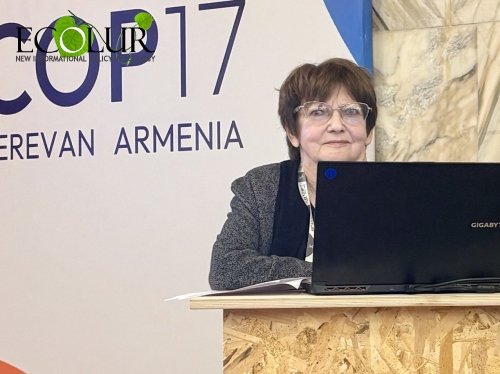
In her presentation, Inga Zarafyan, President of EcoLur Informational NGO, addressed the issue of Amulsar gold mine, emphasizing its adverse impacts on biodiversity, water resources, and environmental democracy. She identified the disregard for Armenia’s international commitments and the requirements of the Bern Convention as a key concern.
Inga Zarafyan recalled that in 2016 Armenia had proposed including 23 candidate sites, covering approximately one million hectares, in the Bern Convention’s Emerald Network. This represented 34.8% of the country’s territory. A review of the Emerald Network candidate sites is currently underway, with the expected outcome being a reduction in their total area to 23.8%. As a result, the Emerald Network candidate sites encompassing the area of the Amulsar gold mine project will be excluded from the network.
In 2020, EcoLur Informational NGO, Armenian Forests NGO, and Green Armenia NGO, together with CEE Bankwatch Network, submitted a complaint to the Secretariat of the Bern Convention, raising concerns about the potential impact of mining operations on Emerald Network candidate sites. The Bureau of the Bern Convention sent a letter to the Government of Armenia, requesting that a new environmental impact assessment (EIA) of Amulsar project be conducted before mining begins, that Jermuk National Park be established before CBD COP17, and that civil society be involved in the review of Emerald Network candidate sites. The Ministry of Environment stated that the current EIA conclusion remained in force and that the process of establishing Jermuk National Park was still underway.
Since 2018, when local residents blocked the roads leading to the mine through peaceful civil disobedience, the company has resorted to SLAPP mechanisms, using lawsuits to exert financial and legal pressure on activists, journalists, and residents.
Concluding her presentation, Inga Zarafyan called on international organizations to support the local struggle. She urged them to ensure that the Amulsar EIA is reviewed, refrain from allowing the mine to be operated, and establish Jermuk National Park without further delay in order to protect the region’s ecological future.
Aida Papikyan: “Example of Arpi Lake National Park Reveals Challenges of Protected Area Management”
The management of protected areas in Armenia is not solely a matter of biodiversity conservation. It is also connected to community rights, land use, livelihoods, and public participation in decision-making. These issues lie at the heart of environmental democracy, the practical application of which was addressed in a presentation by Aida Papikyan, a researcher at the AUA Acopian Center for the Environment.
Papikyan’s presentation focused on the example of Arpi Lake National Park, which provides an opportunity to examine the relationship between nature conservation objectives and the socioeconomic interests of local communities.
The establishment of protected areas inevitably leads to certain restrictions on people’s rights to use natural resources. Legislation must therefore be designed in such a way that, alongside restrictions on their rights, citizens also receive corresponding benefits.
In this context, environmental democracy entails not only access to environmental information but also genuine opportunities for the public to participate in decision-making, raise concerns, and defend their rights.
An examination of Arpi Lake National Park provides an opportunity to assess how international commitments on protected area management, Armenian legislation, and management mechanisms operating at the local level are aligned. One important question is whether the legal and institutional frameworks create sufficient conditions for community participation and take local interests into account.
These issues are particularly significant given Armenia’s role as President of the 17th meeting of the Conference of the Parties to the UN Convention on Biological Diversity.
The experience of Arpi Lake demonstrates how important it is to strike the right balance between international commitments on protected area management, national legislation, and the socioeconomic interests of local communities. According to Papikyan, international biodiversity conservation goals will produce tangible results only if people’s rights and the needs of local communities are also taken into account throughout the process.
October 31, 2026 at 18:39