
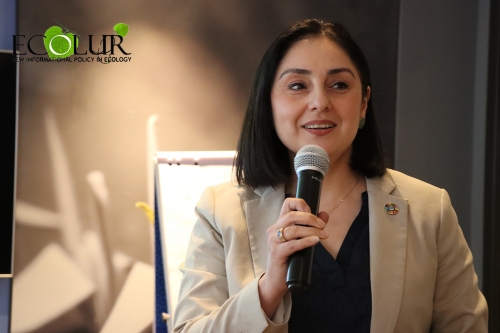
The efforts being undertaken to strengthen the capacities of women's organizations and to ensure the participation and engagement of women in the 17th Meeting of the Conference of the Parties to the United Nations Convention on Biological Diversity (COP17) were presented during the workshop “Civil Society Agenda at the 17th Conference of the Parties (COP17) to the United Nations Convention on Biological Diversity” held on 17 June.
The speaker was Mari Chakryan, Legal Adviser at the Ministry of Environment of the Republic of Armenia, National Coordinator of the Aarhus Convention, and the Ministry's contact person within the coordination group responsible for organizing the COP17 Women's Forum.
Mari Chakryan noted that, at the previous Conference of the Parties to the Convention on Biological Diversity, the 2022-2030 Gender Plan of Action was adopted, setting out in detail the measures that Parties to the Convention are expected to implement.
Speaking about opportunities for civil society participation during COP17, particularly for women's organizations, Mari Chakryan emphasized that while thousands of non-governmental organizations, activists, and environmental defenders will not be able to participate directly in all of the conference's negotiation processes, there are internationally recognized platforms and networks through which they can present their positions and influence decision-making.
According to her, the CBD Women Caucus and the Global Youth Biodiversity Network (GYBN) are the two principal internationally recognized platforms representing, respectively, women's groups and youth within the Convention on Biological Diversity process.
This article was prepared within the framework of “Supporting Armenia's CBD COP Presidency and Domestic Implementation” project, which is implemented by Ecolur Informational NGO in cooperation with the Fridtjof Nansen Institute, with support from the Norwegian Agency for Development Cooperation (Norad).
The views expressed within the framework of the project do not necessarily reflect the views of the Fridtjof Nansen Institute.
July 09, 2026 at 15:18