
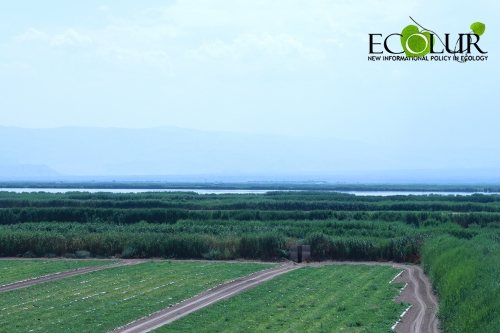
Armash settlement in Ararat Region, with its wetlands, is one of Armenia’s important biodiversity hotspots. The ponds of fish farming facilities here have become habitats for numerous bird species, including species listed in the Red Book of Armenia. Over 200 out of the 353 bird species recorded in Armenia can be found in the Armash wetlands, making the area a unique centre of biodiversity.
Armash wetland is an area with potential for protection under the Convention on Wetlands of International Importance, especially as Waterfowl Habitat (Ramsar Convention). It is also one of Armenia’s 23 Emerald candidate sites. The conservation of Emerald Network sites is carried out within the framework of the Convention on the Conservation of European Wildlife and Natural Habitats (Bern Convention).
Ahead of the 17th meeting of the Conference of the Parties to the UN Convention on Biological Diversity (COP17), the team of EcoLur Informational NGO visited Armash on 16 July 2026 to hold an awareness-raising meeting in the settlement.
During the meeting, EcoLur spoke with Hayk Hakobyan, Head of the Armash Administrative District, about the Armash wetlands, the impact of fish farming activities, the area’s biodiversity and prospects for its conservation.
“Our Armash ponds are a vivid example of cooperation between people and nature,” Head of Armash Administrative District noted.
One of the distinctive features of the Armash ponds is that they are not managed in the same way throughout the year. According to the needs of the fish farming facilities, the ponds are generally drained in late autumn or winter. In spring and during the birds’ breeding season, the ponds are not drained, allowing birds to nest, lay eggs and use the area as a habitat undisturbed.
“The fact that birds continue to nest and lay eggs here, stop at the ponds during migration and then continue on their journey is clear evidence of this,” the Head of the Armash Administrative District noted. According to him, Armash is home to numerous bird species, ranging from flamingos to other species listed in the Red Book of Armenia.
However, Armash’s biodiversity is not limited to wetlands and birds. Rare animal species can also be found in the nearby Urts Mountain Range, including mouflon and wild goat.
“The wild mouflon is found in very few places in Armenia. One of these places is the mountainous part of Armash, in the Urts Mountain Range,” Hayk Hakobyan noted.
Head of Armash Administrative District emphasised that the settlement’s biodiversity could also be presented within the framework of COP17. However, this requires not only the participation of community institutions but also the involvement of local residents.
The article was prepared within the framework of “Supporting Armenia's CBD COP Presidency and Domestic Implementation” project. The project is implemented by EcoLur Informational NGO in cooperation with the Fridtjof Nansen Institute, with the support of the Norwegian Agency for Development Cooperation (Norad).
The views expressed within the framework of the project do not necessarily reflect the views of the Fridtjof Nansen Institute.
September 17, 2026 at 13:44