On October 21, 2026, an event entitled “Communities as Biodiversity Conservers and Sustainable Users” was held in the Green Zone of the 17th meeting of the Conference of the Parties to the UN Convention on Biological Diversity (CBD COP17) in Yerevan. It was organized by EcoLur Informational NGO in cooperation with the Fridtjof Nansen Institute and with the support of the Norwegian Agency for Development Cooperation.
During the session, Hayk Isakhanyan, a representative of Yeghegnadzor Community in Vayots Dzor Region, presented the community’s biodiversity, opportunities for developing local economies through agrobiodiversity, existing challenges, and recommendations.
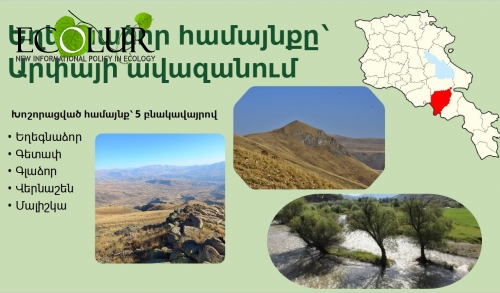
According to Isakhanyan, the rich and unique natural environment of Vayots Dzor requires a special approach. Yeghegnadzor, which comprises five settlements—Yeghegnadzor, Getap, Gladzor, Vernashen, and Malishka—is located in the Arpa River basin and is rich in mountain ecosystems.
In his presentation, Hayk Isakhanyan noted that 1,650 of the 3,800 vascular plant species known in Armenia are found within the community’s territory. Of these, 400 are medicinal plants. The area is also home to animal species such as the bezoar goat, Armenian mouflon, and brown bear. The area known as Teqsar is home to 131 bird species.
Protecting Teqsar as Priority
To conserve biodiversity, it is proposed that the Teqsar area be included in the list of Emerald Network candidate sites for submission to the Secretariat of the Bern Convention. The proposed site is expected to cover approximately 11,381 hectares and include 16 target habitat types.
Challenges: Climate Change and Mining
The community’s traditional agriculture, horticulture, and beekeeping are facing serious threats. H. Isakhanyan identified two main challenges:
1. Water scarcity: Due to the deterioration of the irrigation network, only 18% of arable land in Vayots Dzor is irrigated. In Yeghegnadzor, approximately 1,000 hectares of arable land lack irrigation. To address this problem, the community hopes that a reservoir with a capacity of 3.2 million cubic meters will be built in Koreki Dzor, along with the Getikvank–Yeghegnadzor drinking water pipeline.
2. Mining risks: The Gladzor polymetallic deposit is located in the Teqsar area. Local residents oppose the mine’s operation because it threatens drinking and irrigation water supplies, as well as 3,000–4,000 hectares of alpine pastures. “We consider the development of horticulture, winemaking, livestock farming, organic food production, and tourism incompatible with mining,” Isakhanyan emphasized.
Recommendations and Demands
At the end of his presentation, the representative of Yeghegnadzor Community put forward the following specific demands:
· Recognize Yeghegnadzor as an area whose development is based on agriculture and tourism.
· Reject mining projects until advanced technologies capable of minimizing environmental risks are introduced.
· Build the necessary water infrastructure, including the reservoir and pipelines.
· Support the community in addressing climate change and mitigating human–wildlife conflicts, particularly those involving bears.
October 31, 2026 at 19:39