

EcoLur
In the framework of the project entitled “Support to SHPP-relating Reforms Through the Dialogue of Public and RA Nature Protection Ministry for Sustainable Use of River Ecosystems” the expert group visited “Artavan 1” SHPP. “Artavan 1” SHPP is located in Vayots Dzor Region, on the Artavan River (length – 19 km). It’s operated by “Januk” LLC.
As a result of the monitoring, the expert group found out:
- According to the project, the static pressure of the SHPP is 300 m, estimated pressure - 299.39 m, while according to Public Services Regulatory Committee it’s 266.39 m. The estimated yield used by the SHPP is 1.3 m3/s, projected capacity – 2870 kW. According to the certificate issued by the Public Services Regulatory Committee, the factual useful delivery of the electricity is 6.08694666666667 million kWh, duration of license - 20.10.2010-20.10.2025, water usage permit - 02.05.11 - 02.05.14.
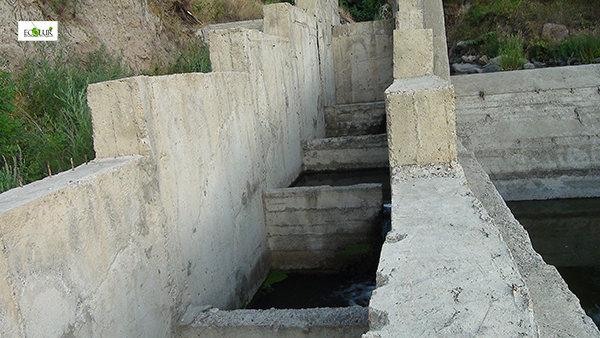
- The length of the dam in the water intake section is 10 meters, height – 2.5 meters, where there is a fish passway constructed on the right side 16 meters high and 1,5 meters wide. The fish passway has six pools 2.3 meters long, where the water flows through either the upper groove or the lower hole.
- The large sizes of the constructed fish passway is not compatible with the narrow riverbed and this structure makes ensuring favorable conditions for the fish migration in the river dubious.
- At the moment of observation the environmental flow was ensured only at the expense of remaining yields from the sand trap. It’s assumed that no water has recently flown down the dam into the river, which can show the canes grown lavishly down the dam.
- According to the water usage permit data, the SHPP can annually take 14290.0 cum water from the river leaving environmental flow of 0.056 m3/s in the river.
- You can meet brown trout and the South Caucasus Spirlin in the Artavan River.
- There is a fish-protecting net with 4-centimeter-long slots.
- According to “Computation Center” CJSC data, in 2014 “Artavan 1” SHPP operated for 12 months and produced 4533156 kW electricity.
- The derivation pipeline is made of steel, entirely under the ground and the area is reclaimed. The length of the pipeline is 3821.5 meters; its diameter is 820 mm, according to the project data.
- There are locally produced turbines in the SHPP building (including 4 turbines and 3 generators), whereas only one was operating at the moment of observation. One turbine of the SHPP ensured 120 kW capacity with 150 l/s water amount. According to the employee working in the SHPP, the SHPP ensures its projected capacity only in May and June. The reason is the lack of water and technical capacities of the turbines.
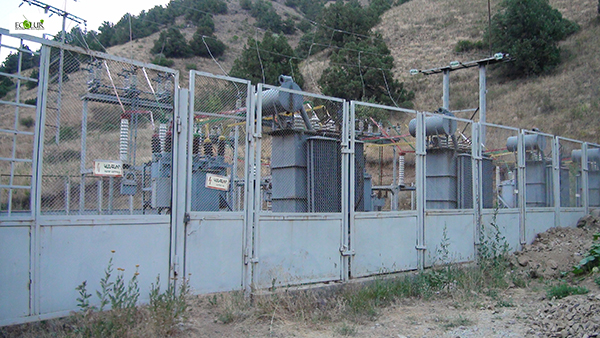
- The transformer substation is fenced, but the installed transformers are not equipped with oil-collecting system.
- There is not solution to the discharge of household wastewater.
- The area of the station is fenced, improved and greened.
- There is no water-meter sealed by a relevant environmental body in the water intake.
- There is no automatic management system of water level in the water intake.
Proposals
- To reconstruct the water intake section with the hydrotechnical solutions relevant to the area and river to ensure the migration of the fish without any obstacles and the environmental flow let out into the river.
- To examine whether the environmental flow of 0,056 m3/s is sufficient for the normal vital activities of the river and its surrounding natural ecosystems and to ensure the online supervision of the environmental flow.
- To ensure automatic management of the environmental flow in the head section thus regulating the water amount used by the SHPP and the amount of the set environmental flow through measuring devices.
- To replace the turbines with ones having higher technical effectiveness, which will have entirely automatic management system.
- To organize the discharge of the household wastewater in the prescribed manner – water-proof well or “mini” cleaning station.
- To equip the transformers with an oil-collecting system.
- To equip the entrance part of the pipeline with cellular cage net.
 |
 |
 |
 |
 |
 |
 |
 |
 |
 |
 |
 |
 |
The material was developed in the frames of “Supporting reforms in the sector of small hydro power plants through enabling a dialogue between civil society and the Ministry of Nature Protection for sustainable use of river ecosystems” supported by UNDP/GEF Small Grants Programme".
January 29, 2016 at 15:46