
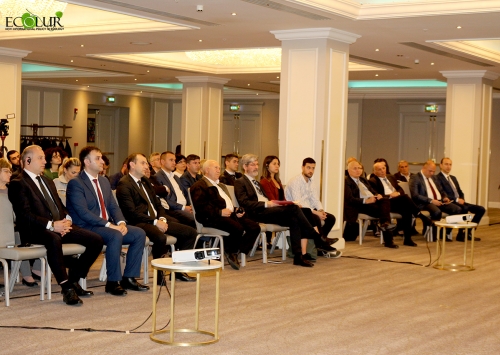

On May 6, 2022, the National Inception Workshop initiated by the World Wildlife Fund Armenia (WWF-Armenia) in Yerevan dedicated to the launch of the second phase of "Promotion of Eco-Corridors in the Southern Caucasus" and "Living Landscapes for Market Development in Armenia" projects.

Deputy Environment Minister Aram Meymaryan delivered a welcoming speech at the workshop: "Over the years, due to improper treatment of nature, we have a situation where some species are at risk of extinction. In this context, the project on creating ecological corridors is important, as it contributed to the increase in animal species, their safe movement through specially protected areas of nature," he said.

Mr. Jakob Ziegler, Attaché at Embassy of the Federal Republic of Germany in Armenia, noted that the protection of natural systems is a priority for the German government. "The use of ecosystems harms the natural environment. We must overcome it through multilateralism, cooperation between different countries and institutions," he noted.

Mr. Werner Thut, Chargé d’affaires a.i. of Switzerland (in Armenia), Deputy Regional Director Swiss Cooperation for the South Caucasus, mentioned that that they were able to design an innovative project that has significant potential. "We try to combine nature conservation with economic growth in a practical way so that it makes sense to the local population. Villagers living in protected areas can earn money from the landscapes where they live in," he outlined.

Mr. Frank Mörschel, Senior Portfolio Manager of KfW Development Bank mentioned in his welcome speech that he is glad for the launch of the second phase of Promotion of Eco-Corridors in the Southern Caucasus" project especially considering the findings of the first stage. "A lot of effort has been put into the first phase of the Eco-Corridor project, it has been a successful approach that promotes the preservation of landscapes in the communities and provides an opportunity for local initiatives," he said.

Hovik Karapetyan, the administrative head of Zangakatun settlement, a beneficiary of the first stage of the project, spoke about the impact of the project on the development of their settlement. "Our habitat is rich in biodiversity, the protection of animal habitats has never been included in any development program. "In 2018, we joined the eco-corridor promotion program, as a result of which we received 166,500 euros, which is still spent not only on environmental measures, but also on socio-economic development of the community," he said.

WWF Armenia Director Karen Manvelyan presented the general description of the two projects, their interconnection with each other and other international projects implemented in the region. "The Caucasus has a high priority for the WWF because it has great biodiversity, but at the same time that biodiversity is endangered by various risks, such as illegal hunting, mining, illegal logging, climate change. All this can be considered in our approaches and projects. The connection of the projects is first of all biodiversity, nature protection, sustainable use of natural resources, the opportunity for local businesses to make a profit" he said.

Armen Shahbazyan, National Coordinator of Second Phase of "Promotion of Eco-Corridors in the Southern Caucasus" project, presented the main idea of Eco-Corridors Project and the findings of the first phase of the project. "We cannot preserve wildlife by creating specially protected areas, we cannot create national parks across the country. We must have alternative approaches. According to him, the second stage of the project will be implemented in 16 settlements of Lori, Tavush, Vayots Dzor and Syunik Regions.

Mkrtich Ayvazyan, President of "Strategic Development Agency" NGO, referred to "Living Landscapes for Market Development in Armenia" project, presenting the main idea. "The general idea is the following: to improve the living standards of the population, to use natural resources sustainably, to mitigate climate change and to diversify rural incomes," he mentioned. Six rural communities from Lori, Tavush, Vayots Dzor and Syunik Regions benefit from this project.

Karen Manvelyan, in his turn, emphasized that through these programs it will be shown that it is possible to combine economic development with nature protection. "The idea is that if we can stabilize the flora and fauna in the target villages, it will lead to an increase in species, which will be an additional incentive for tourist visits. At the same time, sustainable ecosystem management will provide a solid basis for communities to use their natural resources. Of course, if the number of tourists increases, the villagers must be ready to receive those tourists and have appropriate conditions. The visit of tourists will also bring investments in those communities," he said.

The above two programs are implemented by WWF-Armenia. "Promotion of Eco-Corridors in the Southern Caucasus" - Project II is funded by the Economic Community of the Federal Republic of Germany by the Ministry of Cooperation and Development (BMZ) through KfW Bank. "Living Landscapes for Market Development in Armenia" project is funded by the Swiss Government through the Swiss Agency for Development and Cooperation (SDC). Funding is 4,500,000 Swiss francs (CHF). This project is implemented by the World Wildlife Fund (WWF) and the Strategic Development Agency (SDA) as part of the wider Regional Eco-Corridor for the Caucasus (ECF) project.
May 07, 2022 at 10:21