
Yulia Kulishova, Delovoi Express
The mining company’s operation leads to environmental disaster, but its closedown will bring to social disaster.
“EcoLur” Informational NGO conducted a monitoring of Deno Gоld Mining Company’s operation on the basis of the S.O.S. signals received from the residents about the environmental and social situation in Kapan and adjacent communities. The monitoring results were presented at the Aarhus Center in Yereven. The results were deplorable.
Under “EcoLur” President Inga Zarafyan, the hardest situation is in Syunik Community. As a result of breakdown dumping in 2006-2007, the soil, as well as vegetable gardens and orchards in Syunik Village were contaminated, the cattle died, and the children had heavy allergic reactions, up to skin peeling off their hands. The State Environmental Inspection responded only when the mass media started talking about this emergency state. The company was fined in the amount of 10 million AMD that was directed to the state budget. Only a part of the community residents received their compensations. These are 7-8 families having received compensations only for land areas that were found under dumps. What about the compensation for damage caused to health, contamination of the whole territory with wastes, for the damage caused to cattle farms, no one in the village is aware of them.
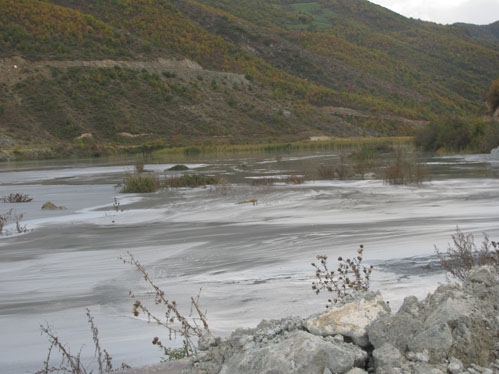
The flow stopped after the construction of the Geghanush tailing in 2008. Nevertheless, there are still tailings in the community which the company left uncovered. The Norashenik River runs next to these tailing and its banks are fixed with the same tailings which brings to continuous flow of heavy metals from the tails to the river. According to the data of Center for Ecological Noosphere Studies of National Academy of Sciences of RA, in the samples of the soil taken from the community area the following excesses in MPC (maximum permissible concentrations) are observed: Сu – 6 times, Mo – 4 times, Ni – 2,4 times, Hg- 30 times, Cd –10 times. It should be noted that cadmium and mercury are considered to be highly toxic elements incompatible with the standards for healthy life. These pollutions are maintained in the soil for many years, if not to say forever, and continue their destructive effect. Malignant diseases are common in the village. But the status of the grounds in Syunik Marz, they are considered suitable for farming, they keep on growing herbs, vegetables, and fruit, to produce meat and dairy supplied to Kapan. Breast cancer is widely common. According to the locals before the tailing we had a good harvest of cherry and crab cherry. After the tailing everything got disappeared.
This booklet contains the villagers’ statements. “Approximately 5 thousand hazel trees grow in our forest. Each tree gave from 20 to 30 bags of hazelnut,” said Kamo Hovhannisyan, Head of Village Administration, “but the harvest has decreased by 80%.” “This year three of my newly born calves died, they couldn’t stand on their legs and couldn’t even drink. I did my best but it’s all the same. I have been breeding cows all my life, but I have seen nothing like this,” said farmer Hovik Emchyan, “I think if trees wither, the animals eating this grass also get poisoned.”
Geghanush Villagers’ scream was not heard by any official. During the discussions Deno Gold Mining Company representative Norayr Aghayan said that the number of hazel trees in the community is not 5000 but much less. It should be noted that the company representatives immediately held a non-constructive position directing all their energy to protect their prestige at any price and even by denial of publicly known facts. Particularly they were dubious of the information that in 2006-2007 vegetable gardens and orchards in Syunik Village were contaminated, the cattle died, and the children had heavy allergic reactions, though the company was fined for this very deed. They also didn’t agree that the tailing caused decrease in productivity of hazel trees by 80%. The Chairman of the Greens Union Hakob Sanasaryan said that scholars have already proved that heavy metals in the tailings cause damage to human health, plants and animals, while the Geghanush tailing is not an exception. The main issue is who bears responsibility for the contamination of the village territory. As the representative of Deno Gold Mining Company Norayr Aghayan called attention to high content of molybdenum in the soil. Under him, the Combine wastes contain no molybdenum, so these data are dubious. The matter is that at present it’s hard to determine who exactly bears responsibility for pollution, as Syunik Community is under the influence of breakdown emissions of the tailing in Artsvanik developed by Zangezour Copper and Molybdenum Combine, dumps from the development of Shahumyan gold-polymetallic mine developed by Deno Gold Mining Company and former breakdown emissions by Deno Gold Mining Company.
If the company closes this enterprise, social disaster will pose to Kapan. The population in Kapan makes up 45,6 thousand people, while the Combine is the only large enterprise where about 1000 people are employed. A closed circle has emerged: the mining company’s operation leads to environmental disaster, but its closedown will bring to social disaster. And apparently this situation will deteriorate with the lapse of time.
As the participants of the discussion noted many of the abovementioned issues are not only Deno Gold Mining Company’s problems, but those of the whole mining industry and the economy and its priorities in general. Unfortunately, this destructive industry is the main priority for the economic development of Armenia. Meanwhile it should be taken into consideration that the concept for this sphere hasn’t been worked out; there is no appropriate legislation for equivalent assessment of damage to environment, the legislation basis is incomplete, while state control is weak. There are no mechanisms to protect human right to one's own property and other rights, when these rights collapse with the interests of mining companies. In this environment of high-level corruption and weak control almost everything depends on the company’s good will that may stop operating at any moment, and bear no responsibility, including financial one. Copanies themselves realize this fact and make use of it.
As “For Sustainable Human Development” NGO President Karine Danielyan said this problem is systematic for the whole country. The territory of Armenia is covered with tailings like wounds and ulcers that never close up. The scales of this disaster are so wide that they are even visible on the photos made from the space. Every day we hear that new permits are given for the development of new mines. And still uranium is coming up. Under K. Danielyan, if not to review development priorities, Armenia will cease its existence in 50 years.
January 27, 2010