
Artur Hovhannisyan, the “Hayots Ashkharh”
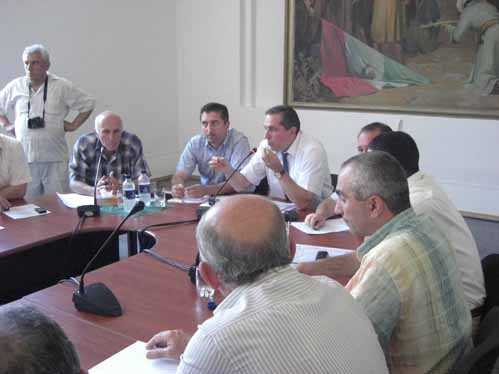
The prospecting-investigative works for uranium mine approved by the government decision № 234-N in 2008 in the territory of Lernadzor Community, Syunik Region, are still in progress. A discussion was held in regard with the works in progress at Kapan Municipality on 2 July. The assurances on safety of these investigative works made by Areg Galstyan, the Chairman of the Board of Directors of “Armenian-Russian Mining Organization” CJSC and the company’s Chief Geologist Samvel Dayan didn’t reassure the local population, the Aldermen’s Council members in Kapan (and not only them) and the heads and representatives of NGOs participating in these discussions, as well as the Head of Lernadzor Community Stepan Poghosyan. The local NGOs, representatives from Kapan and Lernadzor Communities, on one hand, and Areg Galstyan and S. Dayan, on the other hand, reached an agreement under which NGO, Kapan and Lernadzor community representatives will be invited to measure radiation and radiological background before and after drillings, and moreover, a detailed map for radiological background will be drawn up.
Areg Galstyan as if tried to assure the present opponents that these current prospecting-investigative works still don’t mean any mine development, just the country needs to know where and what it has. However, we think it’s clear to everybody why these investigative works are conducted, why the Russian party invested many financial resources, and if sufficient reserves are detected with at least not high economic efficiency, mine development is to commence.
According to the results of the public discussions on the uranium mine in the territory of Lernadzor Community held at the Aarhus Center in Kapan on 4 August 2009, the minutes were drawn up that particularly says: “...the authorized representative from Lernadzor Community noted with satisfaction that the negative impact on the environment will be minimum and there will be opportunity to create work places for the locals.” In this regard the Head of Lernadzor Community outlines this process was a lie from the very beginning, as he factually didn’t say anything like that. “At present Lernadzor as well as neighboring villages have no such problems as the community is only 2 km far from Kajaran, the biggest industrial center, and the locals are traditionally secured with work at Kajaran Copper and Molybdenum Combine,” said Lernadzor Head at the uranium project discussions held at Kapan Municipality, “Community population, as well as I myself are firmly against this project. Nobody wants a uranium mine to be opened or developed near his house. People spent 40-50 million AMD to build their houses and to live in them, but now some of them don’t continue building their houses till the end, as they are uncertain. If they decide to develop the uranium mine, people will derelict not only in Lernadzor, but also in the regional settlements.”
Under the pressure of participants’ persistent questions the Nature protection Deputy Minister and the Chairman of the Board of Directors of “Armenian-Russian mining Company” CJSC Areg Galstyan admitted the aim is certainly to find and develop uranium if economically beneficial.
The Company’s Scientific Advisor and NAS Academician Sergey Grigoryan spoke about uranium development by leaching on different occasions and Areg Galstyan touched upon this topic in passing. In short, in-situ leach mining involves pumping of a leachate solution (usually sulfuric acid) into the ore body via a borehole, which circulates through the porous rock dissolving the ore and is extracted via a second borehole with pumps. If this method is applied, no ore will be taken out. There are almost no suspicions this method will be applied to develop uranium mine in Lernadzor for at least two or three reasons: first, there is no railway connection between Armenia and Russia where ore should be processed, while transportation of thousand tons of uranium on trucks is impossible (not to mention difficulties with loading and unloading) economically unprofitable and very dangerous. Another problem is getting permit by Georgia or any other transit country.
Environmentalists say uranium extraction by in-situ leaching method has a number of minuses together will all its pluses. We will mention only one – great danger of underground water pollution. It should mentioned this active acid dissolving radioactive uranium may come out on the surface, contaminate and poison the Voghji River running through Lernadzor Village. Lernadzor and other neighboring villages use its water for irrigation purposes.
July 08, 2010