
EcoLur
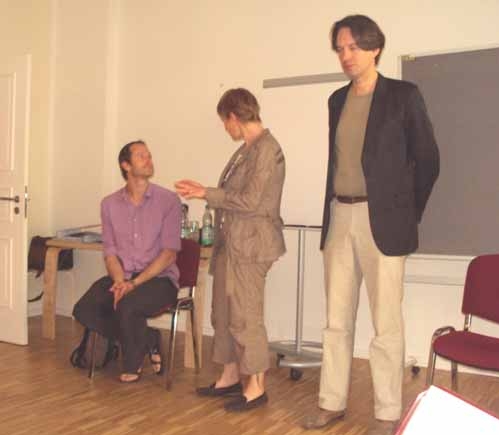
Copenhagen is a collapse or an opportunity? Tilman Santarius, Head of the International Climate and Energy Policy at the Heinrich Böll Foundation, touched upon this debatable idea in his speech at the Summer Academy “Culture and Climate” in Berlin on 29 June.
The participants to this summer academy are representatives of 8 countries from Post-Soviet era – Armenia, Belarus, Georgia, Kazakhstan, Kyrgyzstan, Russia, Uzbekistan and Ukraine. “If European countries experience disappointment from Copenhagen, it can become an entrance to big politics for developing countries,” said Santarius and outlined present situation when big politics is a summary of individual policies where everybody is responsible for themselves.
The opinions expressed by the Summer Academy participants in regard with Copenhagen outcomes are varied.
The very first complaint is about quote sale. “Quote sale doesn’t mean just business, but should be directed to developing ecologically clean production in that particular country, while the profit made from quote sale must not be directed to generating extra emissions,” said Ketevan Tskhakaya (Georgia) and added the most important aim is to reduce global number of emissions. At the same time Armenian (EcoLur) and Kyrgyzstan (Biom) representatives shared the opinion if to speak about business, it always suppresses environmental principles and frequently leads to anti-environmental consequences. They think this model should be changed. “350” NGO (Ukraine) considers it necessary to conduct strict monitoring of financial flows directed to clean development mechanisms.
Santorius didn’t bring any own arguments for this or that opinion. He noted that alternative models of global warming are still not expected (EcoLur’s note: clean development mechanism is based on the very existing model of atmospheric air temperature average-annual increase due to emission of greenhouse gases). Santorius outlined one should run own policy at domestic level in order to be able to influence on big politics in global warming, including that of clean development mechanisms.
July 07, 2010