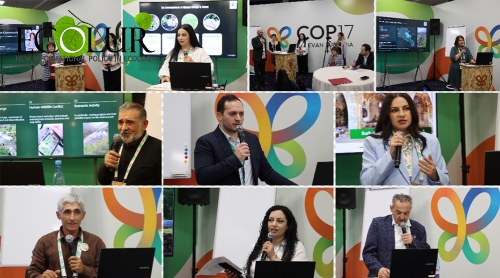
Ahead of the 17th meeting of the Conference of the Parties to the UN Convention on Biological Diversity (CBD COP17), EcoLur Informational NGO and representatives of local self-government bodies, NGOs, and active residents from Tavush, Lori, Gegharkunik, Vayots Dzor, and Ararat Regions in Armenia have issued a joint statement.
The authors of the statement emphasize Armenia’s importance as one of the world’s 36 biodiversity hotspots and draw attention to serious challenges at the local level, ranging from the harmful impacts of economic activities to a lack of funding, limited community participation in decision-making, and climate-related challenges.
The communities are addressing the Secretariat of the UN Convention on Biological Diversity, the Parties to the Convention, and international organizations, proposing that communities be recognized as the primary level for implementing environmental action, that direct funding mechanisms be established, and that environmental requirements for high-risk economic projects be strengthened.
The full text of the statement is provided below.
COMMUNITY STATEMENT OF THE REPUBLIC OF ARMENIA
For the conservation, restoration, and sustainable use of biodiversity
On behalf of the local self-government bodies, organizations, and residents listed below, Victoria Burnazyan, Vice-President of EcoLur Informational NGO:
1. Arman Bazinyan, Acting Head of Dilijan Municipality, Tavush Region, Republic of Armenia
2. Suren Kostandyan, Head of Pambak Municipality, Lori Region, Republic of Armenia
3. Armenui Ghukasyan, Head of Staff of Sevan Municipality, Gegharkunik Region, Republic of Armenia
4. Anush Sargsyan, Administrative Head of Debet Settlement, Pambak Municipality, Lori Region, Republic of Armenia
5. Garnik Hovsepyan, Administrative Head of Dsegh Settlement, Tumanyan Municipality, Lori Region, Republic of Armenia
6. Hayk Isakhanyan, Yeghegnadzor Municipality resident, Vayots Dzor Region, Republic of Armenia, and founder of Izoton LLC
7. Liana Asoyan, President of Blejan Environmental, Social and Business Support NGO, based in Gavar Municipality, Gegharkunik Region, Republic of Armenia
8. Satik Badeyan, Programme Manager at the Center for Territorial Development and Research NGO, based in Sevan Municipality, Gegharkunik Region, Republic of Armenia
9. Albert Haroyan, Coordinator of the Aarhus Centre in Dilijan Municipality, Tavush Region, Republic of Armenia, and President of Ecopolis Environmental Center for Community Security and Development NGO
10. Tehmine Yenokyan, Gndevaz Settlement resident, Jermuk Municipality, Vayots Dzor Region, Republic of Armenia, and President of Green Armenia NGO
11. Tigran Matevosyan, President of Armash Rural Communities Support and Development Center NGO, based in Armash Settlement, Ararat Region, Republic of Armenia
12. Anahit Matevosyan, Armash Settlement resident, Ararat Region, Republic of Armenia, and Founder of SunRise Tour social enterprise
We, the undersigned representatives of the communities of the Republic of Armenia, attach great importance to the hosting of the 17th meeting of the Conference of the Parties to the UN Convention on Biological Diversity in Armenia. Armenia is considered one of the world’s 36 biodiversity hotspots due to its rich yet threatened biodiversity. We welcome the Global Review process of the Kunming–Montreal Global Biodiversity Framework, through which the progress made by Parties to the Convention towards the conservation, restoration, and sustainable use of biodiversity, as well as existing gaps and challenges, will be assessed.
As part of this global process, we recognize our responsibility for the conservation, restoration, and sustainable use of biodiversity. At the same time, we face a number of challenges that make the conservation and restoration of biodiversity difficult.
These challenges include:
· Certain types of economic activities in community areas that destroy local biodiversity, disrupt ecosystem balance, accelerate desertification processes, contribute to the occurrence of landslides, and alter the local landscape and natural environment;
· Poverty, which often increases pressure on local biodiversity;
· Human–wildlife conflict;
· Lack of financial resources to implement biodiversity conservation and restoration programmes;
· Insufficient resilience to climate change;
· Unsustainable use of water resources;
· Challenges in the field of waste management;
· Failure to take into account the traditional knowledge, views, and rights of communities during public hearings on economic programmes related to biodiversity conservation;
· Low community participation and lack of inclusiveness in decision-making processes related to biodiversity;
· Construction carried out at the expense of green spaces;
· Insufficient use of nature-based solutions;
· Limited capacities at the community level.
Recognizing the vital importance of biodiversity conservation for the livelihoods and development of our communities, we declare:
· Our commitment to contributing to the implementation of the national biodiversity targets of the Republic of Armenia for 2026–2030;
· Our willingness to become partners in biodiversity conservation, to protect and preserve the natural heritage of our communities, to support ecosystem restoration, to prevent biodiversity loss, to reduce human–wildlife conflict, and to be guided by nature-based solutions.
We believe that biodiversity conservation and the sustainable development of communities are not conflicting, but rather complementary objectives.
We are confident that, through joint efforts and cooperation, we can contribute to achieving global goals. Therefore, through this Statement, and as a collective voice of communities, we express our willingness to contribute to the achievement of the 2030 targets of the Kunming–Montreal Global Biodiversity Framework.
With reference to the item in the Multi-year Programme of Work entitled “Issues related to Article 8(j) and other provisions of the Convention related to Indigenous Peoples and local communities,” we propose the following to the Secretariat of the UN Convention on Biological Diversity, the Parties to the Convention, and relevant international and national institutions:
1. Recognize communities as the primary level for implementing biodiversity conservation and restoration actions.
2. Introduce mechanisms to finance measures for the conservation, restoration, and sustainable use of biodiversity in communities.
3. Promote the application of nature-based solutions and ecosystem approaches in community infrastructure, water resource management, climate change adaptation, land restoration, urban green spaces, and disaster risk reduction.
4. Establish mechanisms to ensure the full participation of communities in decision-making processes related to biodiversity.
5. Make communities key players in achieving the targets of the Kunming–Montreal Global Biodiversity Framework by assigning them obligations and establishing mechanisms for their implementation.
6. Include community-level actions in National Biodiversity Action Plans.
7. Strengthen the capacities of communities in biodiversity conservation and sustainable use.
8. Establish strict environmental requirements for economic projects whose implementation threatens biodiversity loss, environmental pollution, or the disruption of ecosystem balance.
9. Recognize biodiversity not only as an environmental asset, but also as an opportunity for the economic and social development of communities, by promoting ecotourism, agrotourism, sustainable agriculture, the creation of green jobs, and nature-based local economic activities.
The statement has been submitted and published on the official CBD COP17 website for presentation to delegations of the Parties to the Convention during COP17 proceedings.
The article was prepared within the framework of “Supporting Armenia's CBD COP Presidency and Domestic Implementation” implemented by EcoLur Informational NGO in cooperation with the Fridtjof Nansen Institute, with support from the Norwegian Agency for Development Cooperation (Norad).
The views expressed within the framework of the project do not necessarily reflect those of the Fridtjof Nansen Institute.
October 21, 2026 at 23:11