
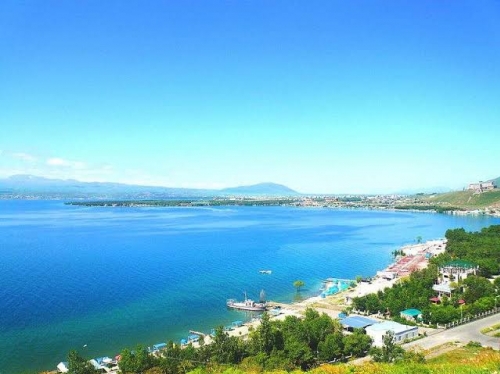
On October 22, 2026, a three-year project entitled “EU4Biodiversity in Sevan: Promoting the Restoration of Lake Sevan’s Ecosystem” was launched in Yerevan during the 17th Conference of the Parties to the Convention on Biological Diversity (CBD COP17), with €1.5 million in funding from the European Union. The project is being implemented by the United Nations Development Programme (UNDP), which is contributing an additional €30,000, in partnership with the Government of Armenia, represented by the Ministry of Environment.
According to Vassilis Maragos, Head of the EU Delegation to Armenia and EU Ambassador, the project will build on previous initiatives by improving the monitoring system and database to assess the impact of biodiversity loss on the lake. He emphasized that the initiative aims to strengthen environmental governance, promote science-based restoration efforts, and foster close cooperation among institutions, local communities, and development partners. Efforts will also focus on engaging local communities, fishermen, young people, and schoolchildren. In addition, the visitor center of Sevan National Park will be modernized, and tourist trails will be improved.
UNDP Resident Representative in Armenia Natia Natsvlishvili emphasized the importance of combining institutional capacity, scientific expertise, local action, and sustainable financing.
“Our goal is not simply to implement a series of activities over the next three years. We aim to help build stronger institutions, more reliable monitoring systems, healthier natural environments, and practical approaches to environmental financing that can continue to deliver benefits long after the project ends.”
UNDP Project Coordinator Magda Avetisyan outlined the project's main priorities:
- Restore selected areas of Lake Sevan's ecosystem, particularly riverbanks and river mouths, including two rivers and two river sections critical for the reproduction of the Sevan trout population.
- Introduce improved fisheries management practices and modern technologies.
- Conduct a remote-sensing inventory of 10,000 hectares of forest cover in the Lake Sevan basin.
- Strengthen the capacity of Sevan National Park's forest nursery using seedlings of native endemic species.
In addition, the project will explore innovative financing approaches for ecosystem restoration, supporting the development of sustainable revenue-generating opportunities for Sevan National Park, including recreation and ecotourism. Incentive mechanisms to engage the private sector are also being considered, including green business labeling and encouraging local businesses to adopt more environmentally sustainable practices.
In an interview with VT Hayastan News, a Poland-based Armenian news program, Inga Zarafyan, President of EcoLur Informational NGO, addressed the environmental challenges facing Lake Sevan. She highlighted the problem of construction and development along the lake's shoreline, noting that even when individual structures are dismantled, the issue of the infrastructure serving these facilities remains difficult to resolve.
Commenting on the negative impacts of agriculture, livestock farming, nearby industrial facilities, and mining operations on the lake's water quality, Inga Zarafyan stated:
“For several years now, we have been witnessing algal blooms in Lake Sevan. This has become a recurring cycle, indicating the lake's severely deteriorated ecological condition.”
According to the environmentalist, another major challenge is the lake's low water level, which disrupts its natural self-purification processes. Zarafyan attributed the low water level in Lake Sevan to excessive water abstraction.
November 18, 2026 at 18:26