


The residents of Akhtala Community in Lori Regi
Akhtala Mining and Processing Plant CJSC operates in Akhtala, which operates Shamlugh copper mine.
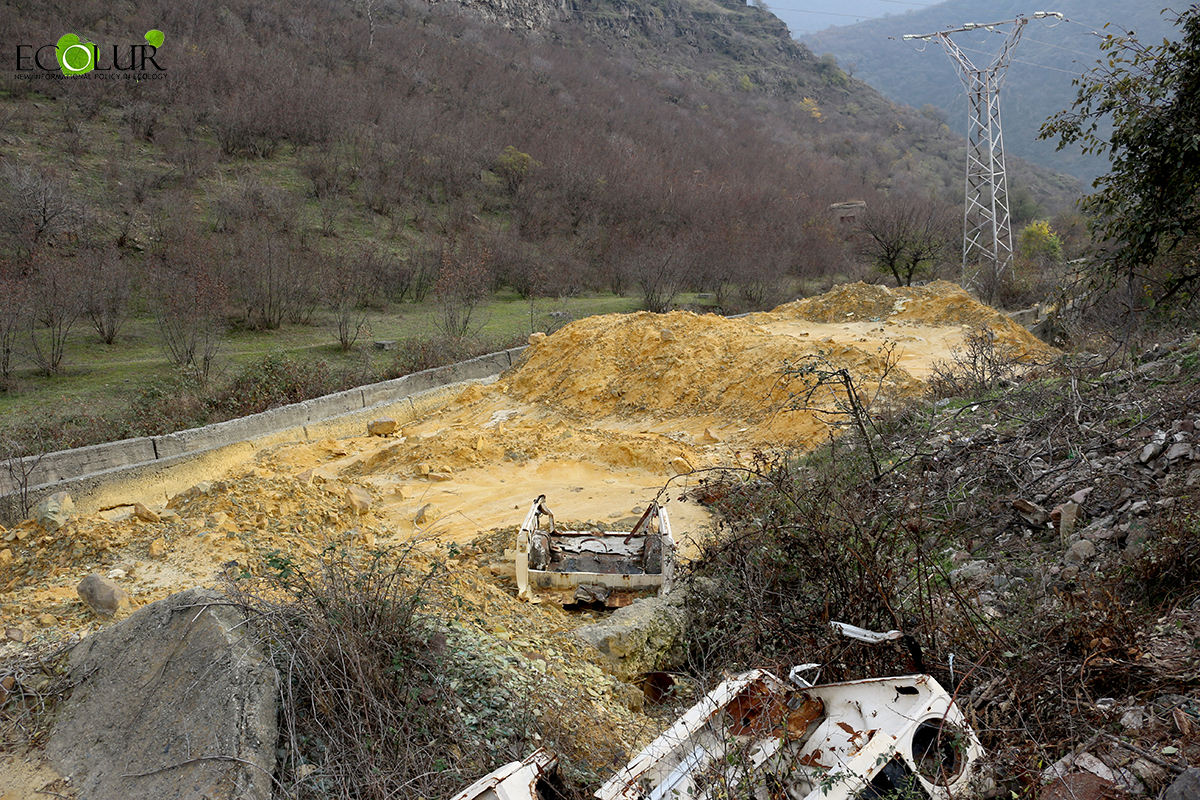
The mine is located in the administrative area of Shamlugh settlement in Akhtala Community, in the Akhtala river basin. During the operation of the plant, 3 tailing dumps were formed in Akhtala community - "Nazik", "Pahesti Dzor" /reserve/ and "Nahatak". "Nahatak" tailing dump is located between Mets Ayrum and Tchotchkan communities.
In 2016, Akhtala OPC expanded the area of the tailing dump by building an 8-meter-high dam, but the tailing dump continues operating to this day. The residential houses of Mets Ayrum village are located at a distance of 50-100 meters from the tailing dump. "Nazik" tailing dump is located near Akhtala monastery complex and is considered to be reclaimed.
However, there is almost no soil cover in the tailing dump, so uncovered tails mix with precipitation in the Akhtala River. "Pahesti Dzor" tailing dump is located on the road to Shamlugh. All three of these tailings are sources of environmental pollution and human health.
What polluted the enlarged community of Akhtala and the organisms of the people living there?
In 2014, chemist Seyran Minasyan examined the peach in Mets Ayrum and found that the presence of heavy metals in them exceeded the standard multiple times.
In 2015, the American University of Armenia conducted a blood test on children in Akhtala and found that heavy metals in children's blood exceeded the standard multiple times.
In 2018-2021, research was conducted in cooperation with Center for Community Mobilization and Support NGO, EcoLur Informational NGO, the Armenian Women for Health and Healthy Environment NGO, and Czech-based “Arnika” Organization for Chemical Safety, which substantiate the presence of mining contaminants in Mets Ayrum, Akhtala, their spread in soils, fruits and vegetables and in the human body.
Studies have shown that in 26.7% of all samples taken from Akhtala community, the lead concentration exceeds the maximum permissible concentration (MPC). In 93.6% of arsenic samples, it also exceeds the MPC. According to the same research, 84.6% of the blood lead in the children of Akhtala exceeds the limit level recommended by the JCCs of the Centers for Disease Control and Prevention.
Mercury was found in agricultural products grown in the areas of Akhtala, Tchotchkan, Karkop and Neghots communities in 5 samples of crops, the MPC norms were exceeded by 2.6-11.6 times. Cadmium was found in all samples of agricultural products, in four samples exceeded the MPC. The cadmium content in raspberries obtained in Neghots village was 131.9 times higher than the MPC.
Lead was found in all plant samples, it also exceeded the MPC. The most worrying conclusion of the research is that the agricultural products received in Alaverdi and nearby villages (Neghots, Karkop, Tchotchkan) do not comply with the food safety norms operating in Armenia and abroad. Dangerous agricultural products are consumed not only by the producer, but also penetrate the local market, which is a risk factor for public health.
Alaverdi, Akhtala, Tchotchkan, Karkop and Neghots communities have been found to have high levels of heavy metals, including hazardous class I (As, Pb, Zn) and II (Cu) elements.
/«Exposure assessment of potentially toxic trace elements via consumption of fruits and vegetables grown under the impact of Alaverdi's mining complex», D.Pipoyan, M.Beglaryan, L.Sireyan, N. Merendino, Human and Ecological Risk Assessment: An International Journal, Volume 25, 2019 - Issue 4/ https://www.tandfonline.com/
Recently, a journalists' visit to Akhtala was organized to present the problems of Akhtala and other mining communities impacted by mining. "We say we are losing lands as a result of the war. But we will bring them back. Nevertheless, we will not be able to bring back these polluted lands for 500-600 years. Our state must think about this in advance, think of developing alternatives to mining. "We have great intellectual potential, prospects for developing agriculture and tourism," Environmental Lawyer Nazeli Vardanyan said, Director of Forests of Armenia NGO.
Inga Zarafyan, President of EcoLur Informational NGO, noted that the bodies of local residents are constantly exposed to this pollution. "It is necessary to show political will, and to monitor people's health through the company at least for free or at the expense of the company funds, at least, once a year," she said.
According to Inga Zarafyan, the companies working in the mining sector have one problem - they increase the production year by year, but do not try to acquire new technologies, do not try to extract more minerals. "They process a lot of minerals, which means that they produce more waste. But where to throw that waste? The tailing dumps are limited," she said.
Oleg Dulgaryan, President of " Center for Community Consolidation and Support " NGO, noted that the state should undertake the introduction of relevant legislation, where the rights and interests of the community residents will be protected. "At the moment, the legislation works only for the benefit of the miner. The local government of any affected community should introduce a policy to protect the social and ecological rights of the community, to provide alternative development directions for the community," he said.
Article was prepared within the framework of "Social and Ecological Responsibility" Project
“Social and Ecological Responsibility” project is carried out by the NGOs involved in "Social-Ecological Consortium” - “Center for Community Mobilization and Support”, “Martuni Women’s Community Council”, “New Horizons”, “EcoLur” and “Forests of Armenia” NGOs within the frameworks of The Data for Accountable and Transparent Action (DATA) project.
The Data for Accountable and Transparent Action (DATA) project is made possible by the generous support of the American People through the United States Agency for International Development (USAID). The contents of DATA Project are the sole responsibility of “Center for Community Mobilization and Support” NGO and project partners and do not necessarily reflect the views of USAID, EPF, and DATA Consortium.




December 17, 2021 at 09:42