
As of 2020, a total of 297 landfills that did not meet sanitary standards had been identified and mapped in Armenia. As a result of municipal consolidation and the commissioning of a sanitary landfill serving Kotayk and Gegharkunik Regions, approximately 100 landfills were taken out of operation between 2021 and 2024.
The remaining active landfills continue to pose serious risks to both the environment and human health. They contaminate soil and water with heavy metals and toxic substances, while also polluting the atmosphere through emissions of toxic and greenhouse gases.
According to various sources, 690,000-720,000 tonnes of municipal solid waste are disposed of in Armenian landfills annually, and waste volumes continue to increase. According to studies conducted by World Bank and the Acopian Center for the Environment of the American University of Armenia, the composition of waste is approximately 25% glass, plastic, and paper, 57% organic waste and 15% residual waste.
How Waste Management Can Be Improved
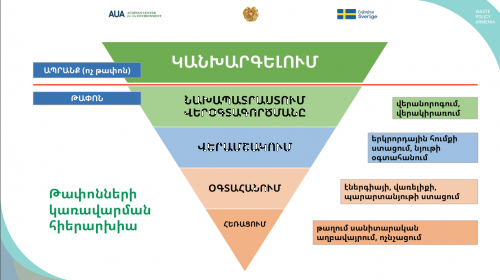
The internationally recognized framework for waste management is the five-tier waste hierarchy, the primary principle of which is the prevention of waste generation. This is followed by reuse, recycling, energy recovery, and only as a last resort, waste disposal in landfills or by other means.
In Armenia, however, the country performs best in the final stage-disposing of waste in landfills.
The implementation of the five-level waste management hierarchy is envisaged under the Comprehensive and Enhanced Partnership Agreement (CEPA) between Armenia and the European Union. The 2019 roadmap for implementing the agreement stipulated that, within four years of CEPA’s entry into force, Armenia would introduce measures aimed at reducing waste generation, promoting separate waste collection, and increasing recycling.
The roadmap adopted in 2026 further provides that by the second quarter of 2026, methodological guidelines for implementing the five-level waste management system should be developed and approved, and local self-government bodies should prepare local waste collection and solid waste management plans.
The introduction of the five-level waste hierarchy is also envisaged under the **Waste Collection System Strategy**, adopted in 2021. According to a report by the Ministry of Territorial Administration and Infrastructure, measures undertaken to support implementation of the hierarchy include:
adoption of amendments to the Law on Waste Collection and Sanitary Cleaning;
development of a methodology for conducting waste composition studies;
adoption of procedures for the collection, transportation, storage, and disposal of biodegradable waste; and
preparation of the draft Law of the Republic of Armenia on Extended Producer Responsibility.
In accordance with amendments adopted in 2026 to the Law on Trade and Services and related legislation, beginning January 1, 2027, the sale or provision of the following products will be prohibited in retail trade at commercial establishments, public catering facilities, marketplaces, mobile trade outlets, fairs (vernissages), exhibition-sales events, itinerant trade points, peddling activities, and outdoor retail locations:
polyethylene bags and sacks;
single-use plastic products (including products made of expanded polystyrene foam);
containers;
plates;
cups;
cup lids;
spoons;
forks;
knives; and
sticks intended for drinking or stirring beverages.
This measure is intended to prevent the generation of consumer waste arising from these products.
A number of standards related to packaging, recycling, and energy recovery have also been adopted.
Despite the reforms undertaken, developments in the sector have largely been limited to the adoption of legal acts that have not yet been fully and effectively implemented. The introduction of the five-level waste management system remains at an embryonic stage, as evidenced by the fact that only approximately 10% of recyclable waste is recycled and waste sorting levels remain low.
The primary reason for this situation is the inadequate financing of the waste sector, reflected in insufficient cost recovery mechanisms and incomplete implementation of the “Polluter Pays” Principle.
Prerequisites for improving the situation include an appropriate tariff policy, environmental taxation, Extended Producer Responsibility (EPR), and other economic instruments.

This material was produced within the framework of the Waste Policy Armenia (WPA) program, funded by Sweden and implemented by the Acopian Center for the Environment at the American University of Armenia (AUA), with financial support from Sweden and technical support from AUA.
The views, conclusions, and opinions expressed in this material are those of the author(s) and do not necessarily reflect the positions of the program, the American University of Armenia, or the Government of Sweden.
June 12, 2026 at 13:03