
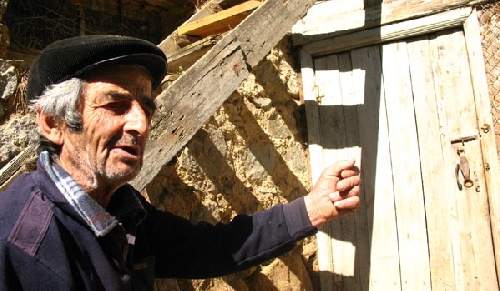
Gayane Mkrtchyan, ArmeniaNaw
Mountains appear as if cut with swords in Syunik province, Armenia. They soar proudly, standing back-to-back.
The only highway of international importance runs through the bends of these mountains on its way to Iran. After such a recurrent bend, Lernadzor village, embraced by mountains and forests, appears. Houses hang from slopes.
“During the Soviet period, there were 11 villages from Kapan to Kajaran, however the city ‘swallowed’ all of them, but Lernadzor remained. Unlike many, residents of Lernadzor, who have apartments in Yerevan, Kapan, and Kajaran, locked their doors there, and returned to Lernadzor. Our peasants clung to their land and water,” says Head of Lernadzor village Stepan Petrosyan.
Lernadzor is some 340 km south of Yerevan, 20 km from Kapan (capital of Syunik province), and some six km from Kajaran, where one of the industrial giants of the province – Kajaran Copper-Molybdenum Plant is located.
Unlike remote villages of Armenia, where the unemployment has high indexes, there is no such threat in Lernadzor. Seventy percent of the village’s population works at the plant.
This village is first mentioned in the records of Armenian historian Pavstos Buzand in the fifth century.
Lernadzor is the historical Old Dzorki province. Anciently this village was called Tir, later Kyurdikend (honoring Prince of Armenia Kyurdik).
“In the 1920s, not perceiving the importance of those names, the village was renamed– Lernadzor,” explains Robert Grigoryan, headmaster of Lernadzor’s school. “The village was replaced to its current territory from the opposite side of the mountain in 1958, where Kyurdikend was located.”
Ten years later, in 1968, an earthquake destroyed the villagers’ houses.
Village Head Petrosyan says that the cottages designed for 17 years, have already served for 40 years.
“In 2005, after a long-lasting wait, the Government provided villagers with subsidies to build new houses. Currently, about 30 percent of the villagers live in newly built houses,” he says. “And now there is another problem . . .”
The issue, hotly discussed in Lernadzor, is uranium mines, which villagers point to, some 300 meters from their settlement.
“People are puzzled; they are not sure whether to complete the construction of their houses. It is bad enough as it is that we do not live in an ecologically clean environment. Our houses are located next to the industrial giant of Kajaran, they exploit the earth’s crust, it is an open mine. If the uranium mines are exploited, it will be the only reason why Lernadzor residents will leave their houses,” the village head says.
Armenian-Russian Mining Organization CJSC has the monopoly of uranium resources research and uranium mines exploitation in the whole territory of Armenia. The research works started on August 5, 2009, and they will last until August 23, 2014.
The agreement granted to the company by the RA Ministry of Natural Protection, has not passed public hearings, even though in 2001 Armenia ratified the Aarhus Convention, defining participation of the public in issues of ecological concern.
“They should ask Lernadzortsis’ opinion. It is like settling the Nagorno-Karabakh issue without Karabakhtsis.
Our life will be at stake first. Even moving to Kapan will not help. All of us are well-educated people, and we understand quite well that it is necessary to live at least 60 km away from the area where uranium mines are being exploited,” says Petrosyan.
The village head says that they are told nothing, whereas, Lernadzor residents want to know what will happen to them next, their future.
“What will become of us? Maybe the village will be replaced?” the village head says.
And while the mining company continues its exploration, Lernadzor residents will continue living in the dark concerning the future of their community.
Marusya Ghukasyan, 74, prepares ‘choratan’ (dried matsuni)) for summer, in her yard. Sorrel braids are hanging from a rope. Her husband, Alyosha Hakobyan, 78, who was one of the constructors of Kapan-Meghri highway, says that there is another uranium mine under the highway.
“Hundreds of cars drive through that highway every day. Do they close the only highway of Armenia to open uranium? People will run away from this area. And who is going to stay here to work at Kajaran Plant?” Hakobyan asks.
Lernadzor resident Lyudvig Gevorgyan, 65, cleaning the iron pole of his balcony, says, “Look, this is yellow dust, blown here from Kajaran, and we breathe this; and now the uranium… It would be slow death for all of us.”
June 02, 2010