
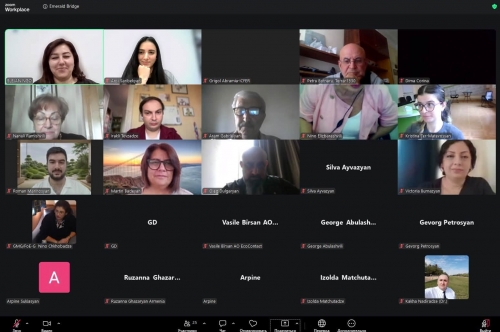
On September 28, the regional kick-off workshop of “The Emerald Bridge: Strengthening Trans-Regional Green Synergy” was held online.
The workshop presented the programme’s objectives and expected outcomes, the priorities of the working group and expectations for the 17th meeting of the Conference of the Parties to the UN Convention on Biological Diversity (COP17), as well as the COP17 agenda, side events, preparatory work by Armenian NGOs, and details of the draft Global Review of the Kunming-Montreal Global Biodiversity Framework.
Representatives of Armenia, Georgia and Moldova participated in the discussion on COP17.
Objectives and Main Areas of “The Emerald Bridge” Programme
Liana Asoyan, Founding President of Blejan Environmental, Social and Business Support NGO, presented the objectives and main activities of “The Emerald Bridge” programme.
The project is implemented by the "BLEJAN" Ecological, Social and Business Support NGO, with financial support from the European Union and the German Marshall Fund of the United States' "Transatlantic Foundation" (GMF TF), in cooperation with partner organizations: "Research-Intellectual Club Dialogues of Generations" (RICDOG) from Georgia and the "Terra-1530" NGO from Moldova.
According to Liana Asoyan, President of Blejan Environmental, Social and Business Support NGO, civil society organisations in the three countries have valuable experience and knowledge in the fields of environmental protection, biodiversity, sustainable energy, climate and public participation. However, more sustainable and structured mechanisms are needed to facilitate the exchange of this experience and cross-border cooperation. The “Emerald Bridge” programme was developed to address this gap.
The programme aims to establish a mechanism for continuous regional cooperation among civil society organisations in Armenia, Georgia and Moldova. It envisages online thematic meetings, the exchange of best practices and practical tools among the three countries, the establishment of cross-border thematic subgroups, and study visits to Armenia and Moldova.
COP17, to be held in Armenia, is also an important component of the programme. Participants will have an opportunity to present the experience and perspectives of civil society from different countries within the framework of the conference and discuss common issues related to biodiversity conservation.
The programme is expected to result in a joint policy brief containing practical recommendations that will reflect a shared vision of civil society in the three countries and could serve as a basis for further action at national and regional levels.
Liana Asoyan emphasised that the programme is not aimed merely at exchanging information over the coming months, but at establishing cooperation among the civil societies of the three countries that will continue beyond the completion of the programme.
The heads of the three working groups of the Eastern Partnership Civil Society Forum from Armenia, Georgia and Moldova then delivered presentations on their countries’ priorities and expectations related to COP17.
Victoria Burnazyan, Vice President of EcoLur Informational NGO, gave a presentation on COP17 to be held in Armenia.
COP17 as a Platform for Global Biodiversity Decisions
According to Victoria Burnazyan, recommendations for the work of the COP are provided by the Convention’s subsidiary bodies, including the Subsidiary Body on Implementation (SBI), the Subsidiary Body on Scientific, Technical and Technological Advice (SBSTTA), as well as the subsidiary body dealing with Article 8(j) of the Convention and other provisions concerning Indigenous Peoples and local communities.
The Blue Zone will be the main official and diplomatic negotiation venue for COP17 in Yerevan and will be located at the Meridian Expo Centre. The Green Zone is intended to mobilise civil society, communities, academic and educational organisations, and businesses and will be located at the Karen Demirchyan Sports and Concert Complex.
COP17 Agenda
Victoria Burnazyan informed the participants that a Leaders’ Summit hosted by the Government of Armenia, forums for major stakeholder groups, side events and workshops are scheduled for October 15–16. The opening ceremony is scheduled for October 18, while the main COP17 proceedings will take place from October 19 to 30. The high-level ministerial segment is scheduled for October 27–28.
Seven parallel events are also planned during COP17: the Business and Biodiversity Summit, Nature and Culture Summit, Youth Summit, Science Summit, Cities Summit, Women’s Forum and Finance Day.
Dedicated thematic days will focus on invasive alien species; water and biodiversity; oceans; the 30x30 target; transformative change; mountain ecosystems; National Biodiversity Strategies and Action Plans; education; agriculture and food systems; and ecosystem restoration
Four Main Priorities of COP17
In her presentation, Victoria Burnazyan highlighted four main priorities of COP17:
Global Review — progress in implementation and accountability;
Finance and digital sequence information — financing, the Cali Fund and benefit-sharing;
Participants — Indigenous Peoples, communities and stakeholders;
Synergies — biodiversity, climate, land and water.
According to her, one of the key draft decisions to be discussed at COP17 concerns the first Global Review of the implementation of the Kunming-Montreal Global Biodiversity Framework. Countries are expected to review their actions aimed at biodiversity conservation and sustainable use in order to assess progress, identify gaps and evaluate the effectiveness of measures being implemented.
The 30x30 Target and the Global Review
The Kunming-Montreal Global Biodiversity Framework aims to halt and reverse biodiversity loss. The Framework sets the goal of effectively conserving and managing at least 30% of the world’s terrestrial, inland water and ocean areas by 2030. Each Party to the Convention has committed to placing 30% of its territory under conservation.
According to the SBI report on the Global Review, 129 out of 196 countries have submitted national reports. At the same time, fewer than half of the national targets corresponding to any of the global targets have been assessed as being on track. The report notes that means of implementation remain below the level required for the full and effective implementation of the Framework, particularly for developing countries, including least developed countries and small island developing states.
According to the document, Indigenous Peoples, communities and groups representing persons with disabilities face challenges related to limited resources and technical capacities, access to information and knowledge, effective participation, and coordination mechanisms.
At the same time, issues related to access to information and justice; rights to land, territories, resources and traditional knowledge; protection of environmental and human rights defenders; and gender-responsive biodiversity governance have been less reflected in national targets.
According to the document, unless collective implementation is accelerated through expanded international cooperation, improved actions and efforts, and strengthened means of implementation, the 2030 targets and mission will not be achieved.
The document also stresses the need to address gaps and challenges in the implementation process. It emphasises that failure to achieve the Framework’s 2030 targets could jeopardise its 2050 goals and vision.
During the online workshop, Victoria Burnazyan also shared useful tools and platforms created by EcoLur Informational NGO ahead of COP17, including:
“Guide to Civil Society Participation in the 17th Meeting of the Conference of the Parties to the UN Convention on Biological Diversity (CBD COP17)”
“Civil Society’s Voice at CBD COP17 / Քաղաքացիական հասարակության ձայնը՝ CBD COP17-ին” Facebook platform.
October 07, 2026 at 16:56