
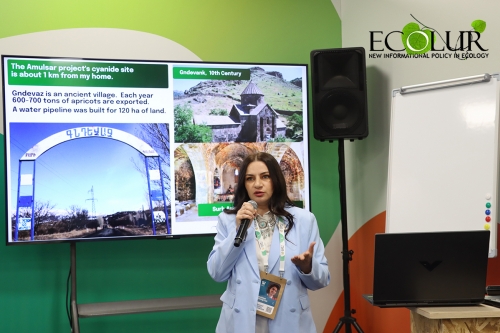
The Green Zone at the 17th meeting of the Conference of the Parties to the UN Convention on Biological Diversity (CBD COP17), currently taking place in Yerevan, has become a platform for bringing the environmental challenges facing Armenian communities to international attention. At the official event “Communities as Guardians and Sustainable Users of Biodiversity,” held on October 21 and initiated by EcoLur Informational NGO in partnership with the Fridtjof Nansen Institute and the Norwegian Agency for Development Cooperation, representatives of communities affected by development projects presented their biodiversity conservation strategies and demands.
Jermuk Community was represented by Tehmine Yenokyan, a Gndevaz resident and President of Green Armenia NGO. In her speech, she addressed the community’s vast natural resources, which are now under threat from Amulsar gold mining project.
“Jermuk is home not only to enormous potential as a health resort, but also to an ancient historical and cultural heritage and rich biodiversity. However, Jermuk’s ecosystems remain vulnerable to human-induced and industrial pressures,” Tehmine Yenokyan said.
Historical Heritage and Tourism Infrastructure
As early as the Middle Ages, the princely dynasties of the Orbelians and Proshians used Jermuk’s hot springs for therapeutic purposes and recreation. The ancient village of Gndevaz is an integral part of the area’s heritage. It is home to Gndevank Monastery, dating back to the 10th century, and the Church of St. Astvatsatsin, built in 1686.
Modern development in Jermuk began in the 1930s and 1940s. In 1970, the town was granted the status of an all-Union health resort.
Today, the community has seven sanatoriums, 30 hotels and other accommodation facilities, a mineral and non-mineral water bottling plant, and a cable car. Gndevaz has significant agricultural potential, exporting 600–700 tonnes of apricots annually. Gndevaz and Kechut together have approximately 180 hectares of orchards, including apricot, sweet cherry, cherry, walnut, peach, and plum trees.
“Through the efforts of the Green Armenia NGO, with support from the UNDP/GEF Small Grants Programme in 2023–2025, the Armenian government’s subsidy programme, and co-financing from Jermuk’s municipal budget, the irrigation system was expanded, bringing 120 hectares of previously unirrigated land under irrigation. This project could have encouraged agricultural investment and the establishment of new orchards. This was particularly important because it could have helped create an economic counterweight to Amulsar mining project for Gndevaz community,” Tehmine Yenokyan said.
She noted that Jermuk is surrounded by forests. In addition to native tree species, poplars and firs were planted in the area in the 1950s, the 1980s and 1990s, and in 2011.
Due to its rich biodiversity, the Jermuk Emerald candidate site has been designated in the area and is under the protection of the Bern Convention. The site is notable for red-listed species, including the bezoar goat, brown bear, apricot-coloured cinquefoil (Potentilla porphyrantha), Apollo butterfly, Armenian viper, and others.
Challenges Facing Jermuk Community and Obstacles to Development
Speaking about the challenges facing the community, Tehmine Yenokyan highlighted the risks associated with the Amulsar gold mining project. She said that the cyanide leach pad planned as part of the Amulsar project would be just one kilometre from her home.
Risks Associated with Amulsar Gold Mine
· Contamination of surface water and groundwater in the region due to acid rock drainage.
· Acidification of the Kechut and Spandaryan reservoirs.
· Impacts on Lake Sevan through the Vorotan–Arpa tunnel system.
· Impacts from dust on approximately 180 hectares of orchards around Gndevaz and Kechut.
· Impacts on the health of community residents.
· Damage to the Jermuk brand, its health-resort status, and its tourism potential.
Amulsar is located in a critical water-generating area encompassing the Arpa and Vorotan rivers, Kechut and Spandaryan reservoirs, and more than 100 springs.
According to the speaker, public and professional opinion holds that several laws and international conventions have been violated, including:
· The Law on Lake Sevan,
· The Law on Flora,
· The Subsoil Code,
· The Law on Environmental Impact Assessment and Expertise,
· The Aarhus Convention,
· The Bern Convention,
· The Minamata Convention.
Struggle to Save Amulsar (2011–2026)
A group of Gndevaz residents, together with two non-governmental organizations, challenged in court the documents authorizing the Amulsar project. Following nine years of legal proceedings, the Administrative Court largely upheld the claim in 2024. The opposing party appealed the ruling to Appeal Court. From December 2024 until today, Appeal Court has not issued its ruling. The date for announcing the decision was postponed from September to November, thereby avoiding the period of COP17. Meanwhile, Prime Minister Nikol Pashinyan announced the launch of operations at Amulsar, disregarding professional and expert opinions.
Civil society has filed a complaint concerning Amulsar project with the Office of the Compliance Advisor Ombudsman (CAO) of the International Finance Corporation (IFC), part of the World Bank Group, and with the Independent Project Accountability Mechanism (IPAM) of the European Bank for Reconstruction and Development (EBRD). A complaint has also been submitted to the Secretariat of the Bern Convention. The Bureau of the Bern Convention has called on the Government of Armenia to conduct a new environmental impact assessment (EIA) and review.
The article was prepared within the framework of “Supporting Armenia's CBD COP Presidency and Domestic Implementation” implemented by EcoLur Informational NGO in cooperation with the Fridtjof Nansen Institute, with support from the Norwegian Agency for Development Cooperation (Norad).
The views expressed within the framework of the project do not necessarily reflect those of the Fridtjof Nansen Institute.
October 23, 2026 at 23:19