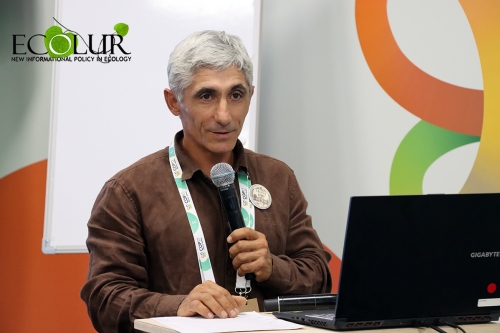
With the aim of ensuring that local communities’ voices are heard by decision-makers on ecosystem conservation, a session entitled “Communities as Biodiversity Conservers and Sustainable Users” was held on October 21 in the Green Zone of the 17th meeting of the Conference of the Parties to the UN Convention on Biological Diversity (COP17). The session was organized through cooperation between EcoLur Informational NGO and the Fridtjof Nansen Institute, with support from the Norwegian Agency for Development Cooperation.
Representatives of Armenian communities delivered presentations addressed to international and national institutions, highlighting environmental crises and alternative development pathways.
Tigran Matevosyan, a representative of Armash settlement in Ararat Region and President of “Armash Rural Communities Support and Development Center” NGO, presented a development model for Armash.
Located in the southern part of the Ararat Plain, Armash has a distinctive geographical position where aquatic, wetland, arid, and mountainous landscapes converge. This unique combination has made Armash one of Armenia’s most important bird areas.
Over 200 Bird Species and an Ecological Corridor
In his presentation, Tigran Matevosyan emphasized the vital importance of Armash’s fish-farming ponds, salt flats, and reed beds within its land area.
· Over 200 of the approximately 353 bird species recorded in Armenia occur in Armash’s wetlands.
· The area is home to 45 bird species included in Armenia’s Red Data Book. These include the white-headed duck, which is red-listed in both Armenia’s Red Data Book and the International Union for Conservation of Nature (IUCN) Red List as an endangered and threatened relict species.
Beyond its birdlife, the nearby Urts Mountain Range, which borders the Khosrov Forest State Reserve, serves as a vital ecological corridor for the movement of Red Data Book species, including mouflon and bezoar goats, toward Vayots Dzor and other areas. Due to its exceptional biodiversity, Armash is included in the list of candidate Emerald Network sites under the Bern Convention as “Khor Virap–Armash,” covering approximately 6,998.2 hectares. Armenia is currently considering whether to submit the Khor Virap and Armash sections as separate candidate sites.
Challenges: Drying Lakes and Illegal Hunting
According to the speaker, Armash’s ecosystem faces serious challenges:
1. Changes in the aquatic environment: A real risk of lakes drying up.
2. Illegal hunting (poaching): A direct threat to populations of rare and protected species.
3. Burning of reed beds: Uncontrolled fires destroy bird nesting sites and habitats.
“Ecoashkharh”: Community Initiative
As a practical measure, Tigran Matevosyan presented “Ecoashkharh” initiative he established. Having witnessed the threats facing local birdlife, he created a safe ecological environment spanning approximately six hectares. It includes a tree belt, a pond, a marsh, and a birdwatching tower, and hunting is prohibited within the area. This demonstrates that biodiversity conservation can and should begin with initiatives led by local residents themselves.
10-Point Strategy for Armash’s Development
Armash’s proximity to Yerevan creates opportunities for developing birdwatching, educational programs, and ecotourism. To realize this potential, the speaker proposed ten interconnected steps:
1. Conduct a new, comprehensive baseline biodiversity assessment.
2. Establish a long-term bird monitoring system.
3. Monitor water quality regularly.
4. Create an integrated GIS database on biodiversity and aquatic areas.
5. Develop a community environmental education program for young people.
6. Implement a pilot program for supervised birdwatching.
7. Train local nature guides (eco-guides).
8. Explore the possibility of establishing “Armash Biodiversity Center.”
9. Develop green entrepreneurship, including ecotourism and local products.
10. Direct part of the economic benefits generated by ecotourism toward nature conservation.
“The lakes, birds, reed beds, salt flats, and Urts Mountain Range are the natural capital of our community. If we can conserve biodiversity today, it can create new development opportunities tomorrow,” Tigran Matevosyan concluded.
The article was prepared within the framework of “Supporting Armenia's CBD COP Presidency and Domestic Implementation” implemented by EcoLur Informational NGO in cooperation with the Fridtjof Nansen Institute, with support from the Norwegian Agency for Development Cooperation (Norad).
The views expressed within the framework of the project do not necessarily reflect those of the Fridtjof Nansen Institute.
October 22, 2026 at 16:58