
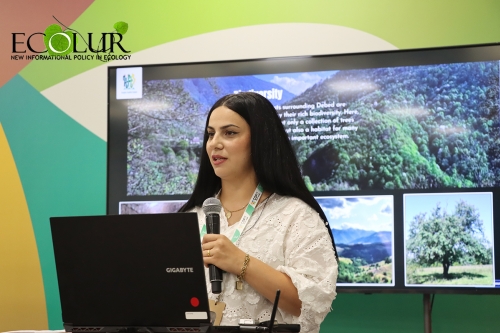
Against the backdrop of global environmental challenges, an official session entitled “Communities as Biodiversity Conservers and Sustainable Users” was held in Yerevan on October 21 to highlight the role of local communities. The event, held in the Green Zone of the 17th meeting of the Conference of the Parties to the UN Convention on Biological Diversity (CBD COP17), was initiated by EcoLur Informational NGO in partnership with the Fridtjof Nansen Institute and the Norwegian Agency for Development Cooperation.
At the meeting, Anush Sargsyan, Administrative Head of Debet settlement in Pambak Community, Lori Region, presented the interconnected and vital issues of forest ecosystem conservation and community well-being.
Debet is a high-altitude settlement surrounded by forests. According to Anush Sargsyan, the forests surrounding the settlement are essential not only for biodiversity conservation but also for local residents’ livelihoods and well-being, as well as for expanding economic opportunities.
Forest ecosystems provide habitats for numerous plant and animal species, regulate water flows, help conserve soil, and mitigate the impacts of climate change. They also create opportunities for ecotourism, environmental education, local production, and green job creation.
Forests are also socially important to Debet: residents have traditionally relied on firewood to heat their homes in winter and collected wild berries and fruits.
“The experience of Debet demonstrates that forest ecosystem protection must go hand in hand with improving the energy efficiency of homes, creating affordable heating alternatives, and implementing community-based biodiversity conservation initiatives,” Anush Sargsyan said. According to her, Debet and other forest-adjacent settlements face the challenge of balancing the conservation of forest resources with residents’ essential needs.
For many families, firewood remains the primary—and in some cases the only accessible—means of heating their homes in winter. At the same time, a significant proportion of rural homes need improved energy efficiency and thermal insulation. As a result, more firewood is required to heat these homes.
According to Anush Sargsyan, the relatively high prices of electricity and natural gas also limit residents’ ability to use them for heating. Under these circumstances, forest conservation policy cannot be limited to regulating the use of forest resources. “We cannot ask people to give up firewood if we do not offer them affordable alternatives.” This idea captures the central message of her presentation.
Climate Change Increases Vulnerability of Forest Ecosystems and Settlement
According to Debet residents’ observations, climate change-related problems have become more frequent in the settlement in recent years.
Unpredictable and intense precipitation leads to flooding, soil erosion, and mudflows. Fallen and damaged trees in forests sometimes obstruct water flows, increasing the risks to the settlement.
Temperature changes, longer periods of drought, and the increasing frequency of hazardous hydrometeorological events place additional pressure on forest ecosystems.
These challenges require coordinated action not only to protect forests but also to restore them, adapt to climate change, and strengthen community resilience.
According to Anush Sargsyan, programs aimed at climate change adaptation and strengthening community resilience have been implemented in Debet in recent years. Nevertheless, improving residents’ housing conditions and energy efficiency remains an urgent issue.
Among the possible solutions, Anush Sargsyan highlighted home insulation, improved energy efficiency, greater access to solar energy and other renewable energy solutions, and financial assistance for households.
“Such measures can simultaneously reduce household heating costs and ease the pressure on forest resources,” Anush Sargsyan said.
Return of Red Deer: Example of Biodiversity Conservation
Speaking about positive achievements, Debet’s administrative head presented the successful red deer restoration program. In recent years, the community has actively participated in protecting deer released into the region’s forests as part of the program. According to Anush Sargsyan, Debet residents monitor the animals’ safety, alert specialists when necessary, and assist animals that are injured or in distress. The speaker also noted that the absence of hunting pressure in the region creates favorable conditions for wildlife.
“The effectiveness of environmental programs depends not only on the measures implemented but also on local residents’ awareness, responsible attitudes, and cooperation with specialists,” Anush Sargsyan said.
Forest Conservation as Prerequisite for Sustainable Development
The example of Debet raises an important question for forest-adjacent settlements: how can natural ecosystems be protected while ensuring that people’s essential needs are met?
Achieving long-term results in forest conservation requires combining several approaches:
· Raising residents’ environmental awareness.
· Improving the energy efficiency of homes.
· Developing affordable alternative heating options.
“The forest is not merely a means of supporting our livelihoods today; it is the future of our children,” the representative of Debet concluded.
The article was prepared within the framework of “Supporting Armenia's CBD COP Presidency and Domestic Implementation” implemented by EcoLur Informational NGO in cooperation with the Fridtjof Nansen Institute, with support from the Norwegian Agency for Development Cooperation (Norad).
The views expressed within the framework of the project do not necessarily reflect those of the Fridtjof Nansen Institute.
October 22, 2026 at 17:40