
Lragir.am
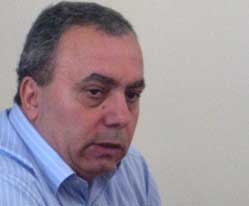
Recently, international financial structures often dwell on Armenia's mineral industry, noting that there are shadow and tax issues in this sphere. In this regard we turned to Armenia's former Prime Minister Hrant Bagratyan asking a few questions in this connection.
Hrant Bagratyan said that in the Armenian mineral industry a complete chaos reigns. The point is that in 2002-2009 Armenia urgently privatized all the major mines but their form of government, taxation mechanisms, and the relationship between the employers, the state and the budget remained the same. In other words, the annuity is still administered by employers. When they were not yet privatized, for example, 10-12 years ago, there was no problem, because everything was left to the state, that is to the society. After privatization, the income is owned by the employer, whereas it should be addressed to the public.
Hrant Bagratyan explained what he means by saying annuity. He in particular brought the example of the Kajaran cooper-molybdenum plant saying that the factory has been privatized but the subsoil, mine, molybdenum belong to the public. The society is to set in the concession agreement the price per 1 point ore to be sold to the plant. This is the annuity. According to Hrant Bagratyan, the question is that no one wonders whether the society gave the right to a mine owner to overdo the plan for example by two thousand tones.
Hrant Bagratyan says that this is a new issue because the mines were privatized during Robert Kocharyan’s tenure. Bagratyan says that the opposition, in particular the HAK, came out to have assumed the duty of solving these issues. The mining taxation issue was one of the most important issues of the 2008 presidential program of the opposition leader (RA first president). In addition, Bagratyan says, this question is a key issue of 6 months ago released “100 steps” program of the opposition. In particular, the 15th paragraph of the program reads: “In mining industry (molybdenum, copper, limestone, tuff, basalt, iron, gold, etc.) the charge for natural resources should be removed. Instead, every year it is necessary to establish the actual cost of the mine with the budget, for the operator to buy it from the society. In this way it will be possible to combine the tax mechanism with the change of global prices of raw materials. Determined by the dynamics of the global prices, the mining company must pay to the budget the income exceeding the state price”. According to Bagratyan, this will give additional 1 billion per year to the budget.
Bagratyan says that currently this sphere is not taxed. The state really does not take money for the subsoil. There are currently 2 types of fees / taxes: The first is for use of natural resources and environmental protection. It is paid by the employer. In 2008 in this state budget it amounted to 9.9 billion drams, and in 2009- 6.1 billion drams. In fact this has nothing in common with the true annuity, with the mine public price. First, it is 2.5 percent of the expected annuity. Second, the cost is calculated by the method of expenditure. They pay so much to restore the nature ruined as a result of the operation of the mine. Bagratyan says there is no such a thing in the world for long. Third, the royalties. It is assumed that in case of super profits, the miner, employers will have to face additional taxes.
In answer to the question how it is presumed that 1 billion should be paid, the Armenian former prime minister said that it is simple calculation. From the income from sale of minerals for example Libya takes 92 percent, Indonesia, 83, Russia 78, Norway, 74, Alaska, 60, Venezuela 58, Canada 55, Britain 50 percent. Armenia takes ... 21 percent, if we taking the cost of mining the state figure…2 percent, proceeding from our evaluation of the value. In Armenia, every year (2008), 8769 tons of molybdenum concentrate, 71307 tons of copper concentrate, 7467 tons of zinc concentrate, ferromolybdenum 5323 tons is produced, while for all of this volume at current prices, NSS gives 76.8 billion (192 million dollars). Only ferromolybdenum by Bloomberg prices (pre-crisis) amounts to 800 million Dollars. The volume of construction was 576 billion. Can you imagine, sand, stone, natural stone, cement raw materials, etc. cost only 1.3 percent of construction?
In response to the question why it is not possible to increase the existing fees of nature protection, to toughen royalties, Hrant Bagratyan said that under market conditions, when the mines are state and the operators are private, taxes and fees should be set based on income rather than consumption. For example, pure iron factory, Armenia Molybdenum Production, based on the press, a shareholder of this company is also R. Kocharyan: he produces and sells 5300 tons ferromolybdenum, at 50-150 dollar per kg, and the self-cost is 3-5: the man sells enriched ore at super cheap prices to foundries, and sells outside at remarkably high prices. In other words, putting low price on the ore, he renders the nature annuity production profits. By the way, today the above-mentioned plants bring to their owners 12-20 million dollars monthly.
As to what other measures could be taken to regulate thee current wild exploitation of the nature, besides the tax changes, Bagratyan said that in many cases it is necessary to implement structural measures. For example, in the last decade (1999-2009) shores of Lake Sevan were privatized. In general, shores are not due to privatization; abroad, people can enter any beach for free, to bathe or rest. Payment is only when there is some property of any company on the beach. Our people, privatized right the beach, the lake and the water are not yet privatized. Hrant Bagratyan says that only a power formed through legitimate elections can adjust the situation.
July 23, 2010