
Ruben Grdzelyan, Golos Armenii
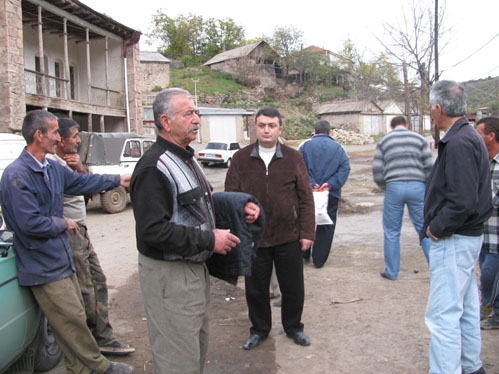
The other day "EcoLur" Informational NGO held the discussion of the published booklet "Environmental and Social Profile for Deno Gold Mining Company’s Operation in Armenia". Almost all the stakeholders took part in this meeting.
It should be noted that the main and scientifically substantiated evidence for outrageous situation in the regions refer to the monitoring conducted in 2007 by the Center for Noospherical Studies of the National Academy of Sciences of RA. "EcoLur" President Inga Zarafyan tends to refer this situation with Deno Gold Mining Company’s operation. The latter used the Artsvanik tailing belonging to Zangezour Copper and Molybdenum Combine.
Deno Gold representatives did not dispute their guilt, but pointed out another fact. Deno Gold Mining Company’s PR Manager Norayr Aghayan drew attention to the fact, that the tails contain no molybdenum, whereas the molybdenum content in Syunik soil exceeds the maximum permissible concentration by 4 times. Moreover, Artzvanik tailing, the largest tailing in Armenia, belongs not to them but to Zangezour Copper and Molybdenum Combine. Besides, being located in Kajaran Zangezour Copper and Molybdenum Combine uses the whole infrastructure in Kapan, i.e. this giant in Kajaran is also to blame for this situation. Tigran Stepanyan, the representative of “Anticorruption Center” located in Kapan (apparently feeling sympathy for Deno Gold), got the implication and addressed a question to “EcoLur” President: “Why is only Deno Gold Mining Company’s operation taken as a basis when studying the environmental situation in Kapan Region?” Inga Zarafyan explained this as follows: SOS signal was received due to this very company’s operation.
"We reclamated our part of the Artsvanik tailing in accordance with such standards having never applied before for the conservation of any tailing in Armenia,” said Hasmik Mkrtumyan, Deno Gold Mining Company’s Engineer-Ecologist, “What about the Geghanush tailing from where toxic dust was spread all over Kapan during many years, we completely inundated it with water: thus this phenomenon is excluded. Besides, here we use a closed cycle for whirlpool, which is also an exclusive procedure in Armenia. What about the impact of soil pollution with heavy metals on people, nobody studied or proved this".
The Chairman of the “Greens Union of Armenia” Hakob Sanasaryan interfered in the discussion. "The matter is not only the quality of wastes management. The matter is that our laws are impermissibly liberal: companies can produce as much wastes as they want to. Companies make no environmental payments for the volumes of their tails. As a result, it turns out that in any case dozens of million tons of harmful substances, no matter to what extent you store them in a correct and cost-based manner, have impact on people, agriculture and nature".
We have neither legislation, nor established standards for maximum permissible concentration to determine soil pollution with heavy metals. The Ministry of Nature Protection of RA conducts monitoring of water resources and urban environment only. Nowadays when one speaks about maximum permissible concentration of metals in soil, the Soviet standards are taken as bases which are at present officially not recognized, i.e. these standards merely don’t exist for our country! One can check the water that contains compounds of heavy metals from the tailings, galleries and open mines or dumps, but to check the soil is impossible.
In this regard it would be strange to listen to officials’ reasoning. Head of Information Centre of the Ministry of Nature Protection of RA Gagik Hovhannisyan suggested applying to the deputies in regard with laws and not to waste executive bodies’ time. Would you believe this! We thought that the Armenian Constitution gives officials an opportunity to put forward legislation initiatives.
"The deplorable situation in Kapan Region is not the result of one day,” states Expert Sergey Arevshatyan who took part in the monitoring conducted by the academic center three years ago: “Whole Kapan is situated on ages-old mines, dumps and processed rocks. To determine precise situation we need alternative and comprehensive information about the extent of environmental pollution and mining industry environmental impact".
In any case "EcoLur" titled its booklet in a very correct manner "...in Armenia", as the Armenian images of most responsible foreign companies significantly differ from their images in other countries.
January 26, 2010