
http://bankwatch.org/sites/default/files/PipeDreams-LukOil-21Jan2015.pdf
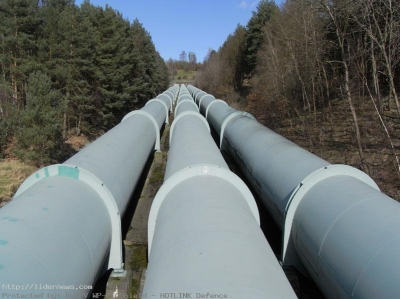
After years of discussions about diversifying Europe’s gas supply to reduce dependence on Russian imports, during the last year the EU has prioritised the Southern Gas Corridor or Euro-Caspian Mega Pipeline, as it has been dubbed by civil society groups. Estimated at USD 45 billion, this chain of projects would bring gas to Europe from the Shah Deniz offshore gas field in Azerbaijan, owned by BP, Russia’s Lukoil, and Azerbaijan’s SOCAR, among others.
The corridor would pass through Georgia, Turkey, Greece, Albania and Italy to other EU markets, and consist of the South Caucasus Pipeline extension (SCPx), Trans-Anatolian Pipeline (TANAP), Trans-Adriatic Pipeline (TAP) and other branch lines. Later it may also include the Trans-Caspian Pipeline (TCP), which would enable the export of Turkmen gas to the EU.The preference for the Southern Gas Corridor has been given additional bearing by the conflict between Ukraine and Russia, and although the projects are mostly carried out by private sector companies (except SOCAR which is owned by the state of Azerbaijan), the EU looks set to take on many of the risks: the Southern Gas Corridor will be backed with public money via the connecting Europe Facility, potentially the European Investment Bank (EIB) and the Project Bonds Initiative, and indirectly via a loan by the European Bank for Reconstruction and development to Lukoil for the second phase of developments at Shah Deniz, a loan set to be approved in early 2015. Export credit agencies from EU countries may also back the Corridor.
This brings financial risks for the EU and its Member States, which could end up costing taxpayers, gas consumers, and the people in exporting and transit countries. If new gas import infrastructure is the wrong answer, it is partly because the wrong questions are being asked. someone who asks “How much energy can we save? How do we do it? What does it cost? Down to what level can we reduce our energy demand?” and works to achieve these goals will end up saving energy. Someone who asks “From which country can we get gas that isn’t Russia?” will end up dancing with repressive regimes of all shades like those in Azerbaijan, Turkey and Turkmenistan, and looking around for money to pay for expensive pipeline projects.That the EU has not prioritised energy savings sufficiently is epitomised by the recent disappointing, non-finding energy efficiency target of 27 percent by 2030. But even if this target is accepted as sufficient, the EU has not sufficiently analysed how much gas is really needed in a decarbonised EU. It has prioritised a whole series of huge gas import projects in its list of Projects of Common Interest (PCIs), of which the Southern Gas Corridor is the largest, but its own Energy Roadmap 2050 shows that we simply do not need so much gas during the coming decades if the EU is to
reduce its use of fossil fuels. The impact assessment for the adoption of energy efficiency targets for 2030 show the same thing.
The full article you can find here.
January 28, 2015 at 14:22