
EcoLur
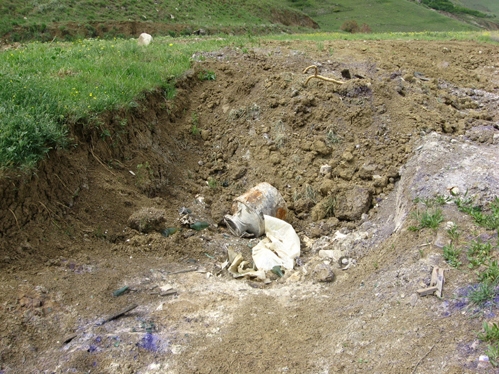
According to Mushakan villagers, the toxic cloud from Voghjaberd Waste Burial Ground has spread 10 kilometers away from it. Mushakan is a village located on this very distance from notorious Voghjaberd Waste Burial Ground. “Our wives went to gather spring herbs in the direction of the waste burial ground. They felt some heavy smell and returned saying something was wrong there. And the hill doesn’t look like it used to,” said Sveta Aslanyan, Mushakan Administration Head, “later a cow pasturing near the waste burial ground died in our village.” Getting worried Sveta Aslanyan applied to Erebouni Community of Yerevan City and also connected with the administration of the neighboring village. And only recently she received information from Erebouni Sanitary and Epidemiologic Inspection that villagers should behave more carefully, not to gather any herbs near the waste burial ground or to pasture their cows.
In her interview with EcoLur “Women for Health and Healthy Environment” NGO Executive Director Lilik Simonyan said the survey results of Mushakan and Verin Jrvezh villagers, as well as Verin Jrvezh holiday villagers showed that Mushakan villagers felt the smell, but they didn’t realize where it came from as many villagers were not aware of waste burial ground itself. “We think that measures on promoting population awareness should have been taken long ago, but state bodies are slow to act,” Lilik Simonyan said. The organization possesses the expert opinion provided by the Center for Ecological Noosphere Studies of the National Academy of Sciences of RA dated on 17 April 2010. Under preliminary data, the samples taken from the surface of the waste burial ground contain high concentrations of arsenic, mercury, DDT, hexachlorocyclohexane and phosphorus oxides.
Unfortunately, the state bodies keep on preserving amazing calmness in regard to the waste burial ground despite the opinion provided by OSCE International Expert John Vijgen characterizing the situation as an environmental disaster.
It should be noted under the Aarhus Convention ratified by Armenia in 2001, authorized parties in this case the Ministry of Nature Protection of RA and the Ministry of Health of RA are obliged to disseminate information among population about current risks and to urgent measures to reduce these risks. This is what international practice implies what both ministries are well informed about when actively participating in many international forums, conferences and projects, though they frequently don’t represent what is going on in their own country.
April 27, 2010