
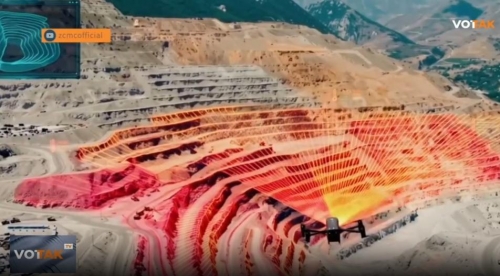
The international broadcasting center of Polish public broadcaster TVP has produced a special report on Armenia’s mining sector, highlighting the stark contrast between the potential economic benefits of mineral resource extraction and the actual damage inflicted on the environment and local communities.
While enormous financial wealth is being transferred out of the country, the devastating consequences remain in Armenia: tailings storage facilities, contaminated water and soil, and direct threats to human health and lives.
Inga Zarafyan, President of EcoLur Informational NGO, described the situation in communities affected by mining operations. As an example, the environmentalist cited cases in which a farmer’s cow became seriously ill after drinking water from a tailings pond, while a child who entered the same contaminated water experienced severe skin peeling.
“Many things have become irreversible. We have dead rivers,” Zarafyan stated, adding that although modern technologies for pollution prevention and remediation are available, their application is still not considered a priority by the government, nor is it mandated for mining companies.
According to mining industry expert Georgi Mirzakhanyan, Armenia’s mineral resources are exceptionally rich in polymetallic ores, uranium, and rare metals, with an estimated total value of up to $15 trillion. Based on the expert’s calculations, if this wealth were distributed equitably, each citizen could potentially receive around $50,000 annually. However, these resources are not contributing to public welfare for several fundamental reasons:
- Mining companies are predominantly registered in offshore jurisdictions and do not provide the state with transparent information, while the government is unable to obtain information from offshore banks.
- Armenia lacks a specialized accredited laboratory capable of accurately assessing the actual quantities and value of extracted mineral resources.
- Armenia is one of the few countries engaged in mining and metallurgy that has not adopted international legislation on production sharing.
According to experts, the primary cause of the current situation is an inadequate legislative framework. The constitutional provisions governing the ownership of subsoil resources have been amended twice, weakening governance of the sector. As a result, comprehensive legislative reforms have become an urgent necessity to ensure strict state and public oversight of mining activities.
November 19, 2026 at 11:49