
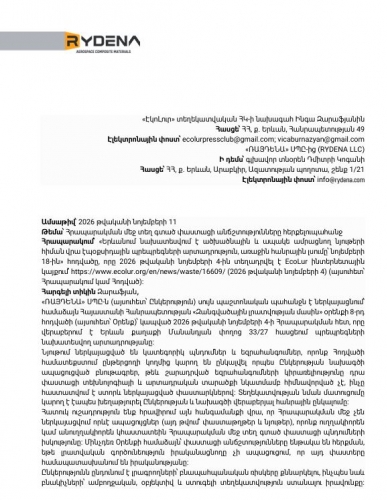
Dmitry Kogan, General Director of RAYDENA LLC, has sent a letter to EcoLur Informational NGO demanding a retraction of the information concerning environmental risks published in the November 4 article on www.ecolur.org titled “Production of Epoxy Prepregs Based on Carbon and Glass Reinforcement Materials Planned in Yerevan; First Public Hearing Scheduled for November 18.”
As a reminder, the production of epoxy prepregs based on carbon and glass reinforcement materials is planned at 33/27 Manandyan Street in Yerevan’s Shengavit Administrative District. The initiator of the proposed activity is RAYDENA LLC. The first public hearing will take place on November 18, 2026, at 11:00 a.m. at the office of Head of Yerevan’s Shengavit Administrative District (26 G. Nzhdeh Street, Yerevan).
It should be noted that, at the time the article was published, an online search, including a search of the official website of Yerevan Municipality, did not locate RAYDENA LLC’s project documentation for examination. Therefore, the article explicitly stated, “Information available online concerning similar enterprises indicates,” before presenting risks typically associated with such facilities, including sanitary protection zone requirements, the spread of air pollution, explosion and fire hazards, noise, and hazardous waste that is difficult to manage.
Below, we reproduce in full the letter by Dmitry Kogan, General Director of RAYDENA LLC.
“Subject: Demand for Retraction of Factual Inaccuracies Contained in the Publication
Publication: The article titled ‘Production of Epoxy Prepregs Based on Carbon and Glass Reinforcement Materials Planned in Yerevan; First Public Hearing Scheduled for November 18,’ published on the EcoLur website on November 4, 2026, at https://www.ecolur.org/en/
Dear Mrs. Zarafyan,
RAYDENA LLC (hereinafter referred to as the Company) hereby submits this formal demand pursuant to Article 8 of RA Law ‘On Mass Media’ (hereinafter referred to as the Law), in connection with the Publication dated November 4, 2026, concerning the proposed prepreg production facility at 33/27 Manandyan Street, Yerevan.
The Article contains categorical statements and conclusions which, in the context of the Article, readers may perceive as established characteristics of the Company’s project, although the applicability of these conclusions to its actual technology and production site has not been substantiated, as demonstrated by the arguments presented below. Such presentation of information may significantly distort public perceptions of the Company and its project.
We draw particular attention to the fact that the Publication provides no evidence, including documents or other materials, that would directly or indirectly substantiate the factual claims made therein. Under the Law, factual inaccuracies are subject to retraction unless the media outlet proves that the information corresponds to reality.
The Company recognizes journalists’ right to discuss environmental risks, as well as residents’ right to receive complete, objective, and verifiable information.
Through this Demand, the Company challenges not the right to criticism, but the presentation of general industry-related assumptions as established facts concerning a specific project. Public discussion of environmental issues requires a distinction between verifiable facts, assessments, and hypothetical impact scenarios.
The Company’s project envisages establishing a high-tech production facility for prepregs (semi-finished composite materials) based on hot-melt epoxy binders, intended for use in advanced industrial sectors such as civil aviation, automotive manufacturing, shipbuilding, and others.
To implement the project, the Company is acquiring state-of-the-art production, laboratory, and engineering equipment from leading international manufacturers. This equipment makes it possible to manufacture prepregs without using solvents or other hazardous volatile substances.
The Company’s production process consists of the following operations: the initial components are measured according to a precise formulation, thoroughly mixed, and heated to a temperature not exceeding 80°C, which is significantly below the boiling or decomposition temperatures of the components. When heated, the mixture becomes more fluid, similar to honey, and the equipment distributes it evenly onto a specialized technical fabric. The environmental advantage of this technology lies in preparing and applying the binder without solvents: the required fluidity is achieved through heating, thereby completely eliminating the use of solvents.
Similar technology is used by leading prepreg manufacturers in Japan, the United States, and the European Union. In particular, materials manufactured using this technology are employed under the European Clean Aviation initiative, which aims to develop ‘green’ aviation through the use of more environmentally sustainable materials and technologies.
For example, the factory of Syensqo, a leading European prepreg manufacturer, located in Heanor, United Kingdom, is situated approximately 100 meters from residential neighborhoods. Moreover, the factory’s production capacity is more than three times that of the Company’s planned facility.
The technologies currently employed by the Company are among the most environmentally sustainable, and all raw materials used comply with the strictest requirements of the European REACH certification system. This enables the Company to establish a production facility with virtually zero emissions of hazardous substances, at levels comparable to the emissions of one to five passenger cars.
Furthermore, the Company is currently undertaking a number of preparatory measures for the future commissioning of the above-mentioned production facility, with due regard for full and comprehensive compliance with the legislation of the Republic of Armenia, including environmental protection legislation. In particular, the Company has commissioned an official environmental impact assessment (EIA) expert examination, the results of which are expected shortly.
1. Subject of the Demand: Factual Inaccuracies Contained in the Publication
1.1. Sanitary Protection Zone and Prohibition on Facility Location
The Publication states: ‘Such production facilities must not be established in the immediate vicinity of residential buildings,’ and specifies a sanitary protection zone of ‘at least 300–500 meters (and sometimes up to 1,000 meters).’
The Article does not cite specific provisions of the legislation currently in force in the Republic of Armenia, provide a technical classification of the Company’s complete production process, or present baseline data concerning the production site that would establish the applicability of these distances to the project in question.
The construction standards of the Republic of Armenia (RA Construction Standards 31-04.01-2024) provide for different types of industrial activities and indicative dimensions of sanitary protection zones. The use of epoxy components and carbon or glass reinforcement materials does not, in itself, determine the sanitary hazard classification. Selecting the applicable provision requires consideration of the quantity of raw materials processed, the technological processes involved in preparing the binder, film formation, impregnation of the reinforcing material, and other actual operations. The Company’s project documentation specifies a particular classification, the final applicability of which must be substantiated by the regulatory characteristics of the process rather than solely by the names of the raw materials.
We demand the publication of a retraction clarifying that the sanitary protection distance of 300–1,000 meters and the alleged prohibition on locating such production facilities are general industry-related information and cannot be presented as requirements already established for the Company’s specific project.
In the event of disagreement, please identify the specific provisions of the legislation currently in force in the Republic of Armenia and the factual data on which the published claim is based.
1.2. Incorrect Description of the Technological Process
The section concerning fire risks uses the expression ‘epoxy resin production’ and discusses uncontrolled reactions during such production.
The Company’s proposed project does not envisage the production of epoxy resins or any other type of resin. According to the technological process outlined in the project, the Company receives the initial components and performs their mixing (binder preparation), binder film formation, and impregnation of the reinforcing material using the hot-melt process.
Under this technology, no solvents are used at any stage of manufacturing the product. This description does not exclude the need for a separate assessment of the environmental impacts of potentially volatile components during the manufacture of finished products and the cleaning of equipment.
Applying the characteristics of the production or synthesis of initial resins to prepreg manufacturing, when no such operations are performed, is technically incorrect.
We demand the publication of a retraction stating that the Company’s project does not envisage the production of epoxy resins.
1.3. Round-the-Clock Operations and Noise
The Publication states that ventilation, drying, and cooling equipment ‘operate around the clock, generating intense industrial noise and vibrations that disrupt residents’ peace and quiet.’
However, the Article provides no information concerning the operating schedules of the Company’s specific equipment, their noise characteristics, the actual locations of noise sources, or calculated noise levels in residential areas.
Since the facility is described as proposed, it is necessary to clearly distinguish between its anticipated operating schedule and an impact that has already been established as fact.
The possibility that certain auxiliary units may operate at night does not mean that the entire production line will operate around the clock, nor does it, in itself, demonstrate that permissible noise levels near residential buildings will be exceeded.
To minimize noise impacts, the Company plans to install all ventilation units on the opposite side of the building, which, taking the building’s height into account, will prevent noise from spreading toward residential buildings.
Any claim concerning noise impacts requires information on the characteristics of noise sources, equipment operating schedules, their layout, and an acoustic assessment.
We demand the publication of a retraction concerning the claims that the Company operates around the clock and that its activities disturb residents’ peace and quiet.
2. Incorrect Attribution of General Risks to a Specific Project
The Article discusses the potential consequences of volatile substances and fiber dust reaching residential buildings and provides examples of solvents and hazardous waste.
Information about potential harmful impacts does not, in itself, mean that such impacts have already been established or are inevitable at the site in question.
An assessment of a specific project involves relevant calculations and evaluations covering the list and quantities of materials used, material balances, actual processing temperatures, potential emission sources, ventilation and filtration system parameters, and pollutant dispersion calculations.
The technology employed by the Company does not envisage the use of solvents, including acetone and toluene, directly in the production process.
At the same time, the characteristics of potentially volatile substances and waste generated during production activities must be assessed and documented.
The Article presents acetone and toluene as general examples. Please clearly state that their actual use by the Company has not been established by the Publication.
If information concerning similar production facilities was used, please disclose how their formulations, production methods, temperatures, and operations are comparable to the technology proposed for the project in question.
The inability to recycle cured thermosetting composites through conventional remelting does not automatically determine the composition and hazard classification of all production residues.
Uncured mixtures, cured test specimens, and containers with varying degrees of contamination are assessed separately and are subject to treatment by specialized organizations and disposal at appropriate landfills in accordance with Armenian legislation, as envisaged by the Company’s project.
Please identify the sources of the specific waste characteristics and clarify the wording if it could be interpreted as presenting already established facts concerning the composition and management of the Company’s waste.
3. Legal Grounds and Professional Responsibility
Article 8 of the Law provides for a person’s right to demand the retraction of factual inaccuracies that violate their rights, unless the disseminator proves their accuracy. Within one week of receiving such a demand, the editorial office is obliged to inform the applicant of the timeframe for publishing the retraction or provide written notice of its refusal to do so.
If the editorial office refuses to publish a retraction or response, or violates the procedure or deadlines established by law for its publication, the Company has the right to apply to the courts, in accordance with the procedure prescribed by the Law, demanding publication of the retraction and its response.
Under Article 1087.1, Part 1, of the Civil Code of the Republic of Armenia, a person whose honor, dignity, or business reputation has been harmed through insult or defamation may bring legal action against the person responsible for the insult or defamation.
Under Part 4 of the same Article, in defamation cases, the burden of proving the existence or absence of the relevant factual circumstances generally rests with the defendant.
The subject of verification is the specific factual claims concerning the Company. The Company is not obliged to prove the absence of every hypothetical environmental risk merely because such risks are listed in the Article; what must be verified are the specific factual claims attributed to the Company.
The Company is independently fulfilling its obligations to prepare environmental project documentation in accordance with the procedures established by the legislation of the Republic of Armenia.
4. Our Demands
· Publish a retraction of the disputed factual information outlined in Sections 1.1–1.3 in the same media outlet, under the heading ‘Retraction,’ in compliance with the rules established by Article 8 of the Law concerning deadlines, placement, formatting, and visibility.
The retraction
· Must clearly identify which information was incorrectly presented in relation to the Company’s project.
· Within one week of receiving this Demand, provide written notification of the timeframe for publishing the retraction or issue a written refusal. In the event of refusal, please provide the reasons concerning each of the disputed factual claims and present verifiable evidence supporting their accuracy.
· Confirm receipt of this Demand.
· After publishing the retraction, provide a link to it in a reply letter.
5. Consequences of Refusal
In the event of refusal to publish the retraction, failure to comply with the deadline established by the Law, or violation of the prescribed publication procedure, the Company reserves the right to submit appropriate complaints to the competent state authorities of the Republic of Armenia and to the courts to protect its rights and legitimate interests, in accordance with Article 8 of the Law and Article 1087.1 of the Civil Code of the Republic of Armenia.
This letter constitutes a formal demand for retraction pursuant to Article 8 of the Law.
The Company hereby consents to the publication of the information and materials contained in this Demand exclusively in the event that the corresponding retraction is published.
Sincerely,
General Director
Dmitry Kogan”
The official website of Yerevan Municipality now contains a notice concerning the proposed activity and its environmental risks.
The risks associated with the proposed activity must be assessed through the environmental impact assessment process if, following the public hearing, Yerevan Aldermen’s Council decides to approve the activity in accordance with the procedure established by law.
November 13, 2026 at 14:57