
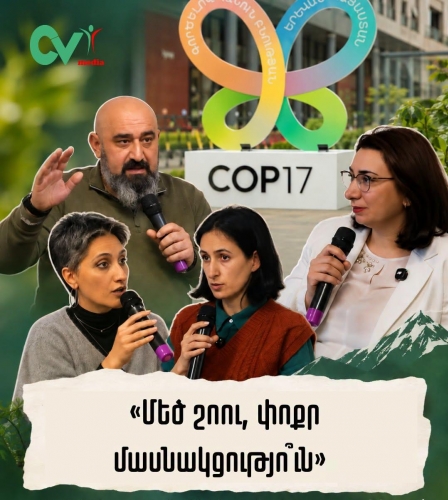
The outcomes of the 17th meeting of the Conference of the Parties to the UN Convention on Biological Diversity (COP17), held in Yerevan, should be assessed not only in terms of the decisions adopted and funding announcements made, but also by their implementation, the actual influence of public participation, and the changes they bring about in Armenia’s environmental policy. These issues were at the heart of the panel discussion titled “What Was COP17? Perspectives from Inside and Outside,” held on November 11.
The panelists were human rights defender and environmentalist Oleg Dulgaryan, Nune Avetisyan, author and host of Public Radio’s Ecosphere program, Kristine Aghalaryan, editor at the Infocom news outlet, and environmentalist Anna Shahnazaryan.
The speakers offered differing assessments. On the one hand, they emphasized the importance of international negotiation platforms; on the other, they criticized the conference’s excessive emphasis on its ceremonial and representational aspects, unequal opportunities for public participation, and the practical impact of the decisions adopted.
Nune Avetisyan considered it one-sided to characterize COP17 merely as a showcase event. In her view, regardless of their ceremonial and representational elements, such conferences remain platforms for shaping international environmental policy. “Whether we like it or not, COPs are the platforms where decisions, large or small, are made that affect countries’ environmental policies,” Avetisyan noted.
As positive developments, she highlighted announcements concerning environmental financing and the Yerevan Pathway initiative, while stressing that announced funding does not automatically translate into project implementation.
This distinction was one of the central issues raised during the discussion: assessing the conference’s outcomes requires understanding not only what was announced, but also what resources have actually been allocated, which projects have been launched, and what changes they are delivering.
COP commitments often remain unfulfilled, largely because of a lack of political will, while environmental funds established for these purposes may remain empty, providing no tangible support on the ground.
Avetisyan also compared COP16 and COP17, referring to the decisions left unfinished in Cali because of the lack of a quorum.
It should be noted that COP16 was suspended and subsequently resumed in Rome, concluding on February 27, 2025, with agreements on biodiversity financing, planning, monitoring, reporting, and reviewing progress.
Conference’s Grandeur and Visibility of Environmental Problems
According to Oleg Dulgaryan, host countries’ desire to demonstrate their organizational capabilities and international standing should not overshadow the very problems these conferences are intended to address.
“COP is very much like an event where we focus more on showcasing the process of holding COP itself than on the problems that exist on our international agendas,” the speaker noted.
He also criticized participation in conference events as an end in itself. Simply attending a conference does not necessarily mean influencing its agenda, presenting a critical position, or having an opportunity to participate in decision-making. According to Dulgaryan, attempts to raise concerns sometimes encountered obstacles.
Citizens on “Stools,” Powerful Actors on “Thrones”
Anna Shahnazaryan, who spoke at several conference events, emphasized the importance of cooperation among states and the role of international political platforms. At the same time, she pointed to the unequal opportunities available to citizens, civil society organizations, major businesses, and financial institutions.
“When actors with vastly unequal, asymmetrical resources gather around the same table, someone ends up sitting on a little stool—that is us, as citizens—while others sit on thrones,” the environmentalist remarked.
In this context, it was also emphasized that, unlike independent civil society organizations, representatives of major businesses and lobbyists have far greater opportunities to influence the agenda and negotiation processes.
According to Shahnazaryan, the conference’s political significance had not been adequately appreciated. In some cases, it was pushed into the background, giving way to organizational presentations, the pursuit of funding opportunities, and business networking.
“For citizens, this should have been a very important political event, but there was a tendency to turn it into a showcase and a more commercially oriented event,” Anna Shahnazaryan noted.
As an example of unequal opportunities for public participation, Shahnazaryan cited complaints from representatives of Friends of the Earth International. According to her, numerous applications submitted by the organization and its partners to hold events in the Blue Zone had not been approved, while events organized by financial institutions were extensively represented.
However, the environmentalist did not advocate abandoning international platforms. “We should strive not to abolish COPs, but to transform them and make them more political events,” Shahnazaryan emphasized.
Media Coverage: What Did the Public Learn About the Decisions?
Kristine Aghalaryan approached the discussion from the perspective of a journalist who had followed the conference from the outside. She said she could not unequivocally describe the entire event as a “show,” but criticized the nature of the information presented to the public, calling it “90 percent show.”
According to Aghalaryan, official meetings, greetings, and handshakes received the greatest visibility in Armenian media, while the substance of the decisions adopted, their significance, and in-depth analysis of environmental risks received insufficient coverage. She attributed this partly to Armenian journalists’ lack of experience covering COP conferences.
Aghalaryan also addressed the transparency and accessibility of documents discussed during COP17, describing her attempt to locate the full text of the Yerevan Pathway.
“Yesterday, I wanted to read the Yerevan Pathway to understand what it actually represents and which important points are highlighted for Armenia. I could not find the complete Yerevan Pathway document. I found only certain excerpts that had been addressed and discussed during the COP,” Aghalaryan noted.
She pointed out that, unlike Armenian media outlets, international publications during the conference focused on specific environmental problems, the consequences of economic activities, and financial commitments. Foreign journalists also consistently examined progress in implementing programs and fulfilling promises made at previous COPs.
Anna Shahnazaryan argued that the media should have responded to high-profile official statements by first examining the UN Secretariat’s report, which indicated that targets had not been met. She noted that no media outlet had analyzed Armenia’s report, which should summarize the measures implemented over the previous four years toward achieving the Kunming–Montreal Global Biodiversity Framework targets.
Amulsar and Overlooked Environmental Problems as Test of National Policy
Oleg Dulgaryan contrasted the conference’s official environmental agenda with developments taking place in Armenia. He referred to the announcement of the opening of the Amulsar mine immediately before COP17 and proposed legislative amendments concerning communities’ influence over environmental impact assessment processes.
Beyond Amulsar, other unresolved problems frequently overshadowed in official reports were also highlighted. These included the risk of algal blooms in Lake Sevan, the failure to fulfill long-standing promises to construct wastewater treatment plants in Gegharkunik Region, and the unsuccessful introduction of closed-loop water circulation systems at fish farms in the Ararat Valley, resulting in the catastrophic depletion of artesian water resources.
It was also emphasized that only a negligible share of the state budget—approximately 0.4%—had been allocated to environmental protection in the previous year.
The discussion also highlighted the Armenian government’s willingness to give the “green light” to virtually any economic investment proposal, including its readiness to provide a USD 150 million loan guarantee for the operation of the Amulsar mine.
What Civil Society Can Do: A New Set of Tools
In the current circumstances, the discussion participants proposed practical steps to influence environmental policy.
In particular, they called for moving away from passive and formal participation in events, updating advocacy and campaigning tools, and adopting methods of exerting stronger pressure on the executive branch.
The importance of preparing alternative, independent analytical reports was also emphasized, rather than relying solely on official declarations and data.
The speakers stressed the need to strengthen international advocacy to overcome the isolation of local communities and exert pressure on decision-makers through international platforms.
Most importantly, instead of resorting to a complete boycott, they advocated actively using all available platforms and legal mechanisms to raise concerns consistently and persistently.
After Conference: Implementation and Accountability
The differing positions expressed by the panelists point to several areas for evaluating COP17 in the future: implementation of adopted decisions, fulfillment of funding commitments, accessibility of documents, and the actual influence of public participation.
Avetisyan raised the question of whether the allocated resources would genuinely contribute to solving environmental problems. Shahnazaryan emphasized the political nature of decision-making and the unequal opportunities available to different actors. Dulgaryan compared the international agenda with Armenia’s domestic policy decisions, while Aghalaryan highlighted the need to provide the public with substantive information about all these developments.
Main photo: "Citizen's Voice" media platform
November 13, 2026 at 14:10