
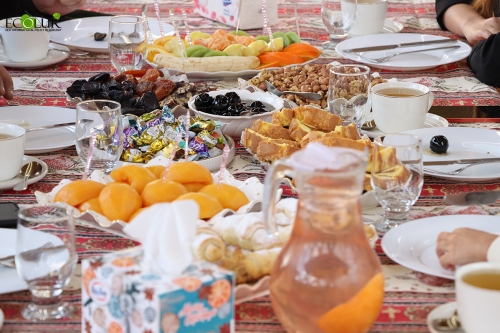
In the historic village of Gladzor, located in Armenia’s Vayots Dzor Region, educator, geographer, and historian Norik Mkrtchyan has established a gastro-yard called “Nortours,” where visitors can taste traditional Armenian dishes.
For many years, Norik Mkrtchyan taught at the local school in Gladzor. After Armenia gained independence and tourism began to develop, he followed friends’ encouragement and entered the tourism sector. He started as a tour guide, later expanding his services to include hospitality, with the involvement of his family.
“With my knowledge, I represent Armenia and its attractions to the world. I have good friends-tour operators-whose groups would come to our home for traditional meals. That’s how we began offering services without any infrastructure in place,” said Mkrtchyan.
Gladzor is a key point along tourism routes in Vayots Dzor. Nearby attractions include Spitakavor Monastery Complex, Tanahat Monastery, Proshaberd Fortress, the historic University of Gladzor, and Vayots Mount. These routes bring tourists to Gladzor, including to Norik’s gastro-yard, where his family serves traditional Armenian cuisine.
Visitors enjoy homemade wine, seasonal dishes, preserves, and teas made with local herbs. Master classes are also held in cheese aging and vodka distillation.
Norik Mkrtchyan hopes his example will inspire fellow villagers. A second gastro-yard, Tanahat, is already operating in Gladzor. As he notes, the growth of such businesses is helping make the region’s tourism sector more cohesive and interconnected.
Moreover, the hospitality services offered at his home contribute to local development and provide income opportunities for neighbors.
“When we provide our services, we also rely on our neighbors. Our own household alone cannot supply all the necessary produce. We buy eggs from one neighbor, milk and yogurt from another, lavash, wild mushrooms, greens, vegetables, and herbal teas from others. Our business helps generate supplementary income for the community,” he said.
Despite years of experience, the lack of infrastructure had long been a challenge to providing high-quality service. With support from “Living Landscapes for Market Development in Armenia” (LILA) project, a summer kitchen was built in Norik’s yard-significantly improving the quality and efficiency of services offered at the gastro-yard.
Beyond material support, the project also created opportunities for professional growth.
Seminars with tourism expert Zarmine Zeitountsian and Sedrak Mamulyan, President of “Development and Preservation of Armenian Culinary Traditions” NGO, became sources of valuable knowledge and new collaborations for Norik. Drawing from his expertise in the region’s culinary heritage, Norik contributed to the creation of a book on Vayots Dzor’s traditional cuisine.
Mkrtchyan emphasized the importance of the capacity-building and collaborative environment fostered by the project. “I especially value that such projects bring us organized, systematized information and international experience. If we try to progress on our own, the process is very slow. And in today’s world, moving slowly is simply a mistake.
The fact that for years we lacked printed resources on regional cuisines, but now-thanks to the project-we have books on the cuisines of Syunik, Tavush, Lori, and Vayots Dzor, is a major achievement. We now have a concise, tangible record of the culinary culture created by our ancestors over centuries. This helps us present Armenia to the world more effectively.”
He also highlighted the importance of regional cooperation with other project beneficiaries:
“Thanks to the project, we’ve started collaborating with businesses like Kria Wines, Artchiz Cheese Production, and others. We’ve united around a shared purpose. We produce various types of preserves, but when our family’s production isn’t enough, we work with the Poonj canning factory in Vernashen neighboring village,” he noted.
Living Landscapes for Market Development in Armenia” (LILA) project is funded by the Government of Switzerland through the Swiss Agency for Development and Cooperation (SDC) and is implemented by the WWF Caucasus and WWF Armenia offices, in partnership with Strategic Development Agency (SDA) NGO.


May 13, 2025 at 14:36