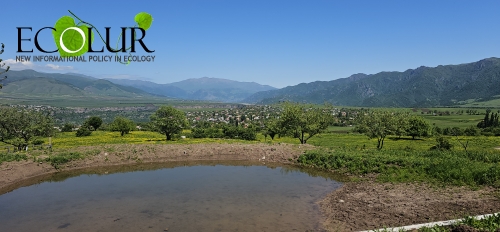
Against the backdrop of the global climate crisis and the vulnerability of local ecosystems, the event “Communities as Guardians and Sustainable Users of Biodiversity” was held on October 21 in the Green Zone of the 17th meeting of the Conference of the Parties to the UN Convention on Biological Diversity (CBD COP17) in Yerevan. Organized through a partnership between EcoLur Informational NGO and the Fridtjof Nansen Institute, with support from the Norwegian Agency for Development Cooperation, the event provided a platform to highlight the direct impacts of climate change on nature. Mariam Yeganyan, a representative of Dsegh in Lori Region and founder of Loreni Tea House, delivered a presentation drawing international attention to the effects of climate change on Dsegh’s vegetation and the threat of Lake Tsovner, a natural monument, turning into a marsh.
Dsegh is a high-altitude settlement located near the Debed River gorge, at an elevation of 1,250–1,350 metres above sea level. The birthplace of Hovhannes Tumanyan is distinguished by its remarkable diversity of vegetation zones, ranging over a relatively short geographical distance from mountain-steppe to alpine zones. Dsegh is home to one of Armenia’s important bird areas, where 177 bird species have been recorded.
To promote the sustainable use of natural resources and develop tourism, Mariam Yeganyan established Loreni Tea House with support from the Living Landscapes for Market Development in Armenia (LILA) project. The tea house was created as an educational platform for responsible wild-plant harvesting and the transmission of traditional knowledge, introducing visitors to the medicinal properties of local plant species. “We have tried to foster a culture not only of taking from nature, but also of understanding and appreciating it,” the speaker noted.
However, daily contact with nature has revealed worrying trends. Experience in wild-plant harvesting has shown that changes in precipitation and humidity patterns are directly affecting plant growth cycles and quality. “A year-on-year decline in plant quality is being observed,” the speaker noted, highlighting visible signs of climate change.
Lake Tsovner at Risk of Becoming Marsh
The impact of the ecological crisis is particularly evident at Lake Tsovner, a state-protected natural monument in Dsegh with a surface area of 1.6 hectares. According to Mariam Yeganyan’s observations, the lake is undergoing several alarming changes:
- The water is turning green, and reeds have begun to spread.
- The water has developed an unpleasant smell, and unusually high levels of frog activity have been observed.
- As early as 2020, Environment Ministry noted in a published document that the lake was gradually becoming shallower and shrinking, showing signs of partial marsh formation, while its water was turbid and polluted.
The speaker stressed that it remains unclear whether these changes are caused by climate change, disruptions to the springs that feed the lake, the accumulation of nutrients (organic matter), or the direct impact of human activities and tourism.
To prevent Lake Tsovner from turning into a marsh, the Dsegh representative put forward several proposals:
Conduct an in-depth expert assessment of the lake’s water quality, oxygen levels, nutrient content, lakebed, sediment, and hydrological regime to identify the causes of marsh formation.
Develop and implement a conservation and ecosystem restoration plan for the natural monument, contributing to the achievement of Target 2 of the Kunming–Montreal Global Biodiversity Framework.
Introduce a community-level climate change adaptation programme and strengthen risk management capacity, contributing to the achievement of Target 8 of the Kunming–Montreal Global Biodiversity Framework.
Facilitate the exchange of international experience to learn what measures other countries are taking to prevent small lakes from turning into marshes.
“Our goal is to ensure that Lake Tsovner does not become an example of ecosystem loss, but rather an example of nature conservation achieved through knowledge, community participation, and international cooperation,” Mariam Yeganyan concluded.
October 26, 2026 at 13:26