
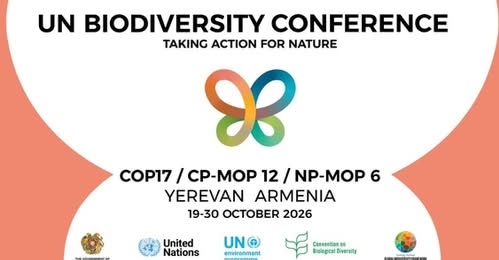
Negotiations at the 17th meeting of the Conference of the Parties to the UN Convention on Biological Diversity (CBD COP17) have concluded in Yerevan. Following the negotiations, an official closing press conference was held, attended by COP17 President and Armenia’s Minister of Environment, Hambardzum Matevosyan, and Astrid Schomaker, Executive Secretary of the UN Convention on Biological Diversity (CBD).
Hambardzum Matevosyan noted that approximately 50 decisions had been adopted at CBD COP17.
“Unfortunately, the biodiversity crisis is so extensive and deep-rooted that the work we are doing can sometimes seem like just a drop in the ocean. The crisis is truly enormous. Nevertheless, we will continue working to address it.
Today, following the conclusion of the COP17 plenary sessions, we can say that the real work of COP17 is only just beginning. So far, we have held the COP17 plenary sessions, and now we are moving on to the next phase of the conference.
Ahead of us are the four initiatives of the COP Presidency, within which numerous issues will be discussed and decisions adopted. Thus, there is still a substantial amount of work to be done,” the COP17 President said.
Astrid Schomaker noted that the conference had adopted decisions that would change the current trajectory of biodiversity conservation by accelerating progress on the one hand and focusing particularly on areas where the greatest setbacks are being observed on the other.
She emphasized the important role of “Yerevan Pathway” initiative. The Yerevan Pathway is designed to accelerate implementation of the Kunming–Montreal Global Biodiversity Framework. It sets out priorities for joint action, ranging from the implementation of national plans and the mobilization of financial resources to strengthening science, monitoring, and the participation of all segments of society.
“The Yerevan Pathway is a key component of the decision on the global review of progress in biodiversity conservation. We have acknowledged that progress is not sufficiently rapid or comprehensive. Therefore, the Yerevan Pathway has been developed, bringing countries together to clarify the steps they need to take to address the identified gaps and challenges. This is an extremely important and significant outcome. Thus, the decision on the global review itself is one of the key achievements of this conference,” Astrid Schomaker said.
She also outlined some of the other decisions related to this initiative.
“For example, the global report states that accelerating progress requires broader engagement, strengthening the capacity of stakeholders, and bringing all actors together. In other words, everyone needs to unite and contribute to the common effort. And that is precisely what happened through the adoption of additional decisions.
“The Gender Plan of Action was reviewed, and new commitments were made while previously undertaken commitments were reaffirmed.
“We also addressed the role of cities and subnational authorities.
“And one particularly important achievement: almost at the last hour, one could say in the final minutes, we managed to adopt a document whose title may not sound particularly impressive, but whose substance is extremely significant.
“It concerns the terms of reference of our unique body. This body works with Indigenous Peoples and local communities, helps strengthen their capacities, ensures their participation in discussions, and enables us, as a body operating under the Convention, to learn from their experience and knowledge. This is truly a remarkable achievement.
“We then turned to areas where, in our assessment, progress remains insufficient, particularly the main drivers of biodiversity loss. Specific decisions were adopted in this regard, relating to climate change and agriculture,” Astrid Schomaker said.
She noted that extensive discussions and debates had taken place on financing:
“To be honest, I have never seen such extensive discussions on the issue of harmful subsidies. Once again, everyone acknowledged that the problems exist, recognized their responsibility, and stated that action is now needed. Of course, with regard to these more complex and sensitive issues, we could not have expected negotiations to result in strong, legally binding commitments. That was never our initial objective.
“Nevertheless, let me emphasize once again that the existence of the problem was acknowledged. At the same time, we established cooperation coalitions and Presidential initiatives. One of these is the Presidency initiative on positive incentives. It provides an opportunity for Parties to come together on a voluntary basis, build the necessary critical mass, and create the momentum needed for progress. Over time, this may enable us to move forward and potentially arrive at more binding commitments. All of this was truly significant.”
Astrid Schomaker noted that arrangements had been established for the transition period to clarify how financial resources contributed to the Cali Fund would be distributed and how other outstanding issues would be addressed.
Asked who would hold the Parties accountable if they failed to meet their commitments, Astrid Schomaker replied:
“The United Nations does not issue grades or report cards for individual countries. The Parties themselves monitor one another’s performance. Fortunately, governments in most countries are elected democratically, which means that voters are also responsible for holding them accountable and can demand answers from their governments.
“Ultimately, however, the most important thing is that nature itself will hold us accountable.
“If we fail to meet our commitments by 2030 and biodiversity continues to decline, governments will have to pay the price for the consequences. Those costs will be incomparably higher than the resources that would have been needed if we had started taking action today.
“I believe this is the central message of accountability that we have sought to place at the heart of discussions throughout this COP.
“We need to honestly assess where we stand, acknowledge that the pace of progress is insufficient, identify the existing gaps, find ways to move forward, then join the Yerevan Pathway and proceed with practical action.”
Speaking about the course of the negotiations, she said:
“First of all, we began addressing deeper economic issues. In other words, our attention was not limited to the familiar targets, such as the 30x30 initiative, species conservation, and so on. We also addressed the underlying causes of these problems: the economic and financial systems that direct enormous amounts of money toward activities that contribute to the destruction of nature rather than those that support its conservation and restoration.
“We discussed how this situation can be changed and which actors need to come together to achieve that goal. All these issues were discussed here, and I believe a considerable degree of mutual understanding was reached. This, in turn, contains the seeds of the foundation needed for further progress.
“The second point is perhaps an issue that did not receive sufficient recognition during the discussions and could have been addressed more effectively. I am referring to the decision adopted on climate change. That decision gives us an opportunity to move forward in addressing climate change and biodiversity loss together, with the hope that our actions will gradually have a greater impact. These are just two examples I would like to highlight to demonstrate the potential for achieving real change. We all recognize that biodiversity loss can only be reversed through systemic and radical transformations.
“This issue was discussed by everyone, and concrete steps were taken in that direction.
“We also discussed how to ensure that the initiative for these transformations does not come solely from the Minister of Environment, calling for change, but that the entire government unites around this goal and that civil society is also involved in the process, understands its role and potential, and recognizes that it, too, can bring about real change.”
In her closing remarks, Astrid Schomaker said:
“We have quite an extensive amount of work ahead of us under the leadership of the COP President. He will remain in office until the next conference opens, and we will certainly keep him sufficiently busy. I am also sure that he will not let us sit idle,” Astrid Schomaker noted.
The next conference, CBD COP18, will be hosted by Ecuador.
October 31, 2026 at 17:00