
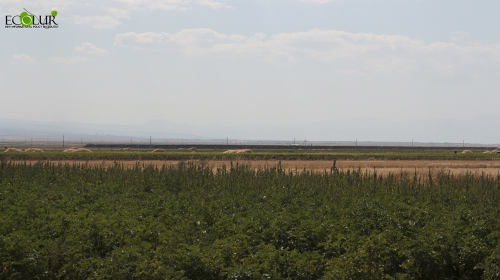
"Masrik-1" solar photovoltaic (PV) power plant is being built on an area of 128.3 hectares in the Masrik field in Vardenis consolidated community, Gegharkunik Region. 165,368 photovoltaic panels will be installed.
The most important issue in this program is related to e-waste management. The issues of e-waste storage, recycling and utilization are not resolved.
E-waste contains hazardous elements such as cadmium, gallium, copper, etc. Environmental Impact Assessment (EIA) report of "FRV MASRIK" CJSC, which is building the station, says: "Photovoltaic technology is based on the effect of sunlight (photons) on the molecular structure of certain materials. These materials must be semiconductors such as silicon, cadmium telluride, copper indium diselenide, gallium arsenide, and other organic materials.
However, the EIA does not mention the storage and recycling of 165,368 photovoltaic panels in case of damage or after operation. It is not known how and where they should be stored before being transferred to a licensed organization, who is responsible for waste management, and how much money and resources are needed for this. That is, one of the hidden risks of the project is the total amount of e-waste, although it is known that the service life of the panels varies from 15 to 30 years.
In its EIA, the company addressed only issues related to engine oil, tires and construction waste arising during the operation of the plant.
Neither Vardenis nor Mets Masrik municipality had any information about the possible storage of electronic waste. Mets Masrik residents told EcoLur that during one of the meetings with the company, the latter mentioned that it is possible to throw this waste into a landfill. Meanwhile, panels are not trash, but recyclable waste. The cost of neutralizing 1 operated panel varies between 20-30 USD.
It is also not known who will bear the financial burden of neutralizing the panels of "Masrik-1" solar plant, while this amount may vary between 3.3-5 million USD. Moreover, there is no technology or standard for processing and utilizing these wastes in Armenia, as Tigran Melkonyan, Head of Energy Department of RA Ministry of Territorial Administration and Infrastructure, informed EcoLur.
On the other hand, there are still no companies in Armenia that are engaged in the processing or utilization of similar waste. When this issue is raised with the relevant authorities, experts in the field assure that there is enough time to think about it.
Environment Ministry, in response to EcoLur's inquiry, bypassed the problem of waste arising from the operation of solar plants, referring only to melted oils and tires, construction waste.
The risks of substances present in e-waste entering the environment and the human body are also not assessed in the EIA report.
In terms of waste, the EIA of the plant does not comply with the 3rd standard of the financial organization investing in the project International Finance Corporation (IFC), i.e. resource efficiency and pollution prevention.
Reminder: that the construction of "Masrik-1" solar photovoltaic (PV) power plant is implemented by the consortium of "Photovatio Renewable Ventures" B.V. (Fotowatio Renewable Ventures B.V.) (Netherlands) - FSL Solar S.L. (Kingdom of Spain). The company undertaking the planned activity is "FRV MASRIK" CJSC.
September 07, 2022 at 11:24