
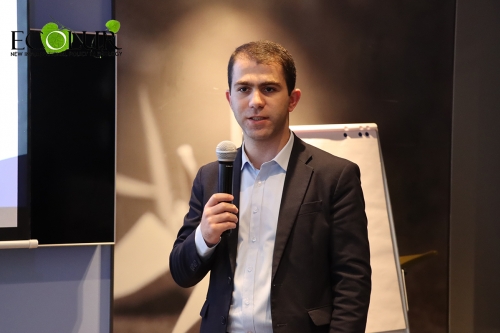
“The key message of COP17 is simple: by conserving biodiversity, we guarantee our future security. The decisions adopted at COP17 must be translated into government action. It is very important that, as the presiding country, we identify the common ground that will enable all Parties to reach consensus,” as Alik Badalyan, Chief Specialist of the Department of Specially Protected Areas and Biodiversity Policy at the Ministry of Environment of the Republic of Armenia, stated in the course of “ Civil Society Agenda at the 17th Conference of the Parties (COP17) to the United Nations Convention on Biological Diversity” workshop organized by EcoLur Informational NGO in cooperation with the Fridtjof Nansen Institute.
COP17 will take place in Yerevan from 19 to 30 October, 2026. During the same period, Yerevan will also host the 12th Meeting of the Parties to the Cartagena Protocol on Biosafety (CP-MOP-12) and the 6th Meeting of the Parties to the Nagoya Protocol on Access to Genetic Resources and the Fair and Equitable Sharing of Benefits Arising from Their Utilization (NP-MOP-6). Approximately 20,000 participants are expected to attend.
A total of 51 documents will be considered at COP17. The most important among them is the first Global Review of the implementation of the Kunming–Montreal Global Biodiversity Framework. COP17 is expected to translate the findings of this review into practical guidance for accelerating implementation of the global targets by 2030.
“The central question of COP17 is whether the world is on the right track to achieve the 2030 targets of the Kunming–Montreal Global Biodiversity Framework. For the first time, the Global Review will be conducted to assess progress, identify policy and financial gaps, and determine whether the targets of the Kunming–Montreal Global Biodiversity Framework require revision,” said Alik Badalyan.
He presented the four main priorities of COP17:
- Global Review – implementation progress and accountability.
- Finance and Digital Sequence Information (DSI) – financing, the Cali Fund, and benefit-sharing.
- Participation – Indigenous Peoples, local communities, and stakeholders.
- Synergies – biodiversity, climate, land, and water.
Alik Badalyan also presented Armenia's four proposed initiatives for COP17, emphasizing that they are still in the preliminary stage.
“We have the opportunity not only to host COP17 but also to demonstrate that Armenia can offer a practical, ambitious, and participatory environmental agenda,” said Alik Badalyan as he introduced Armenia's initiatives.
Armenia's Initiative 1: "Yerevan Tech for Nature Hub"
The initiative aims to improve the collection of high-quality biodiversity data to support more targeted conservation actions. It focuses on:
- artificial intelligence and data analytics;
- environmental DNA (eDNA);
- bioacoustic monitoring;
- remote sensing and satellite data;
- citizen science and open data; and
- improving the quality of accountability.
Armenia's Initiative 2: "Global OECMs Platform to Achieve 30×30"
This initiative proposes the establishment of a global platform for Other Effective Area-based Conservation Measures (OECMs) to help achieve the 30×30 global target, which corresponds to Target 3 of the Kunming–Montreal Global Biodiversity Framework.
“Our goal is not only to expand protected areas but also to improve the quality of their conservation and management. For Armenia, this is an opportunity to connect area-based conservation with local communities, landscapes, and traditional knowledge,” Alik Badalyan noted.
Armenia's Initiative 3: "Yerevan Call / Coalition on Positive Incentives for Biodiversity"
This initiative relates to Targets 18 and 19 of the Kunming–Montreal Global Biodiversity Framework, which establish key financial and economic commitments for biodiversity conservation.
“The annual biodiversity financing gap of USD 700 billion requires new partnerships and positive incentives. Through this initiative, we call on Parties to bridge this gap and distribute financial resources fairly and according to needs. The objective is to shift from incentives that harm nature to investments and economic solutions that generate positive outcomes for biodiversity,” Alik Badalyan noted.
Armenia's Initiative 4: "Yerevan Dialogue on Mountain and Freshwater Biodiversity"
The fourth initiative focuses on mountain and freshwater biodiversity.
“Our negotiations will largely revolve around this initiative. We intend to use Lake Sevan as a case study. The goal is to demonstrate that mountain ecosystems and freshwater resources form the foundation of biodiversity and community livelihoods. In this context, Armenia can promote a practical ecosystem-based approach by making Lake Sevan a symbol of international dialogue,” Alik Badalyan noted. The speaker also explained how civil society can participate in the COP17 process.
Prior to COP17, public consultations and the submission of proposals are planned. During COP17, civil society organizations will be able to organize side events and participate as observers. Following the conference, they can contribute through monitoring, public oversight, and ensuring accountability.
Armenia's biodiversity conservation goals and targets are established in Order No. 100-L of the Minister of Environment of the Republic of Armenia, "On Approving the Biodiversity Conservation Targets of the Republic of Armenia and the 2026–2030 Action Plan."
This article was prepared within the framework of “Supporting Armenia's CBD COP Presidency and Domestic Implementation” project, which is implemented by Ecolur Informational NGO in cooperation with the Fridtjof Nansen Institute, with support from the Norwegian Agency for Development Cooperation (Norad).
The views expressed within the framework of the project do not necessarily reflect the views of the Fridtjof Nansen Institute.
July 08, 2026 at 16:57