
Loss of land, water and forest resources: as a result, food security have turned into the main problems of the modern world, which are complicated with climate change and military and political conflicts. Attempts to solve these problems can only succeed if there is a political will that resists quick money and the capture and destruction of natural resources. Armenia offers solutions by joining green initiatives, ratifying environmental conventions and making statements about the need for a green economy.
How are these issues resolved in reality? Let us speak about the mining industry, regarding which the governmental five-year program (2021-2026) says: “To ensure the reasonable and integrated use of subsoil, excluding its overexploitation.”
As of 01/01/2022 23 licenses for the development of metal deposits have been issued, currently 6-7 deposits are actually being developed. The remaining deposits are either not developed or are developed from time to time, that is, the companies do not fulfill their obligations to the state and impacted communities. There was an attempt on the part of the government to terminate the soil management rights of such companies. Out of five such companies, two companies were declared bankrupt, and three companies restored their rights in court. These selective decisions were followed by legislative reforms to encourage irresponsible business, especially in dealing with impacted communities.
The adopted amendments and addenda to RA Code on Mining restrict the constitutional rights of citizens to hold protest actions, to participate in decision-making provided for by RA Constitution and Aarhus Convention, contradicts current Article 20 (7) of RA Law “On Environmental Impact Assessment and Expertise”. These amendments deteriorated the legal position of civil society.
The new Mining Development Strategy is being developed with the participation of business companies that receive direct and indirect profit from mining. “The project to develop a mining sector development strategy (hereinafter referred to as the Strategy) was initiated by the Government of the Republic of Armenia and is being implemented with the support of the World Bank (Armenian Mineral Policy Grant Project II (Grant No. TF0B3556)”. The customer of the project is the Armenia Territorial Development Fund.
The works planned by the project are coordinated by RA Ministry of Territorial Administration and Infrastructures. The development of the strategy was carried out as part of the joint activities of “Grant Thornton” CJSC (RA), “Grant Thornton Legal and Tax” LLC (RA), “Institute of Mining Metallurgy” CJSC (RA) and “Global Resource: Engineering” (USA), where “Grant Thornton” CJSC acts as the main consultant.
The list does not include those experts and the public concerned who have been addressing developers for several months with proposals for a balanced approach and such regulation of activities in the mining sector that would be consonant with the stated goals in government programs, the goals of a green economy, the rational use of natural resources in the aspect sustainable development and climate policy for adaptation and mitigation of consequences. There is not a word about these aspects in the strategy. On the contrary, those restrictions for the mining business, which are determined on the basis of environmental legislation, are being eliminated, for example, the ban on mining in specially protected natural areas. According to the draft Strategy, it is proposed to allow soil management in specially protected areas.
We especially note the pronounced negativism towards public participation in the decision-making process in the mining sector. Expressions such as “misinformation by environmental activists” or a call for legal repercussions if hearings are obstructed are allowed. This means that the authors of the developed Strategy propose to abandon the mechanism for ensuring public participation in the decision-making process as laid down in the Aarhus Convention. This mechanism allows the public to express their disagreement with problematic projects. However, the Strategy sets prerequisites for the alienation of the environmental community, which is unacceptable in a strategic document.
The mechanism proposed in the Strategy for granting land to soil managers in a unified manner with the granting of a license for soil management seems to be extremely controversial. It is proposed to resolve the issue by amending RA Land Code, providing for the conclusion of a land use agreement on a compulsory basis, for example, using “public eminent domain” mechanism, which has been repeatedly criticized as unconstitutional and not in line with the interests of the owners. Thus, the right of land ownership and the right to decide whether or not to provide land for soil management are taken away from communities and individuals, which contradicts a number of fundamental laws - RA Constitution, RA Land Code and, all human-right-related legislation.
On licenses for soil manage, geological propsecting and research
Licenses for geological prospecting are granted extremely actively and uncontrollably to companies, including those that have a poor history in this business in terms of unfulfilled contractual obligations, defaulting on payments to the state and community budgets, and fulfillment of the company's obligations under social and environmental policy etc. As part of the EITI mining industry transparency process, the names of the owners of companies were disclosed, including unscrupulous owners.
However, unscrupulous owners have not been eliminated, and the new privileges provided apply to the entire mining business. Guarantees in the fulfillment of obligations, or in the prevention of risks of pollution of territories and waters, risks associated with health, compensation, are not provided to the community. In our opinion, agreements on the establishment of special insurance funds, or direct obligations to compensate for damages, or contractual obligations to implement social and environmental programs can serve as guarantees. But discussions on this topic are being closed in the environment of tension and conflict between supporters and opponents of the proposed mining projects.
Here are the most pronounced case studies of soil management, where problems can be traced that can multiply and acquire an uncontrollable large-scale nature.
Case study Teghut: Public Eminent Domain
On November 1, 2007, the government decision N1279 was adopted on public eminent domain in relation to 81,483 hectares of agricultural land in the communities of Shnogh and Teghout in Lori Region. The status of the lands was changed to lands for soil management for Teghut copper-molybdenum mining. For these lands, the owners received insignificant amounts that did not correspond to their true value - about 40 AMD per 1 sq. m. m. This is the price of 4 matchboxes.
423 families living in Teghut and Shnogh villages were deprived of their lands. Out of these, 106 owners refused to accept the so-called compensation and applied to court, which ruled in favor of Armenian Copper program, which is part of Vallex Group of Companies developing Teghut field.
Unable to find justice in local courts, some owners continued to defend their rights in international courts. The European Court of Human Rights ruled to uphold the claims of the owners. Sums of several tens of thousands of Euros (depending on the size of the land given to the company under “public eminent domain” decision) must be paid by the state for its decision on improper compensation. The state also suffers damage due to its connivance with regard to pollution prevention obligations, social obligations, and obligations to restore forests cut down for the development of the infrastructure of the Teghout program. So, after only 3 years after the start of operation, the company fired 1035 workers out of 1190 and stopped its activities. 357 hectares of forests were cut down. Shnogh and Teghout villages were affected by toxic emissions and industrial waste. The Shnogh and Debed rivers are highly polluted with heavy metals, while the Dukanadzor and Kharatanots rivers have disappeared.
Case study Gladzor: Permissible manipulations and predictable consequences
The conflicts related to Gladzor polymetallic deposit have not stopped for more than 8 years, and after the unification of the communities into one consoliated community of Yeghegnadzor, they moved to a new stage. In 2017, Vayq Metal company received a license to operate Gladzor polymetallic deposit, but at preliminary hearings, the residents refused to enter into an appropriate agreement with the company. They backed up their refusal with economic and environmental considerations, first of all, the risks for the production of high-quality Vernashen wine, pollution of agricultural land and water with industrial waste.
A corresponding decision was made at Aldermen’s Council of Gladzor community, which, according to RA Law “On Local Self-Government” and RA Law “On EIA”, is imperative for any activity on the territory of the community.
Environment Ministry, in turn, refused the company a positive EIA conclusion regarding the development of this field. In 2021, an application was filed to Ministry of Territorial Administration and Infrastructures to conduct desk (that is, without field work) geological prospecting of Gladzor field on behalf of Metal Gold company, whose representatives were the same people who once represented “Vayq Metal” Company.
These studies do not imply any hearings. The company, having received such a license, nevertheless, made repeated attempts to organize public hearings. This means that by agreeing to carry out field work, the community practically cancels its previous decision to refuse any work related to the mining sector.
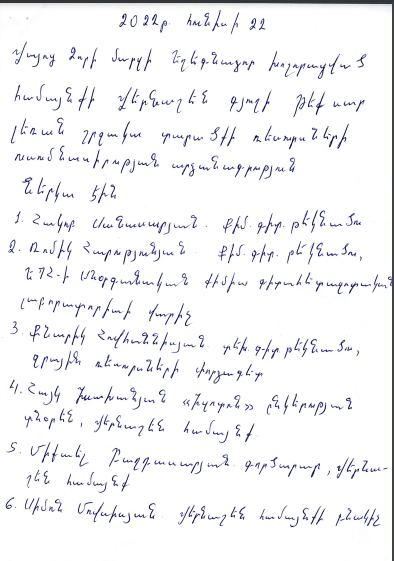
Following the consolidation of the communities in 2022 and the formation of a new Aldermen’s Council, the company made a new attempt to obtain consent for further action. On June 22, the EcoLur team participated in the meeting with David Harutyunyan, Head of local administration of Yeghegnadzor consolidated community, which included the villages of Gladzor and Vernashen, together with Hakob Sanansaryan, Chair of Greens Union of Armenia, PhD in Chemistry, an expert in the field of environmental impact assessment, Roza Julakyan - PhD in Chemical Sciences, Engineer-Hydrologist Qnarik Hovhannisyan, Head of Research Laboratory of Yerevan State University, Romik Harutyunyan - PhD in Chemical Sciences, representatives of “Vayq Metal”, and community members.
During the meetings, a heated discussion flared up around the problem of possible pollution of surface and groundwater located in the study area.
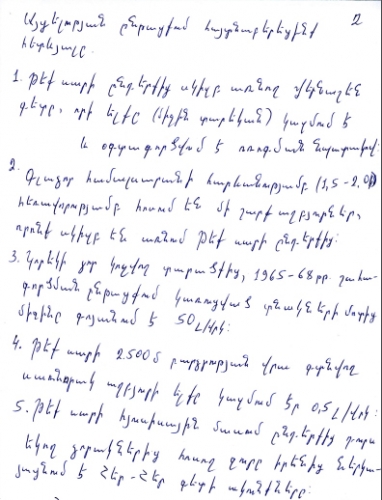
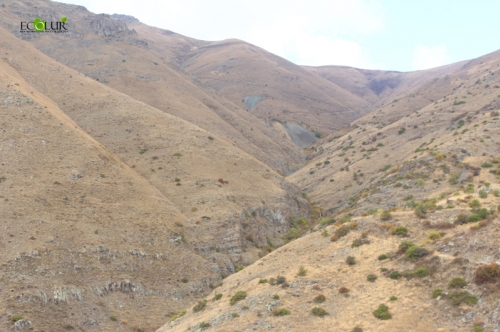
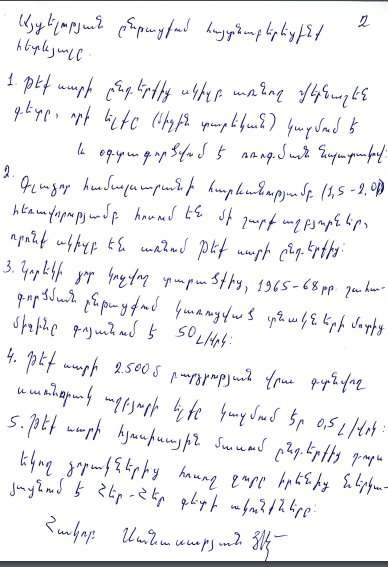
The invited experts, based on the map of the mineral deposit presented in the desk study project, and on their own visual studies, declared the presence of springs in the study area. In response, the Vahe Malkhasyan, geologist of “Vayq Metal”, stated that the map presented in their own project is not correct, and there are no water sources there. The present specialists surveyed the territory, accompanied by local residents, and drew up the following act “Act on the study of water resources on the territory of Mount Teqsar in Vernashen settlement of Yeghegnadzor consolidated community in Vayots Dzor Region.”
The act particularly says:
- The Vernashen River, originating from the foundations of Mount Teqsar, is used for irrigation purposes.
- There are springs originating in the foundations of Mount Teqsar at a distance of 1.5-2 km from Gladzor University.
- The water flow makes up about 50 l/sec in the territory of Koreki gorge, near the houses built in 1965-68.
- The output of water in the source, located at an altitude of 2500 m on Mount Teqsar, makes up 0.5 l/s.
- Water outlets from the foundations of Mount Teqsar on the northern slope represent the sources of Her-Her River.
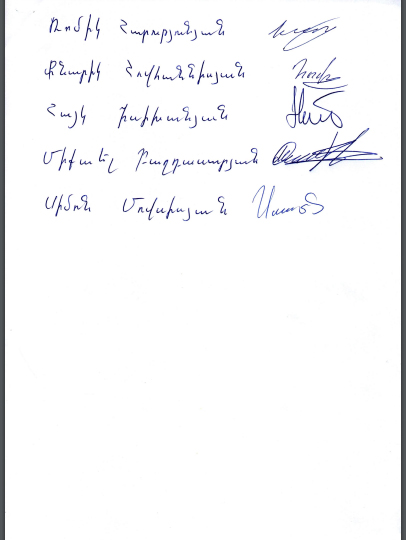
The act was signed by Hakob Sanansaryan, Chair of Greens Union of Armenia, PhD in Chemistry, Engineer-Hydrologist Qnarik Hovhannisyan, Head of Research Laboratory of Yerevan State University, Romik Harutyunyan - PhD in Chemical Sciences, local residents Hayk Isahakyan, Miqayel Baghdasaryan and Simon Movsesyan. The story does not end here.
Conclusion: The lack of proper regulation and procedure for conducting public hearings, provided for in RA Law on EIA, leads to a tense situation in communities that arise when discussing business projects hazardous to health and the environment. The conflict arises between the supporters of the company, to whom the company promises jobs, support in elections to local governments, which in a socially unsecured community finds a lively response, especially among unemployed youth. The other side of the conflict, as a rule, is represented by people who have alternative businesses in the field of tourism, winemaking, agriculture, production of organic products, etc, that is, people with sustainable income.
July 20, 2022 at 16:15