
EcoLur
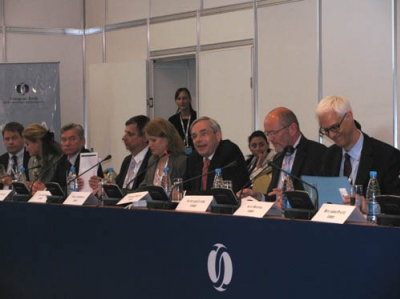
On 20-21 May the 20th annual meeting of the European Bank for Reconstruction and Development (EBRD) was held in Astana (Kazakhstan).
Among hundreds of participants, bankers, companies and company representatives Ecolur from Armenia also took part in this meeting as a representative of civic society. Discussions on the issues of bearing social and environmental risks were held in closed manner.
EBRD stated it follows its policy of social and environmental responsibility. Nevertheless, the data produced by international CEE Bankwatch monitoring network and its partner organizations in the countries of the South Caucasus and Central Asia witness the bank is far from sharing responsibility for risks from the projects funded by the bank. CEE Bankwatch press release says, ‘Analyses show many EBRD-implemented projects promoted development of private business, however, they caused problems to local population or environment, for example, Baku-Tbilisi-Jeykhan pipeline or investments into the coal industry of Mongolia.’
Thus, in their meeting with NGO sector on 21 May the Board of Directors assessed the cooperation with Mongolia as a successful one so that people engaged with mining industry can already use the goods provided by modern civilization such as electricity etc. Nevertheless, a NGO representative from Mongolia, U. K., said the policy run by the authorities having cooperated with the bank led to the fact that huge territories used by nomad population for hundreds of years were seized from the people for the sake of mining industry. “Now we are calling our country not Mongolia, but Minegolia where people are so irritated they shoot at equipment,” said U. K. and outlined nobody asked these people whether or not they want to change their way of living.
NGO sector’s demand is as follows: to have transparent EBRD operation and open access to information, particularly what concerns to projects and environmental impact assessment and their elimination measures, for public to actually affect on decision-making, for the bank to share responsibility for consequences and current risks together with project implementers.
In its turn, though the bank declares about its social and environmental responsibility, in its demands to project operators they actually track the financial side of the submitted documentation. EBRD President Thomas Mirow’s reply that he is not a supporter of procedures boosting bureaucracy given at the meeting with NGOs on 21 May might also serve as comments.
Actually this means the bank doesn’t intend to toughen procedures connected with loaning, including also loaning of projects with high social and environmental risks. In our turn, we would like to mention most developed countries, which are EBRD founders, continuously toughen demands to operators in mining industry or energy sphere, including nuclear power plants, i.e. everywhere where risks are available. Demands include both compensations to residents and receiving people’s consent who live in the project affected zone and establishing special funds for risk management etc. In this way developed countries preserve their environment and social good for their population, while these demands for the operation in our countries are called bureaucracy. Most countries where EBRD operates one can make millions of profit as nobody pays for anything. This suits local authorities in most countries in transition period.
At the panel session of Armenia in Astana on 21 May, EcoLur asked Deputy Chairman and Ex Minister of Economy Nerses Yeritsyan to comment the issue about the bank’s social and environmental responsibility he said national legislation is already too tough and doesn’t need any extra control.
In its proposals to EBRD, CEE Bankwatch called on the bank to work out clear criteria for measuring the actual impact of their investments on ordinary people and not to justify their projects with the help of the magic formula about the need to develop market.
May 25, 2011 at 11:48