
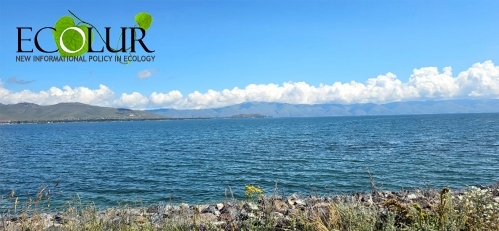
RA Environment Ministry has approved the negative expert conclusion (No. ԲՓ 136-26) on the Environmental Impact Assessment (EIA) report submitted by Sunny Land LLC for the production of mineral powder, gypsum and cement in Tsovagyugh settlement, Gegharkunik Region.
The examination identified serious environmental risks, legal restrictions, as well as significant discrepancies between the information presented in the report, state registration documents and the situation recorded during the site inspection.
Legal Restriction: Prohibition of Mineral Processing in the Immediate Impact Zone of Lake Sevan
Sunny Land LLC planned to organise the production of mineral powder, gypsum and cement in Tsovagyugh settlement of Sevan Community, Gegharkunik Region, on a plot located at the 7th–8th kilometre of the Sevan-Dilijan highway (cadastral code: 05-049-0139-0011), where an asphalt plant is already operating.
The activity falls under Category B as defined by the Law of the Republic of Armenia on Environmental Impact Assessment and Expertise. The production site is located 1,560 metres from Lake Sevan, 600 metres from “Sevan” National Park, and approximately 505 metres from the nearest residential houses in Tsovagyugh.
The primary and unequivocal legal basis for rejecting Sunny Land LLC’s application is the violation of the explicit requirements of RA Law on Lake Sevan. Subparagraph “g” of Paragraph 2 of Article 10 of the Law on Lake Sevan expressly prohibits the location of mineral-processing facilities within the immediate impact zone of Lake Sevan. During the examination, the Lake Sevan Protection Expert Commission of the National Academy of Sciences of the Republic of Armenia presented its position in letters No. F-15/2026 and No. F-26/2026, according to which the planned installation of a ball mill and mechanical processing of mineral materials would take place within the immediate impact zone of Lake Sevan.
Although the project initiator attempted to provide technological justifications in the revised report, the expert commission reaffirmed that the nature of the production itself falls under the scope of the legal prohibition, making it impossible to carry out such activities at the proposed site.
Documentary Discrepancies and the Situation Recorded During the Site Inspection
In accordance with Paragraph 9 of Article 17 of RA Law on Environmental Impact Assessment and Expertise, a site inspection was conducted to compare the actual condition of the site with the information presented in the EIA report. The inspection and examination of the documents revealed a number of discrepancies.
Discrepancy between the registration certificate and the EIA report: According to the state registration certificate for rights to immovable property, the plot was registered as an area free of buildings and structures. However, in the revised EIA report, the company stated that buildings and structures, machinery, stockpiles of mineral materials and an operating Kobesh Machine AS-160 asphalt-concrete production unit were already present at the site. The project initiator explained that no new capital construction would be carried out and that the works would be limited to installing the ball mill and auxiliary supports. Nevertheless, the discrepancy between the state registration certificate and the actual situation was recorded as a significant documentary inconsistency. In addition, the site inspection recorded visible soot emissions from the operating asphalt plant, information about which the project initiator had not provided before the report was revised.
Condition of agricultural land: The EIA report stated that the 0.10404-hectare agricultural plot would remain unchanged and would not be involved in the production process. However, the site inspection established that there was no demarcation of the land plots on site, and that the agricultural land had already been contaminated as a result of the operation of the existing asphalt-concrete plant.
Environmental Risks of Pollution of the Dzknaget River and Aquatic Ecosystem
The Dzknaget River is one of the key rivers in the Lake Sevan catchment under the 2022–2027 Lake Sevan Basin Management Plan. The planned production facility poses a direct threat to the Dzknaget River and the water resources of Lake Sevan.
In its report, Sani Land stated that the ball mill would be located 113 metres from the Dzknaget River. However, the site inspection established that the area actually being operated by the company directly borders the Dzknaget River on two sides. The inspection recorded eroded riverbanks and accumulations of mineral materials in the riparian areas.
The company failed to ensure the distances from sanitary protection and non-alienable zones established by Decision No. 64-N of RA Government dated 20 January 2005.
The report does not contain clear technical solutions or an environmental mitigation plan specifying how dust emissions caused by wind during the open or enclosed storage of raw materials (clinker, gypsum and perlite), as well as the washing out and mechanical runoff of materials caused by precipitation into the Dzknaget River and Lake Sevan, will be prevented.
Violations of Health and Urban Planning Requirements
During the examination process, other authorised state bodies also submitted substantive observations that were disregarded by the project initiator.
In letter No. AA/04/16812 dated on 21 May 2026, RA Ministry of Health stated that it was impossible to provide a positive opinion because the report did not contain calculations of noise and vibration levels during construction and operation at workplaces and in the nearest residential area (the houses in Tsovagyugh are located 505 metres away). This observation was not taken into account in the revised report.
According to the observation of the Urban Development Committee of the Republic of Armenia, the production of mineral powder, gypsum and cement falls under the list of high-risk facilities (Category IV). The project initiator had initially classified the activity as Category II in the design permit (architectural and planning assignment), and following the observation changed it to Category III, which still does not comply with the legally prescribed Category IV classification.
Expert Conclusion
According to Point 3 of Paragraph 2 of Article 30 of RA Law on Environmental Impact Assessment and Expertise, the project initiator is required to ensure the completeness, reliability and substantiation of the submitted materials. Sani Land LLC submitted incomplete and unreliable data and failed to take into account the observations of the interested authorities.
Given that the proposed activity is located within the immediate impact zone of Lake Sevan and that the project entails significant and irreversible risks of pollution of water resources and impacts on the Lake Sevan ecosystem, its catchment basin and landscape, the “Environmental Impact Assessment Expertise Centre” SNCO officially rejected the EIA report submitted by Sunny Land LLC.
September 25, 2026 at 13:01