
Arpi Harutyunyan, ArmeniaNow
Some ecologists warn that rising Sevan can have harmful effect on environment.
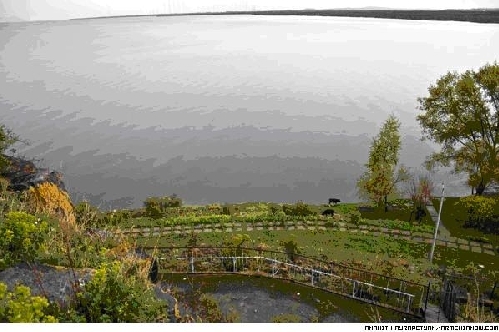
While environmentalists are encouraged by the rapid rise of waterline of Lake Sevan, others caution that the sudden ecological change can have harmful effects.
“The history of Sevan has never seen a situation like this; it has never bloomed with blue green water plants or the shore turned into a swamp,” says the head of the Institute for Hydro-Ecology and Ichthyology of the National Academy of Sciences of Armenia Boris Gabrielyan.
The hydro-ecologists insist the increase of the water should be kept at any price despite immediate problems it might cause for the eco-system of the lake.
“If the woodland neighboring the lake turns into its bed, 5,035 cubic meters of wood will stay under the water with 68 tons on each hectare,” says Rafael Hovhannisyan, deputy chairman of the experts’ commission for the conservation of the Sevan Lake by the NAS. “Our research shows if the woodland stays under the water, 259 tons of nitrogen and 23 tons of phosphor will pour into the lake and can be disastrous both for the water and the fish species.”
Hovhannisyan says leaves and branches contain the greatest amount of nitrogen and in most cases they are not even taken out of the lake.
The data at the environmental protection agency of the Gegharkunik province administration says 2,500 hectares have already gone under the water, and 1,800 of them are covered with forests. 310 hectares have been cleaned so far, 95 more will be cleaned this year.
“Of course if the pace keeps up the lake will indeed be threatened,” says the head of the agency Hambardzum Hambardzumyan. “In some areas already, for instance, in the littoral sections of Lchashen, rotting processes have already begun. In such conditions the content of oxygen in the lake equals to zero.”
According to the data of the Ministry of Environmental Protection 163 million drams ($ 534,426) have already been spent for the cleaning works since 2005. 42 millions more ($ 137,704) will be spent this year.
Hambardzumyan says cleaning processes are in order, and that if state agencies are unable to do cleaning in proper volumes then they should at least not hinder the increase in the level of the lake water so that the lake begins to clean itself up.
But the draft decision on the area of the lake’s wave range now on the table of the government does not mitigate the concerns of the researchers: the once set landmark in 1,908 meters is planned to be lowered to 1,905.
The specialists have suspicions the prevention of water increase is an attempt to save the neighboring buildings mainly belonging to officials and tycoons.
By governmental decision 150 million cubic meters of water will be leaked from the lake in 2008. The volume of the drained water by May made 43 million cubic meters.
First deputy minister of environmental protection Simon Papyan reveals some points in the Sevan water management problem.
“The water agency offered draining 300 million cubic meters of water from Sevan this year, but the figure was argued, the problem was discussed with the PM and the volume was decreased, otherwise they would drain that huge amount of water,” mentions Papyan adding 40-50 percent of the leaked water is lost in unidentified conditions before reaching the consumers and the problem needs to be put on the agenda.
The approaches of the NAS and the ministry differ also on the problem of the fish.
The ministry says there are two endemic species in the lake – trout and barbel and a sub-endemic specie – the koghak.
The trout at present is deprived of the opportunity for natural reproduction. Two of its sub-species, the winter trout and the bojak, are considered to have totally vanished, and the gegharkuni has survived in a tiny amount and there is literally just few summer trout remaining.
Hovhannisyan says in 1983 there were about 10,800 tons of sig of about 30 centimeters in length. In 2005 the amount reached 625 tons, which means a decrease for 17.3 times. Gabrielyan says there are hardly 200 tons of fish of all size kept.
Hambardzumyan predicts if the situation continues the water will lose its quality and the lake will begin to die.
June 13, 2008