
Arpi Harutyunyan, ArmeniaNow
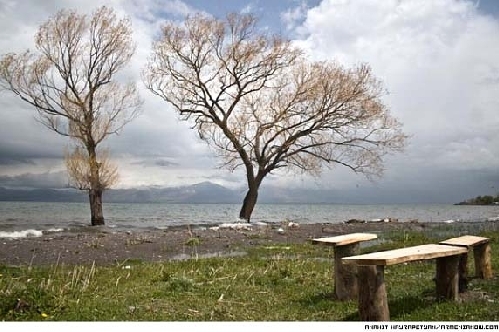
A few years ago, the main problem facing Armenia’s Lake Sevan was the declining water level. Today, according to some officials, it is the opposite. “Several years ago the state and the environmentalists in particular had the problem of increasing the level of water in the Sevan. Now the problem for them is to clear the shore of trees and other plants because of the high water,” says Aram Harutyunyan, the Minister of Environmental Protection. It is explained that the clearance of the shore from trees and plants is needed to avoid the swamping of the lake.
Besides the cleaning works, local people are also concerned that sections of road running close to the lake have either collapsed or are close to collapsing because of the rising water level as penetrating water causes large aperture.
Lake Sevan is now 1,899.11 meters deep against the 1,898.57 meters at the same period last year, which means the level of the water has risen 54 centimeters in one year.
Before the water was artificially drained (for irrigation and energetic purposes), the lake was 17 meters higher at 1,916 meters (SO WHAT’S THE PROBLEM NOW?). During the most active period of drainage between 1949 and 1962 the water level fell by one meter a year.
In 1958, the Central Committee of the Communist Party of Armenia and the Council of Ministers of the Armenian Soviet Republic decided that the annual volume of water in Lake Sevan should be equaled to 500 million cubic meters (instead of the former 1.5 billion). Some 380 million cubic meters were to be used in irrigation and 120 million for energy generation.
Despite the limit, the water level continued to drop. The situation was only reversed in 2002, which, explain specialists, was the result of reduced drainage (up to 150 million cubic meters annually), more efficient regulation of the 29 rivers feeding into the lake and favorable climate conditions.
The road to the village of Tsapatagh in Gegharkunik province is one of those places where even the naked eye can see the consequences of the rising water level, posing a threat to passing cars by the damaged roads.
“Last August, the shepherds of the village came and said that the lake had damaged the road. So we called the provincial administration, which carried out a study,” says Taguhi Boyakhchyan, head of the administration in Tsapatagh village, some 130 kilometers from Yerevan.
“Water has penetrated into the soil layer under the road for up to 10 meters and has caused quite a large aperture.”
Boyakhchyan says that a tender is being issued for repair works. The procedure will take at least two to three months, during which there are fears that the road three kilometers from the village could collapse further and cause an accident.
Nver Poghosyan, head of the Gegharkunik provincial administration is well aware of the situation. He confirms that sections of road in the villages of Lchashen and Karchaghbyur are also at risk of damage.
“We don’t see a significant threat at the moment. Of course, we have submitted the list of problems to the Ministry of Transport, but the water increase has stopped today and therefore there is no particular threat. The roads may not collapse at all,” says Poghosyan.
“The Tsapatagh section has been ruined, but there is agreement it will be restored by the end of 2008. It needs to be reinforced.”
However, locals and experts insist that money should be spent not on reinforcement, but on complete reconstruction. They argue that this will be necessary sooner or later.
Venera Karapetyan from Tsapatagh says that young people in the village have laid large stones at the edge of the damaged road, so that drivers and passers-by pass by that section. Workers at the Tufenkian hotel in the village have painted the stones white to make them more visible at night.
Apres Gabrielyan, who works at the hotel, is very concerned at the length of time it is taking to repair the damaged road.
“It will soon be a year since we appealed to the provincial administration to solve this problem. Who will be responsible if something happens?” he says. “One can’t exclude that the road may collapse when a big bus with tourists passes.”
Poghosyan, however, allays the fears of residents, saying that the road won’t collapse if the level of the water does not go up.
However, Simon Papyan, first Deputy Minister of Environmental Protection, says that the water level has not stopped rising and therefore the threat will continue to hang over people’s heads.
June 06, 2008