
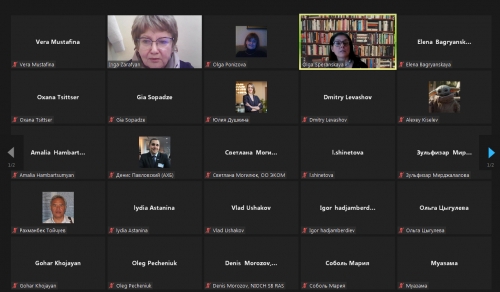
Armenian NGOs participated in the regional meeting of EECCA (Eastern Europe, Caucasus, Central Asia), during which they discussed issues of public monitoring of hazardous substances in the environment, inventory of hot spots of pollution and the development of environmental legislation. The meeting was organized on 9-11 December by the International Pollutant Elimination Network - IPEN.
The main attention was paid to such problems as plastic pollution, the presence of mercury in consumer goods, pollution of territories with industrial waste.
“EcoLur” information non-governmental organization presented for discussion the problems associated with chemical pollution of the territories affected by the mining industry in Armenia.
According to the official data, 7 copper-molybdenum, 4 copper, 14 gold and gold-polymetallic, 2 iron ore and 1 aluminum ore deposits are registered in the state balance of ore reserves of Armenia. Also, 115 mine fields of various metal ores have been found on the territory of Armenia. Mining companies mainly produce concentrates of copper, molybdenum, zinc, in some cases - alloys with a high content of gold and silver (Dore), possibly in the future, lead concentrate.
These deposits also contain rare and expensive elements: rhenium, selenium, telurium, cadmium, indium, helium, thallium, bismuth and others. There are highly toxic metals and elements of no industrial interest that end up in emissions and waste.
The tailings dumps have accumulated over 1 billion tons of tails. Added to this are millions of tons of waste dumps and waste rock, which are also sources of chemical pollution.
We are presenting some research data. According to S. Minasyan's article entitled "Ecochemical analysis of soils and river sediments in the zone of Tukhmanuk mine," the territory of the village of Melik Gyukh, where Tukhmanuk gold deposit was developed and three tailing dumps are located, was poisoned with heavy metals.
The soil contains an increased content of arsenic (As), antimony (Sb), lead (Pb), cadmium (Cd), copper (Cu), manganese (Mn), vanadium (V), chromium (Cr), cobalt (Co), nickel (Ni), zinc (Zn). Pollution spreads to fields where people cultivate crops. Pollution is facilitated by dust from the dry sections of the tailing dumps. Water pollution can spread to nearby soils, from soil to crops, and eventually enter the human body through the food chain.
Research carried out by Czech “Arnika” Environmental Organization for 2018-2021 showed the spread of pollution from industrial facilities, depending on the distance and direction of the wind. Soil, agricultural products, bottom sediments in rivers flowing through the affected area (Tumanyan and Stepanavan areas in Lori region), dust, and biomaterials - hair, urine, nails taken from people living in the affected area were studied. Toxic arsenic is found in virtually all samples taken in excess of the limits set in most countries.
We are proposing, through the mobilization of local residents and local administrations, to involve state structures in charge and extractive business in a constructive dialogue in order to raise the responsibility of extractive companies and the government for maintaining the health and safety of people living in contaminated areas. Urgent measures should be taken to assess the safety of the health of residents and the safety of the environment in areas of chemical pollution, to carry out legislative reforms on the “polluter pays” principle, and to adopt an action plan at the state level to eliminate the causes and consequences of pollution of territories.
December 14, 2021 at 15:53