
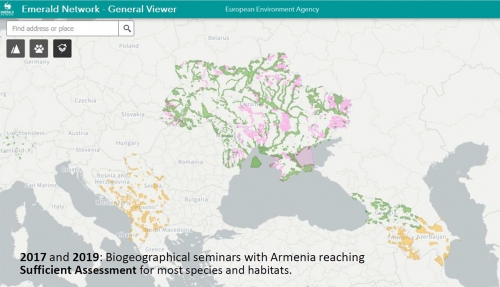
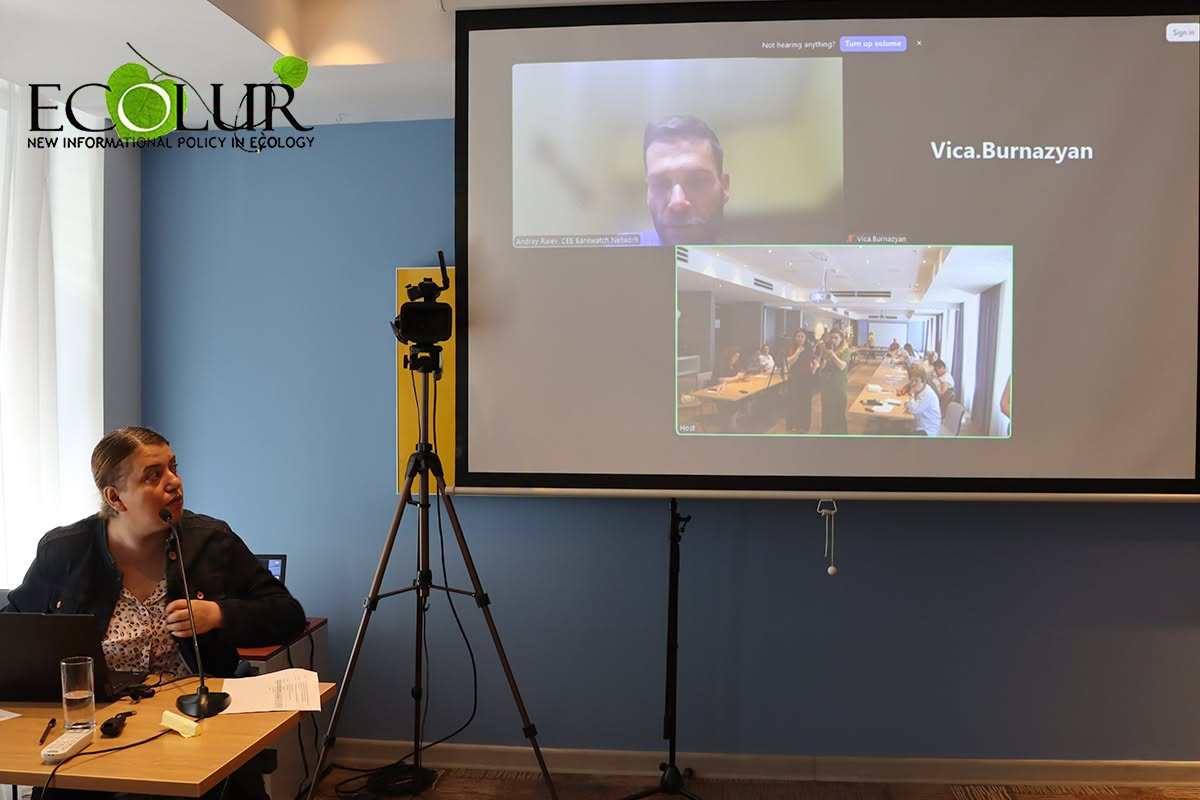
The issue of the reduction of Armenia's candidate Emerald Network sites should be placed on the agenda of COP17 of the Convention on Biological Diversity. The conflict between these environmentally significant areas and competing development interests must be properly assessed, said Andrey Ralev, an expert with the CEE Bankwatch Network, during the workshop entitled “Civil Society Agenda at the 17th Conference of the Parties (COP17) to the United Nations Convention on Biological Diversity.” The workshop was organized by EcoLur Information NGO in cooperation with the Fridtjof Nansen Institute.
The Emerald Network is a pan-European network of areas established under the Bern Convention on the Conservation of European Wildlife and Natural Habitats. Its purpose is to protect rare species of plants and animals, as well as their natural habitats.
As a Party to the Bern Convention, Armenia has proposed a number of candidate Emerald sites. In 2016, Armenia submitted 23 candidate Emerald sites, covering 1,033,719 hectares, or 34.8% of the country's territory. If these sites are adopted, Armenia would fulfill the obligation under both conventions, Bern and CBD, to protect 30% of its territory by 2030. However, in 2023, it decided to revise the network by proposing 30 candidate sites with a significantly reduced total area of 707,739 hectares, representing 23.8% of Armenia's territory. The review process of the candidate Emerald sites is still ongoing.
Andrey Ralev noted that in 2017 and 2019, Armenia received a "Sufficient Assessment" for the majority of its species and habitats under the Bern Convention, with a 91.8% sufficiency index. However, the ongoing revision of the candidate Emerald sites could reduce this sufficiency index.
“Between 2008 and 2016, the Sevan, Jermuk, and Gorhayk sites were proposed, and in 2012 the establishment of Jermuk National Park was proposed, including Mount Amulsar within its boundaries. In 2023, the EU4Environment programme, funded by the European Union and implemented by the World Bank, was launched. Its primary objective was to support the establishment of the Emerald Network in Armenia and the effective management of Emerald sites. However, this also marked the beginning of the review process aimed at reducing the boundaries and overall area of the Emerald Network sites. In 2024, the programme published the document Recommendations for Review of the Candidate Emerald Sites in Armenia.”
“The document proposes reducing the Sevan site by more than threefold and decreasing the number of protected natural habitat types there from 32 to 27. The southeastern wetlands have been excluded, along with nearly all mountain and grassland habitats. Mount Amulsar has been completely removed from the candidate Emerald Network sites. Numerous habitats that have not yet been affected by gold mining activities have been excluded. One of the most important breeding and feeding habitats of the Lesser Kestrel (Falco naumanni) in the vicinity of Amulsar has likewise been omitted. As a result, the European Union-funded programme has effectively contributed to setting back the development of the Emerald Network. Important areas have been proposed for exclusion, and it is necessary to determine how they can be protected,” Andrey Ralev noted.
He further noted that many other obligations of Armenia under the Bern Convention remain unfulfilled, with effective management of only 13% of the protected areas.
According to Ralev, the Bern Convention has expressed concern regarding the reduction of the Emerald Network sites and threats to these sites. In 2024, the Standing Committee of the Bern Convention adopted a decision calling on the Armenian authorities to ensure that a new Environmental Impact Assessment (EIA) is carried out for the Amulsar Gold Mine, taking into account all species and habitats present within the project area.
The Committee also urged the Armenian authorities to resume discussions on the establishment of Jermuk National Park within the framework of "Biodiversity and Sustainable Local Development in Armenia" programme financed by the KfW Development Bank of Germany.
In addition, the Convention called upon the Armenian authorities to include the complainants in the consultation process.
“The Convention proposed assessing the conflict between the Emerald Network and the Amulsar project, but the Government did not give its consent. There are many issues that still require discussion,” Andrey Ralev said.
He identified COP17 as an important platform for addressing these issues and finding solutions.
“Delegations from international conventions, including the Bern Convention, will participate in the conference. This is precisely the forum where we can speak openly and honestly and call for solutions to these problems. I hope that during the discussions we will be able to advocate for the right decisions and demonstrate progress in the protection of environmentally significant areas. COP17 is important for Armenia not only because of its international significance, but also because it offers the country an opportunity to position itself as a leader in the global environmental agenda and serve as an example for many other nations. There is still much work to be done-not only this year, but in the years ahead,” Andrey Ralev concluded.
The views expressed in this guide are those of the author and do not reflect the views of the Heinrich Böll Foundation’s South Caucasus Regional Office in Yerevan.
August 05, 2026 at 14:51