
Vahe Davtyan, ArmInfo
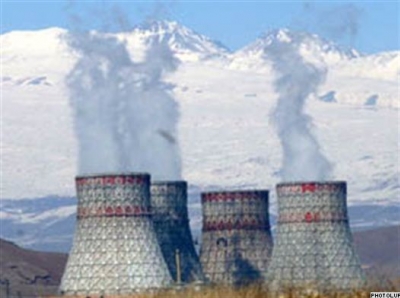
Traditionally, energy is the key sector of industry in Armenia due to its nuclear constituent. Armenian nuclear-power plant (NPP) generates nearly 30%-40% of total electric power generated in the country.
Presently, the United States and EU member-states alongside with some international organizations stand for closing-down of the Armenian NPP since they think that the plant has already outlived its usefulness and no longer meets the environmental and safety requirements. It is not a secret that in 2004 the EU agreed to render the Armenian government 100 million EUR assistance for closing down the NPP. However, the Armenian authorities do not think that the given amount is sufficient for total replacement of the generating capacities of Metsamor NPP. Expert calculations say that construction of a plant with similar or higher capacities will require some 1 billion US dollars. Armenian and Russian specialists say that the service limit of the Armenian NPP is 2016. They are sure that the operative life of the plant can be increased by 15 years till 2031. Therefore, construction of a new power unit of the Armenian NPP is a priority for Armenia. In 2009 the government adopted a decision on construction of the new power unit by the Russian party, which has had a direct impact on the price control of the natural gas delivered to Armenia. According to the official statements by the Armenian Energy and Natural Resources Ministry representatives, the third nuclear power unit is a business-facility that will bring incomes. That is why many foreign companies are interested in investing in the construction and exploitation of the power unit. The feasibility study of the project is ready at present. By preliminary estimates of the Armenian Consulting Group Company, it will cost 5.2-7.2 bln USD if the capacity of the power unit is 1200MW. The expected tariffs of the new NPP will total 7.2- 12.7 cents/kWh depending on investments.
Global experience shows that construction of an NPP by one country is no long expedient. As a rule, the modern NPPs are joint ventures uniting the experience and technologies of the energy systems of various countries. Apparently, despite the open prevalence of Russia in implementation of the project, Armenia will attract also other countries to the project. Metsamor NPP as a guarantor of the energy and environmental safety of Armenia is considered also as one of the leading factors increasing the economic and political competitiveness of Armenia in the region. The Soviet authorities projected the energy system of Armenia as surplus and covering the needs of a part of the region. Armenia is the only country in the South Caucasus able to export electric power. Evidently, in conditions of electricity deficit in the region, Armenia has all the chances to become a regional power-engineering state. However, there are some negative political factors such as closed borders, lack of diplomatic and, in fact, full-fledged economic ties with the two neighbor-states and others. Nevertheless, the global political environment is rapidly changing which makes all the players be ready to pessimistic or optimistic political scenarios. Therefore, it is very important now to present Armenia as a country able to export large volumes of electric-power. This will allow gaining certain political dividends and attract foreign investors. Given the possibilities of annual electricity generation, forecasts of the electricity necessary for internal consumption, as well as the designed capacity of inter-system power transmission lines with the neighbor-states, total volume of electricity supply from the energy system of Armenia to Georgia, Turkey and Iran (which will become possible in case of combined activity of the energy systems of these countries) may total nearly 6 bln kWt/h annually.
It is obvious that Turkey is interested in import of the Armenian electric power. Such statements by the Armenian and Turkish parties have been made in September of 2008 when President of Turkey Abdullah Gul made an official visit to Yerevan at the invitation of President Serzh Sargsyan. During the visit alongside with other issues, the two parties studied also export of electricity from Armenia to Turkey. Representatives of the private sector expressed interest in implementation of the given idea. Initially, Armenia was to launch delivery of electric power to Turkey in the spring of 2009. During the visit of the Turkish president to Armenia a relevant agreement was made between the Energy and Natural Resources Ministry of Armenia, CJSC High-Voltage Power Lines and Belgian Company UNIT engaged in import and distribution of high-voltage electric power. However, the protracted process of normalization of the Armenian- Turkish relations affected implementation of the agreement. Such initially specific projects have become instruments of political debates already 2010.
Obviously, it is Metsamor NPP that ensures surplus energy generation in Armenia. In this light, it is necessary to highlight the statement by Armenian Prime Minister Tigran Sargsyan made in January 2009, 11 months before signing of the Zurich protocols. Speaking at the Bridge International Economic Forum, the prime minister declared that Turkey might participate in construction of the new power unit of the Armenian NPP. Analyzing the prime minister's statement, we have arrived at a conclusion that it was made proceeding from the following: - inviting Turkey to cooperation in construction of the new power unit of the NPP Armenia highlighted the environmental transparency of its key energy facility; - declaring its readiness to work with Turkey, Armenia expressed readiness to take joint measures to reduce the risk of exploitation of the plant both for itself and the neighbor states in case of any problems.
IAEA and other international organizations forecast that in the near future the role of the nuclear energy in energy supply will increase even despite the large-scale measures of power supply and introduction of new energy sources reducing air pollution. In this light, the leadership of Armenia takes all the necessary measures for long-term development of nuclear energy. Alongside with energy safety the country sets another important task i.e. to boost export of the electricity generated in Armenia. To implement this strategic task, it is necessary to restore and maintain the energy infrastructure of the country. Experts say that in case of successful implementation of the envisaged programs in the mid-term outlook, Armenia despite the increase of internal demand for energy resources (including electricity) will remain a country having surplus energy-generating capacities. This, will increase the export potential of Armenia and its economic and political weight in the region.
August 24, 2011 at 15:38