
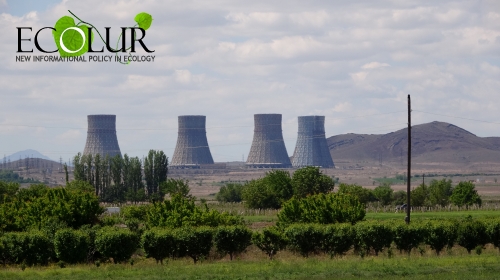
In a new review dedicated to the development of nuclear energy and policy in Armenia, EcoLur presents current trends in nuclear energy development from a climate perspective, as well as Armenia's new approaches to nuclear energy policy. The authors of the review are Roza Dzhulakyan, PhD in Chemistry, and Inga Zarafyan, PhD in Biology.
The main conclusion is that nuclear energy is not climate-friendly as is commonly assumed in international practice, based on carbon emissions indicators. Specifically, the specifics of nuclear energy in relation to other climate targets, such as its impact on water resources and its alignment with the goals and objectives of climate adaptation and mitigation programs outlined in national NDCs and strategies, are not taken into account. The authors believe that nuclear energy in relation to climate policy should be assessed according to climate targets and comply with the basic principle of "NUCLEAR SAFETY FIRST".
This review presents international agreements and Armenia's national legislation in the nuclear energy sector. It also examines obligations under the Comprehensive and Enhanced Partnership Agreement (CEPA) between the Republic of Armenia, the European Union, and the European Atomic Energy Community and its Member States.
The review presented on the Armenian Nuclear Power Plant (ANPP) focuses on safety issues, nuclear waste, water supply problems, and social issues for residents living within a 5-10 kilometer radius of the nuclear power plant.
The review also addresses the issues of extending the operating life of the existing ANPP and constructing a new nuclear power plant.
The review also contains the position of the Armenian group of members of the international climate network CAN EECCA regarding nuclear energy
“Taking into account recent global trends, it is necessary to develop a public assessment of nuclear energy policy based on a balanced approach and assessments of the green transition.
From this perspective, we propose considering the energy component of climate policies without defining particular energy sources as “climate-friendly”. The only negative criterion should relate exclusively to fossil fuels, whose climate impacts are well known and do not require additional research.
We believe that nuclear energy has specific characteristics that are not inherent in other forms of energy and therefore should not be assessed using traditional indicators, including climate indicators. However, given that nuclear energy has been included in the list of climate-friendly energy sectors for political reasons, we consider it essential to establish requirements with a climate-related focus: compliance with climate commitments, impacts on natural resources, harmonization with adaptation and mitigation programmes, and alignment with national NDCs.
We consider it necessary to increase transparency in decision-making in the nuclear energy sector, particularly regarding the protection of the population, radiation safety, and the social needs of vulnerable populations living in the impact zones of nuclear power plants. We consider it necessary to present for public discussion measures concerning radioactive waste and its safe management, as well as political decisions related to counter-terrorism measures and military actions”, is mentioned in the review.
August 14, 2026 at 13:50